Join WhatsApp Channel

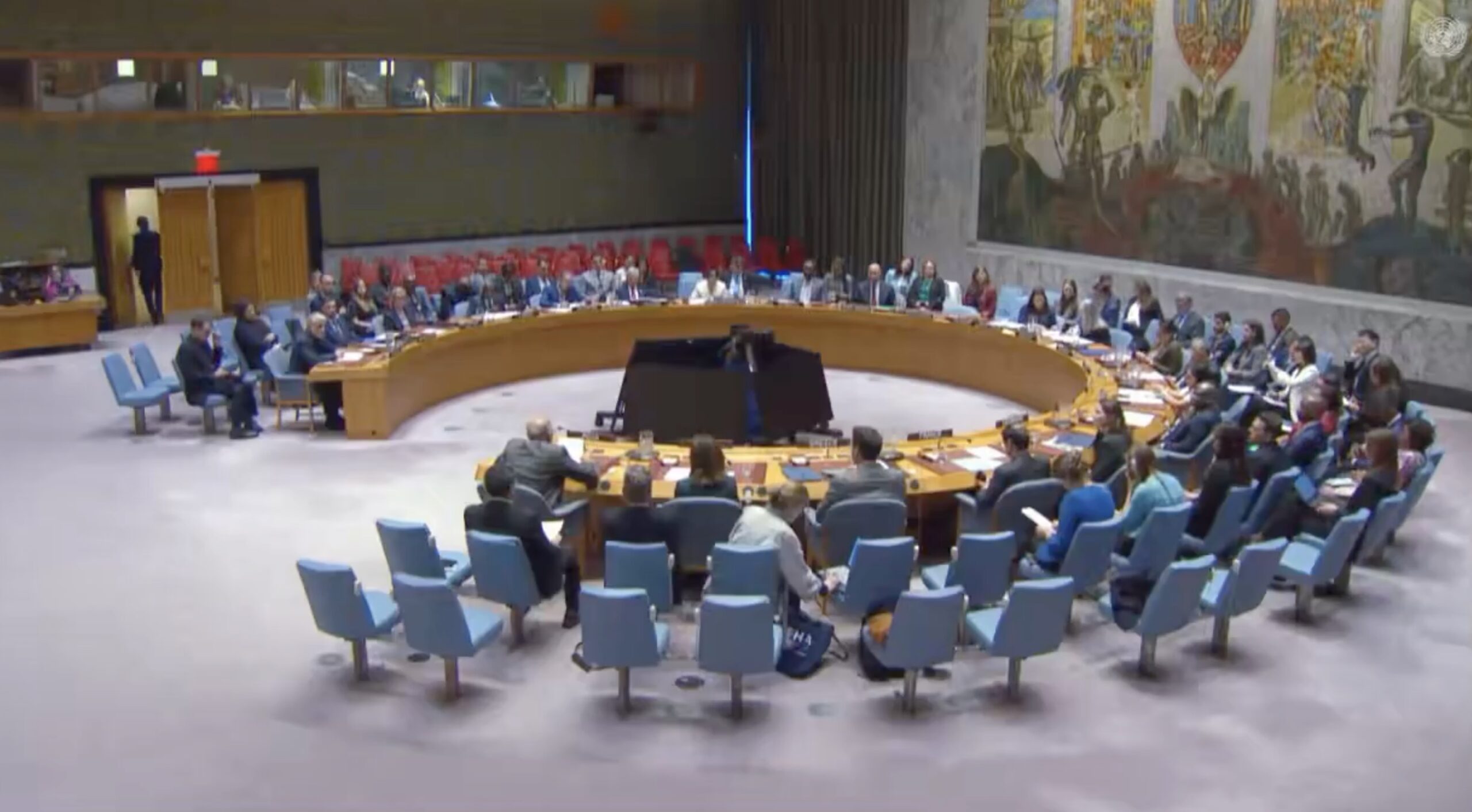
India reiterated its strong support for “peace and stability” in Afghanistan, emphasizing that sustained international engagement is essential to support the country’s development and humanitarian needs.
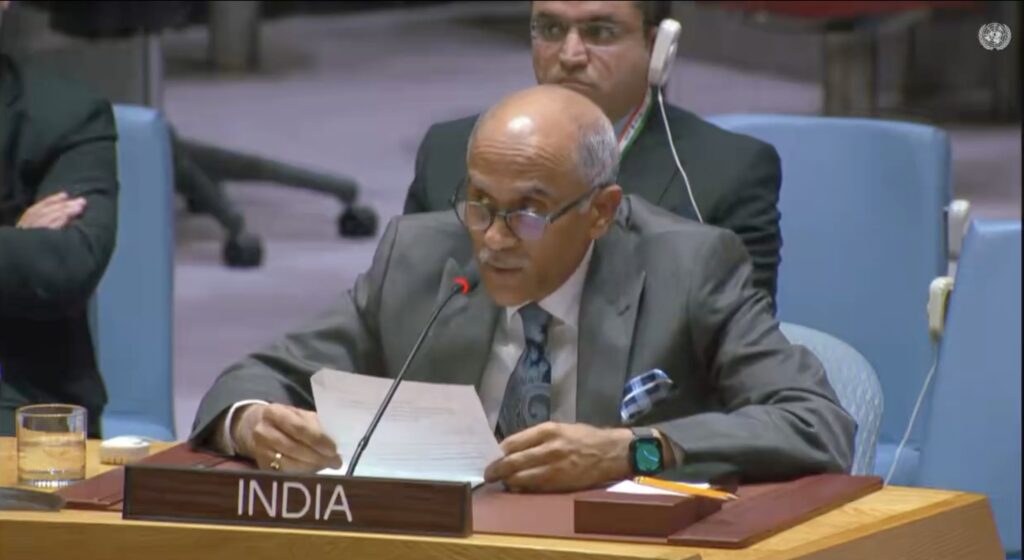
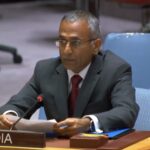
Speaking at a United Nations Security Council meeting on the situation in Afghanistan on March 9, 2026, at UN Headquarters in New York, India’s Permanent Representative to the United Nations, Ambassador Parvathaneni Harish, said India continues to advocate for conditions that would help Afghanistan move toward long-term stability and growth.
In his remarks, Ambassador Harish congratulated the United States for assuming the presidency of the Security Council and thanked Georgette Gagnon, Head of United Nations Assistance Mission in Afghanistan (UNAMA), and Deputy Special Representative of the Secretary-General (Political) for Afghanistan, for briefing the Council.
“India has deep rooted and civilizational bonds with our contiguous neighbor, Afghanistan. Our history of close ties keeps guiding us in the current context, a situation when the proud people of Afghanistan need the world’s assistance,” the Ambassador said. “Over the years, India has continued to strongly advocate for peace and stability that could aid development in Afghanistan. Our participation in the Doha Working Group meetings underlines this commitment.”
He noted that India’s engagement with Afghanistan continues to focus on capacity building and humanitarian assistance for the Afghan people.
India currently supports more than 500 development partnership projects across all 34 provinces of Afghanistan, strengthening cooperation in sectors such as healthcare, public infrastructure, and capacity building.
“We continue to work with UN agencies as well as with agencies such as the Afghanistan Red Cross Society in food security, healthcare, education and sports,” he said adding “The visits of Afghan Ministers last year are helping us ensure that this aid is reaching those who need it the most.”
Ambassador Harish highlighted progress made since the Council’s last briefing in December 2025, particularly in healthcare support. Several development initiatives approved earlier are advancing, including the establishment of a Thalassemia Centre, an Oncology Centre, a Trauma Centre, and a modern diagnostic centre in Kabul. Additional projects include replacing the heating system at the Indira Gandhi Institute of Child Health and constructing a 30-bed hospital in Kabul, along with five maternity health clinics in the provinces of Paktika, Khost, and Paktia.
“In the last three months, i.e., the reporting period for the UNSG’s report, India delivered more than 1 million doses of immunization vaccines for children and 9.5 tons of anti-cancer medicine, In the coming months, we aim to deliver over 17 million additional doses of preventive vaccines to further strengthen Afghanistan’s national immunization program. This is India’s investment in the future of Afghanistan,” he added.
Over the past four and a half years, India has supplied Afghanistan with 50,000 tons of wheat, 380 tons of medicines and vaccines, and 40,000 liters of pesticides. Following two earthquakes last year, India was among the first countries to provide humanitarian assistance, delivering 60 tons of food supplies, 42 tons of earthquake relief materials, and 73 tons of essential medicines.
Ambassador Harish also highlighted India’s partnership with the UN Office on Drugs and Crime (UNODC), under which India has provided 68 tons of medical supplies and 32 tons of social support materials for the rehabilitation of drug addicts.
In the field of education, he noted that India’s scholarship and fellowship programs remain popular among Afghan students. Since 2023, about 3,000 students have benefited from these programs, including 1,000 Afghan women. India also continues to provide financial and logistical support to women-led Afghan self-help groups.
“On the bright side, any visitor to Afghanistan today would see Afghan youth enthusiastically playing cricket,” he noted. “The Afghanistan Cricket Team has been winning hearts wherever they have been playing and their spirit and passion in the just concluded Cricket World Cup was notable. My nation is proud to be part of their journey and happy to see them bring immense joy to the people of Afghanistan who are enduring so much.”
Ambassador Harish also referred to the UN Secretary-General’s report on Afghanistan, highlighting severe humanitarian challenges facing the country. These include the growing number of forced and involuntary returns, widespread food insecurity, and climate-related disasters.
According to the report, about 45 percent of Afghanistan’s population requires humanitarian assistance this year, a situation he described as deeply concerning and one that requires sustained global attention.
These vulnerabilities, he said, require increased efforts to address food security, healthcare, water access, and shelter needs, particularly for returning populations who require housing, basic services, and livelihood opportunities.
“We add our voice to Secretary General’s call on Member States to uphold their international obligations in relation to protection, including the principle of non-refoulement and ensure that returns are voluntary, safe, dignified and accompanied by sustained support for reintegration of returnees into communities,” he added.
Ambassador Harish also referred to concerns raised in the Secretary-General’s report about civilian casualties resulting from cross-border armed violence.
“We reiterate and support the Secretary General’s call urging compliance with obligations under international law, including international humanitarian law and ensuring protection of civilians,” he said, adding that India strongly condemns airstrikes on Afghan territory, describing them as violations of international law, the UN Charter, and the principle of state sovereignty.
“It is hypocritical to espouse high principles of international law and Islamic solidarity on the one hand, while mercilessly carrying out air strikes during the holy month of Ramadan that have killed 185 innocent civilians as of 6 March 2026, around 55% of whom are women and children and displaced over a hundred thousand according to UNAMA on the other.”
He further expressed India’s “grave concern” over what he described as trade and transit restrictions affecting Afghanistan, a landlocked country. Such measures, he said, undermine international commitments made to support landlocked developing countries and contradict WTO norms and international law.
“While we condemn these acts, we reaffirm our support for the territorial integrity, sovereignty and independence of Afghanistan,” he said.
Ambassador Harish stressed that terrorism remains a global threat and called for coordinated international action against terrorist organizations operating in the region.
“India reiterates its commitment to strengthen our engagement with all stakeholders in bilateral, regional and multilateral formats,” he added. “India will always stand for the priorities and aspirations of Afghan society and will always support the people of Afghanistan.”
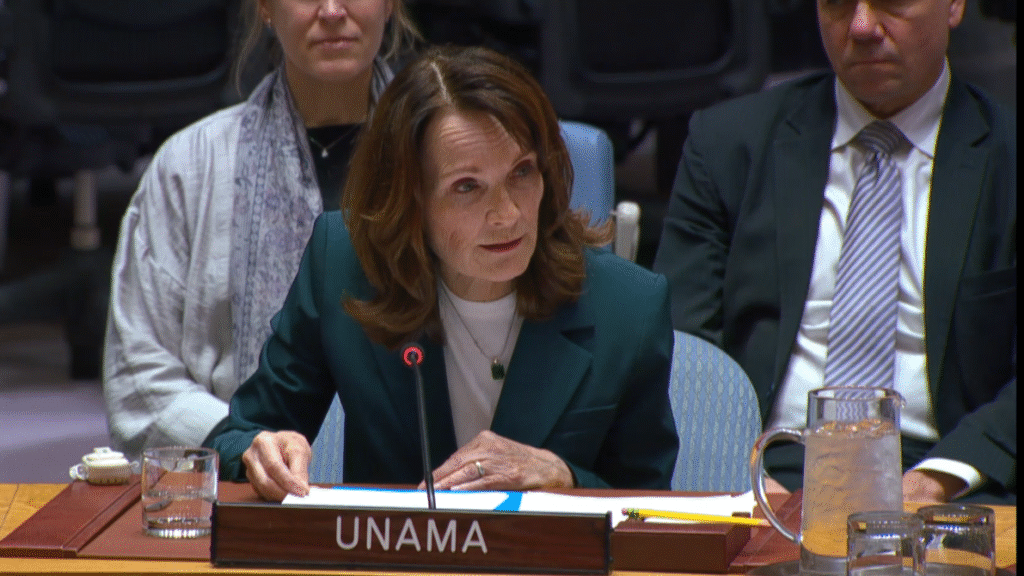
Briefing the Council, Georgette Gagnon said preserving stability in Afghanistan has become even more critical given recent regional developments.
She noted that the conflict with Pakistan has had “punishing human and economic costs.”
“We reiterate the Secretary-General’s deep concern about the escalation and impact on civilian populations, his call for an immediate cessation of hostilities, and for the two countries to resolve any differences through diplomacy,” she said. “We urge both sides to recommit to a ceasefire without delay and safeguard the protection of civilians. I also reiterate our request to ensure the free flow of humanitarian assistance into Afghanistan.”
Gagnon also pointed to broader regional challenges affecting Afghanistan’s fragile economy.
With the Afghanistan-Pakistan border currently closed, Iran had provided an alternative trade route, but that route is increasingly uncertain because of ongoing conflict in the Middle East.
As a result, prices of basic commodities in Afghanistan have begun to rise, placing additional pressure on the country’s already fragile economy. Instability along Afghanistan’s two longest borders further threatens the country’s stability, she said.
“We stress, however, that Afghanistan’s continued alienation from the international system remains the central issue. It prevents other issues, such as economic self-sufficiency, security cooperation, counter-terrorism commitments, human rights concerns, and the humanitarian crisis, from being fully addressed,” she said.
If these challenges remain unresolved, she warned, Afghanistan could once again become a source of “regional and global instability,” driven by “out-migration, terrorism, narcotics” and other threats.
Related posts:
 At UNSC, India Highlights Centuries-Old “Civilizational Relationship” with Afghanistan
 India Highlights Expanding Healthcare and Humanitarian Support for Afghanistan at UN Security Council Debate
 Meenakshi Lekhi Calls Science and Technology the Bridge for a Stronger US-India Partnership at FIIDS Roundtable
 India reaffirms its commitment to support the people of Afghanistan