Join WhatsApp Channel

Lata Mangeshkar and Asha Bhosle enjoyed total supremacy from the mid-1950s to the early 1980s. Here is a look at some more challengers after those we discussed in Part 1.
They were singers whose voices had a very individualistic quality, but in those days, no one explored beyond the set notion that Lata and Asha had to fit all the heroines. Even a modern tweak to the heroine in the ‘70s with Zeenat Aman, followed by Parveen Babi and others, could not shake off the Lata-Asha mindset.
Mubarak Begum, even after massive hits like Kabhi tanhaiyon mein (Hamari Yaad Aayegi) and Mujhko apne gale lagaa lo (Hamrahi), could not make the grade. Besides seven songs in Kamal Amrohi’s Daera, she recorded songs for major composers like Shankar-Jaikishan, S.D. Burman, Salil Chowdhury, Kalyanji-Anandji, Naushad and Madan Mohan. After two solos in Ramu To Diwana Hai (1980), she stopped singing. The singer lived in penury, dependent on charity towards the end of her life in 2016.
Sudha Malhotra was discovered by Ghulam Haider at a show. She made her debut under Anil Biswas in Aarzoo. Despite being part of great songs like Na main dhan chahoon (Kala Bazaar) and Yeh ishq ishq hai (Barsat Ki Raat) and composing and singing the classic Tum mujhe bhool bhi jaao for Didi, Sudha never made it big and called it quits after Laxmikant-Pyarelal’s Yeh pyar tha ya kuch aur tha in the 1982 Prem Rog.
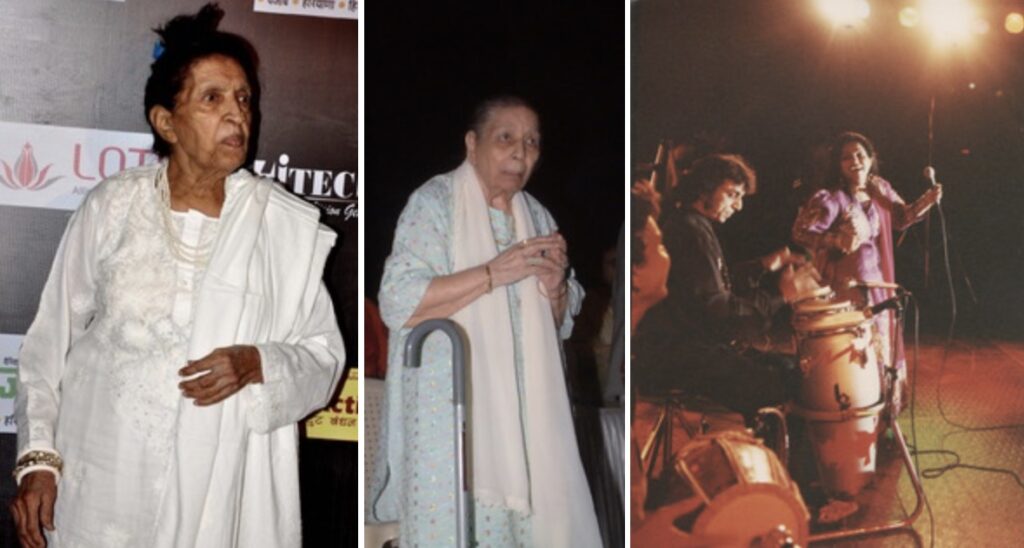
Usha Uthup was the revolutionary / the lady sang pop songs in a saree with a traditional hairdo! “Voices like mine went on the bad girls, not the heroines in those days!” she stated, though in her very first Hindi song, Laxmikant-Pyarelal used her for a devotional number (Jogan preetam ki in Devi)! Her early songs were for Purab Aur Pacchim,Bombay Talkie and finally Hare Rama Hare Krishna (I love you), which was her breakthrough. Her hit-list includes Doston se pyar kiya (Shaan), Hari Om Hari (Pyaara Dushmun) and Koi yahaan naache naache (Disco Dancer). Off and on, she still gets an occasional song, even in regional films, and has also begun to act in movies.
Vani Jairam was introduced by Vasant Desai in Guddi with Bole re papiharaa and Humko man ki shakti dena. But despite her different texture, she could not make it big, even after popular songs with R.D. Burman, Madan Mohan and Laxmikant-Pyarelal, a full score in Pandit Ravi Shankar’s Meeraa and some work in the ‘80s under Bappi Lahiri. For the record, she is Sridevi’s first voice, in Jaidev’s Solwa Sawan. She passed away in 2023.
Preeti Sagar was another fresh voice, whose branding went wrong when she was first associated with art movies (Piya baaj pyaala in Nishant and Mara gaam katha pare from Manthan) and in an English song in a mainstream film (My heart is beating from Julie). Daughter of actor/singer Moti Sagar, she launched a production company later.
Runa Laila was the next to come in – from Bangladesh. Though she is diplomatic about her lack of progress in films, the singer who was a rage on Indian television, could not reach anywhere despite a major hit in Jaidev’s Gharaonda, in which she sang Do diwane shehar mein, and songs under Kalyanji-Anandji, Laxmikant-Pyarelal and Bappi Lahiri.
Sulakshana Pandit
She appeared as a kid singer with Pappa jaldi aa jaana in Taqdeer (1967) and among her early breakthroughs as singer were Tu hi sagar hai tu hi kinara (Sankalp, filmed on herself in a cameo) and Beqaraar dil (Door Ka Rahi). She soon became a big star but her playback activities got curtailed and even in her own films, most composers brought in Lata and Asha as her voice.
Sushma Shrestha was a kid singer and Kanchan offered no competition as she sang exclusively for Kalyanji-Anandji and their brother, Babla, whom she later married. Anuradha Paudwal arrived in this decade but really made headway only in the 1980s, blazing a trail followed by multiple younger singers.