Join WhatsApp Channel

Legendary cricketer Sunil Gavaskar has appealed to people to register as stem cell donors, backing an initiative led by the American Association of Physicians of Indian Origin (AAPI) aimed at helping patients battling blood cancer.
“Hi, you could be the miracle that somebody with Blood Cancer is waiting for. Take a Swab. Save a Life,” the former Indian captain said in a video message posted on Instagram, with AAPI’s official logo visible in the background. Gavaskar, who is widely recognized as an inspirational speaker, philanthropist, and chairman of the H2H Foundation, urged people to participate in the donor registration campaign.
The appeal supports the AAPI Stem Cell Donor Drive, an initiative launched in the United States in 2024 by hematology oncologist Dr. Satheesh Kathula, the immediate past president of AAPI. The program was expanded to India this year under the leadership of current AAPI President Dr. Amit Chakrabarty, who launched the AAPI Stem Cell Drive in India during the recently concluded Global Healthcare Summit in Odisha.
Dr. Chakrabarty expressed appreciation for Gavaskar’s support and outreach. He conveyed his “deep gratitude and appreciation to the Cricket Legend, Sunil Gavaskar for rendering his support to AAPI’s Stem Cell Drive, and for his appeal to everyone to come forward to take a swab and save the lives of those who are diagnosed with the deadly blood cancer.”
Dr. Suresh Reddy, a past president of AAPI who helped secure Gavaskar’s participation, noted that the cricket icon has had a longstanding association with the organization.
“The Little Master has been associated with AAPI for several years. During our 40th Annual Convention in San Antonio, TX in June 2022, he addressed the AAPI delegates, describing AAPI members as being part of the greatest profession in the world. During his interaction with AAPI members, Gavaskar referred to his leadership at the ‘Heart to Heart Foundation’ and how the Foundation is touching many hearts around the world,” Reddy said.
Dr. Sashi Kuppala, chair of the Stem Cell Drive, said the initiative has already received significant public participation across the United States and India. He expressed his “deep gratitude to the hundreds of thousands of individuals, who have come forward to be tested and have committed to be STEM donors with the objective of saving thousands of lives. Thanks to Dr. Chakrabarty, we successfully launched the project in India.”
Highlighting the medical significance of stem cell therapies, AAPI President-Elect Dr. Meher Medavaram said, “Cell-based therapy as a modality of regenerative medicine is considered one of the most promising disciplines in the fields of modern science & medicine. Such an advanced technology offers endless possibilities for transformative and potentially curative treatments for some of humanity’s most life-threatening diseases.”
Dr. Chakrabarty emphasized the importance of expanding the donor registry, particularly for patients of Indian origin.
“Stem cell transplants are a vital treatment for blood cancers such as leukemia and lymphoma HLA markers, which determine donor compatibility, are inherited and vary by ethnicity. I’m thankful to our local AAPI Chapter leaders, members and volunteers across the nation who have initiated and are spearheading the Stem Cell Registration in India and the United States, joining hands with the national AAPI in our efforts in creating awareness and enrolling more youth and adults to be part of this noble mission,” he said.
The initiative was first launched in 2024 during Dr. Kathula’s presidency. Recognizing the urgent need to expand the donor pool, AAPI partnered with the National Marrow Donor Program (NMDP), the world’s largest stem cell registry, to establish a unified national campaign.
“Patients of Indian ethnicity are more likely to match with Indian donors—but the existing donor pool is alarmingly small. Until now, families have had to organize donor drives independently, while also coping with the emotional and medical toll of a cancer diagnosis,” Dr. Kathula said.
Stem cells are used as a treatment option for several types of cancers. Matching donors and recipients is based on HLA typing, which is influenced by ethnicity. As a result, patients of Indian origin are more likely to find compatible donors within the Indian community. However, the number of registered donors from the community remains limited, making it more difficult for many patients to identify a suitable match.
Since November 2024, AAPI has organized donor registration drives in multiple cities across the United States and India, with strong participation from high school and college students. Students who volunteer during these drives receive certificates from AAPI recognizing their contributions.
Dr. Hetal Gor, chair of the AAPI Board of Trustees, highlighted the importance of donor commitment. “You could be someone’s only match—their only hope. Registering is a serious promise, but the donation process is safe and complication-free,” she said.
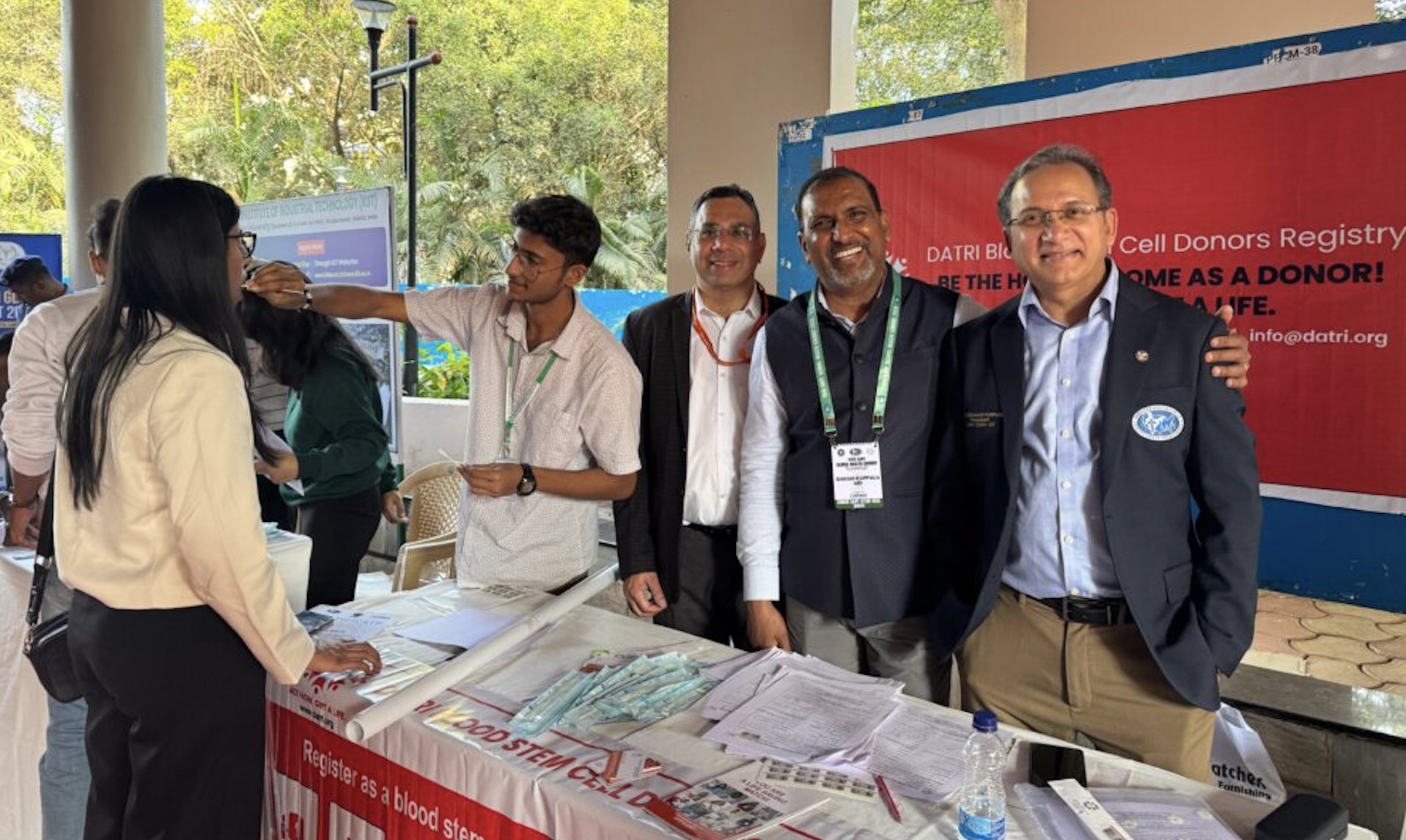
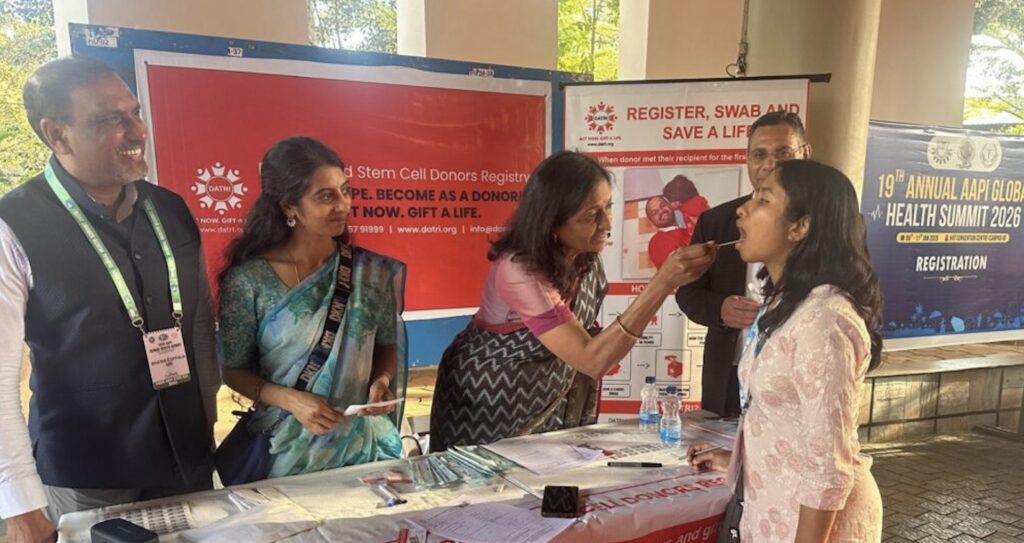
In India, the program was formally launched during the Global Healthcare Summit in Odisha, where hundreds of students and faculty registered as potential donors. AAPI partnered with the Global Association of Indian Medical Students and DATRI Blood Stem Cell Donors Registry to support the initiative.
Dr. Krishan Kumar, AAPI Vice President-Elect, pointed to the challenge faced by many patients seeking matches. “70% of patients lack a family match. For Indians, the odds are even lower due to the limited donor pool.” Describing the process, he added, “Registration is simple. Scan the QR code, fill out your details, and return the cheek swab kit. Your HLA data will be stored securely.”
Dr. Seema Arora, AAPI Secretary, outlined the donation process for those who are matched with patients. “If matched, you’ll provide blood samples locally. Travel may be required, but all costs are covered. The process takes 20–30 hours over 4–6 weeks,” she said.
Dr. Soumya Nerevetla, AAPI Treasurer, emphasized the impact of expanding the donor registry. “Finding a match is especially difficult for South Asians. Every donor helps save lives,” he said.
Dr. Kuppala said the initiative has already received “tremendous response” from AAPI members and the broader Indian community. He added that Gavaskar’s endorsement is expected to significantly expand public outreach and encourage more people to participate in the donor drive.
AAPI is also encouraging its members, many of whom are alumni of medical schools, to work with their institutions to organize donor registration drives on campuses.
“We can do drives at your medical school collaboratively. They just need to announce the drive to the students. AAPI will take care of other logistics. Every registration gets us closure to our objective that no Indian should die anywhere in the world due to non-availability of stem cells.”
Related posts:
 A High School Student’s Mission to Save Lives Through His South Asian Marrow Initiative
 Virginia Governor Glenn Youngkin issues Executive Order for Cell Phone-Free Education in K-12 Public Schools
 AAPI Leaders Celebrate India’s 79th Independence Day at 43rd India Day Parade in New York
 Sant Nirankari Mission NY-CT Chapter Hosts Community Blood Drive with Support from Sen. Steve Rhoads