Indian professionals seeking permanent residence in the United States continue to face some of the longest green-card waiting periods in the immigration system, with the December 2026 Visa Bulletin showing a gap of nearly eight years between Indian and Chinese applicants in the employment-based second and third preference categories.
The latest bulletin issued by the US Department of State offers little relief to Indian technology workers, engineers, researchers and other skilled professionals, even as some employment-based categories have advanced to accommodate available immigrant visa numbers. The contrast with China is particularly pronounced in categories used by highly educated foreign workers, highlighting the uneven consequences of the US immigration system’s country-based numerical limits.
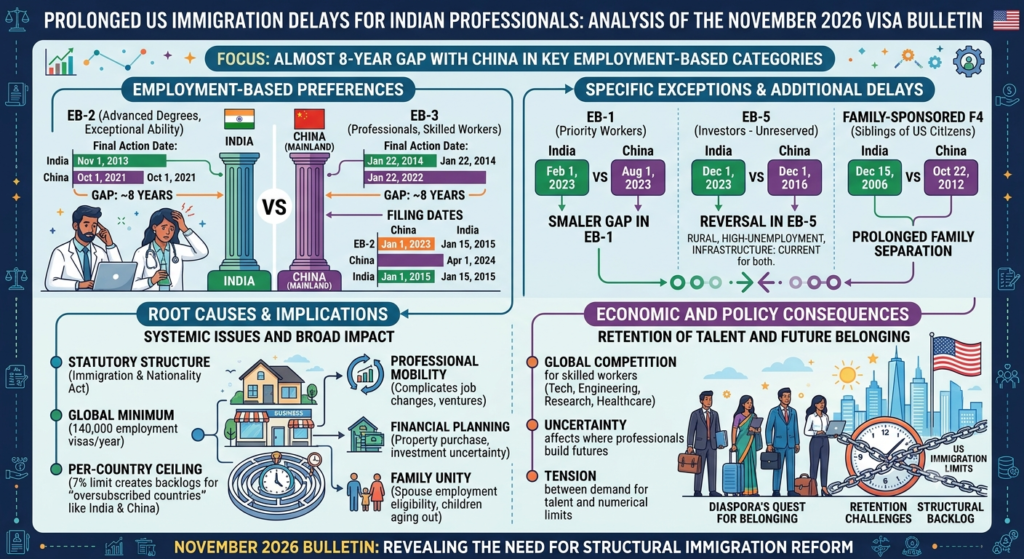
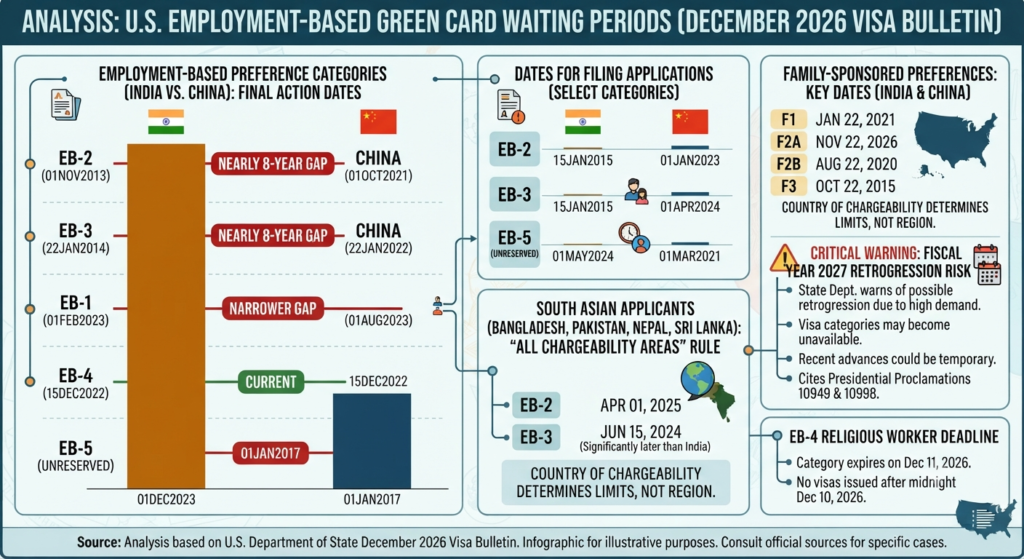
For Indian applicants in the employment-based second preference (EB-2), reserved for professionals holding advanced degrees and individuals with exceptional ability, the final action date stands at November 1, 2013. The corresponding date for Chinese applicants is October 1, 2021, an eight-year gap.
The disparity is almost identical in the employment-based third preference (EB-3), covering skilled workers, professionals and other workers. India’s final action date is January 22, 2014, compared with January 22, 2022, for China.
Advertisement
These dates mean that applicants whose priority dates are later than the dates specified in the bulletin must continue waiting before their immigrant visas can be issued or their adjustment-of-status applications approved.
The difference is also visible in the dates for filing applications, which determine when eligible applicants can begin submitting the required documentation. For EB-2, India’s filing date is January 15, 2015, against January 1, 2023, for China. In EB-3, India stands at January 15, 2015, while China has advanced to April 1, 2024.
The divergence is particularly consequential for the Indian diaspora because a large proportion of Indian professionals enter the US employment-based immigration system through employer-sponsored routes. Extended backlogs can leave workers, including those who have spent years building careers in the country, dependent on temporary immigration status while their permanent residence applications remain pending.
Limited movement in employment-based categories
The employment-based first preference (EB-1), which covers priority workers, including individuals with extraordinary ability, outstanding professors and researchers, and certain multinational executives and managers, presents a narrower India-China gap.
India’s final action date is February 1, 2023, compared with August 1, 2023, for China. Both countries have a July 1, 2024, filing date.
The EB-2 and EB-3 figures, however, underline the scale of the disparity confronting Indian professionals. The country-specific allocation system, combined with demand for employment-based visas, has created a substantial difference between applicants from the two largest Asian sources of skilled immigration to the United States.
The fourth employment-based preference (EB-4), covering certain special immigrants, including religious workers, has a December 15, 2022, final action date across the listed countries.
The employment-based fifth preference (EB-5), which covers immigrant investors, offers a contrasting picture. India’s final action date for unreserved visas is December 1, 2023, while China’s is January 1, 2017. The filing dates are May 1, 2024, for India and March 1, 2021, for China.
The rural, high-unemployment and infrastructure investment categories under EB-5 remain current across the listed countries, both for final action and filing.
Family reunification remains a concern
The bulletin also highlights the prolonged waits faced by families seeking to reunite with relatives who are US citizens or permanent residents.
In the family-sponsored first preference (F1), covering unmarried sons and daughters of US citizens, India and China share a final action date of January 22, 2021. The filing date is February 1, 2021.
The second preference category for spouses, children and unmarried sons and daughters of permanent residents is divided into F2A and F2B. F2A, covering spouses and children of permanent residents, is current for filing across all listed countries. Its final action date is November 22, 2026, for India and China.
F2B, covering unmarried sons and daughters aged 21 or older of permanent residents, has an August 22, 2020, final action date for both countries.
The third preference, covering married sons and daughters of US citizens, has an October 22, 2015, final action date for India and China, while the fourth preference, covering brothers and sisters of adult US citizens, shows a more substantial divergence.
India’s F4 final action date is February 15, 2007, compared with October 22, 2012, for China. The filing dates are August 15, 2007, for India and November 1, 2012, for China.
For South Asian families, the implications extend well beyond the principal applicant. Spouses and children accompanying or following to join preference immigrants are entitled to the same immigration status and order of consideration under the Immigration and Nationality Act. Nevertheless, prolonged processing and visa availability constraints can complicate family planning, children’s education and decisions about where families should establish their long-term futures.
Implications for the wider South Asian diaspora
Although India receives separate treatment in the bulletin because of its oversubscribed immigration categories, applicants from Bangladesh, Pakistan, Nepal and Sri Lanka are not individually identified in the country columns.
They generally fall under the category labelled “All Chargeability Areas Except Those Listed”, subject to the applicable chargeability rules. This means that their employment-based and family-sponsored waiting periods can be substantially different from those faced by Indian-born applicants.
For example, the final action date for EB-2 applicants in the general chargeability category is April 1, 2025, compared with November 1, 2013, for India. The corresponding EB-3 dates are June 15, 2024, and January 22, 2014.
The distinction is important for South Asian professionals because immigration delays are not uniform across the region. The country of chargeability, rather than a common South Asian identity or nationality grouping, determines which numerical limits apply.
For the wider diaspora, the consequences extend to employers attempting to retain skilled workers, families managing cross-border relationships and young professionals weighing the advantages of pursuing careers in the United States against the uncertainty of obtaining permanent residence.
Washington warns of possible retrogression
The December bulletin also contains an important warning about the availability of immigrant visas during fiscal year 2027.
The State Department said immigrant visa issuance rates had declined following various actions taken by the administration and the department to protect national security and public safety and advance US interests. It specifically cited Presidential Proclamations 10949 and 10998.
Against this backdrop, the department said filing dates and final action dates had been advanced across several immigrant visa categories in recent months to ensure that available visa numbers could be used during the fiscal year.
However, it cautioned that retrogression could become necessary in the coming months, depending on immigrant visa demand. Categories could also become unavailable before the end of the fiscal year if annual, category-specific or prorated per-country limits were reached.
The warning introduces an additional element of uncertainty for applicants who may interpret recent forward movement as a sustained improvement in their prospects.
The bulletin also notes that the annual worldwide employment-based preference level is at least 140,000, while the per-country limit for preference immigrants is 7% of the combined annual family-sponsored and employment-based preference limits, equivalent to 25,620 under the statutory framework outlined in the document.
The allocation system is therefore particularly consequential for countries with large numbers of applicants competing for a limited supply of employment-based visas.
Religious worker visas face a deadline
A separate concern involves the employment-based fourth preference category for certain religious workers.
Legislation signed on September 2, 2026, extended the category through December 11, 2026. However, unless Congress takes further legislative action, the category is likely to become unavailable on December 11.
The department said no visas could be issued overseas, or final action taken on adjustment-of-status applications, after midnight on December 10. Applicants admitted under the non-minister special immigrant category must also enter the United States by that deadline.
The provision is relevant to South Asian religious institutions and organizations that recruit or sponsor religious personnel from overseas.
For applicants from India and other South Asian countries, the December bulletin therefore presents a mixed picture: some categories remain accessible, but long-standing employment-based bottlenecks, family reunification delays and the possibility of renewed retrogression continue to shape immigration prospects.
For Indian professionals, the nearly eight-year difference between India and China in EB-2 and EB-3 final action dates is a particularly stark reminder that securing a job in the United States and securing permanent residence remain two very different milestones.