The Queensland government said on November 24, 2026, that a tungsten mine in the state’s far north is expanding to become a major supplier to the United States military, weeks before a Pentagon rule takes effect that will extend a ban on certain tungsten products in US defense contracts to material mined in China.
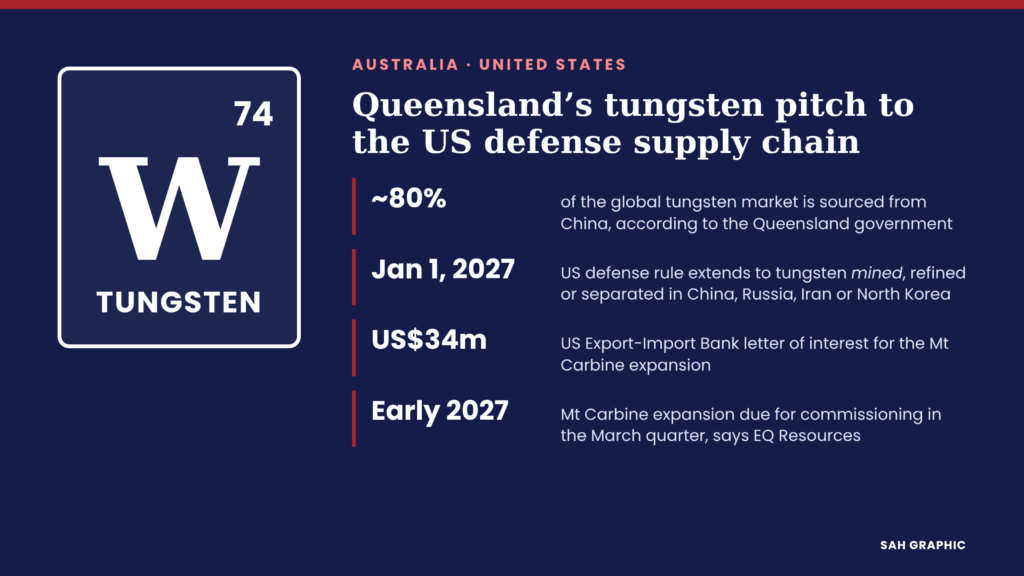
In a joint statement, Queensland Premier David Crisafulli and Minister for Natural Resources and Mines Dale Last said EQ Resources’ Mt Carbine Tungsten Mine is expanding “to become a major supplier of tungsten into the United States market, for use by the Department of War.” The Queensland government said about 80% of the global tungsten market is sourced from China.
Crisafulli said the United States “has opened the door for major investment in critical minerals” and that Queensland is “walking through it as a reliable partner.”
What Changes in Washington on January 1
Advertisement
US defense contractors are already barred from delivering tungsten metal powder or tungsten heavy alloy melted or produced in China, Russia, Iran or North Korea, under the Defense Federal Acquisition Regulation Supplement (DFARS), the Pentagon’s contracting rules.
From January 1, 2027, DFARS clause 252.225-7052 extends the ban to covered tungsten “mined, refined, separated, melted, or produced” in any of those four countries, reaching back through the supply chain to the mining of tungsten ore. The clause implements 10 U.S.C. 4872 and section 854 of the National Defense Authorization Act for Fiscal Year 2024.
The Queensland Deal
According to the Queensland government, the expansion followed “a landmark deal struck with the US Government through the Premier’s trade delegation earlier this year,” after Crisafulli took Queensland’s case “to the highest levels of the US Government including a meeting with the Vice President.”
According to the Queensland government, EQ Resources secured a US$34 million letter of interest from the Export-Import Bank of the United States (EXIM) following Last’s trade mission to the United States in 2025, for “the capital expansion and further development” of Mt Carbine. Last said his negotiation with EXIM during his trade mission to the United States “has delivered a pathway for companies pursuing funding for critical minerals projects in Queensland.” An earlier Queensland government statement, issued in October 2025, said EQ Resources had received an EXIM letter of interest for Mt Carbine “earlier this year.”
Neither Queensland statement described a signed supply contract or a finalized EXIM loan, and the November statement did not set out the terms of the deal it referred to.
According to the state government, the expansion is creating 100 direct construction jobs and hundreds more indirect jobs. David Kempton, the state Member for Cook, described EQ Resources as “a respected operator” that “has built strong relationships across the far north.” Craig Bradshaw, Managing Director of EQ Resources, said the investment “will strengthen an established Australian tungsten-producing operation.”
What the Company Told Shareholders
EQ Resources Chair Michael Nossal said in his address to the company’s annual general meeting on November 25, 2026, a day after the government statement, that the Mt Carbine expansion “is on schedule and on budget, with commissioning due in the March quarter of 2027.”
Nossal said the company had issued production guidance for the first time, of 240,000 to 280,000 metric ton units of tungsten for the 2027 financial year. He described EQ Resources as “one of the few established tungsten producers outside China,” saying “Western governments and manufacturers are paying far more attention to where their tungsten comes from.”
The Chair’s address, released to the Australian Securities Exchange, did not mention the US Department of War, EXIM or a US supply agreement. Nossal said that in September the company had agreed to take a 10% interest in a joint venture with Elmet and Blue Moon Metals “to restart the Springer APT plant in Nevada.”
Queensland’s Wider Push
The Queensland government said it has expanded its Critical Minerals Fund to A$250 million and committed a further A$146 million to bring former mines back into production.
The announcement comes just over a year after President Donald Trump and Prime Minister Anthony Albanese signed the United States and Australia critical minerals framework at the White House on October 20, 2025.