Indian professionals seeking permanent residency in the United States continue to face prolonged immigration delays, with the November 2026 Visa Bulletin exposing an almost eight-year gap between Indian and Chinese applicants in key employment-based green card categories.
The latest bulletin issued by the US Department of State highlights the growing disparity in access to permanent residency for skilled workers and professionals with advanced degrees, raising concerns about the long-term implications for the Indian-American community, employers and America’s ability to retain internationally recruited talent.
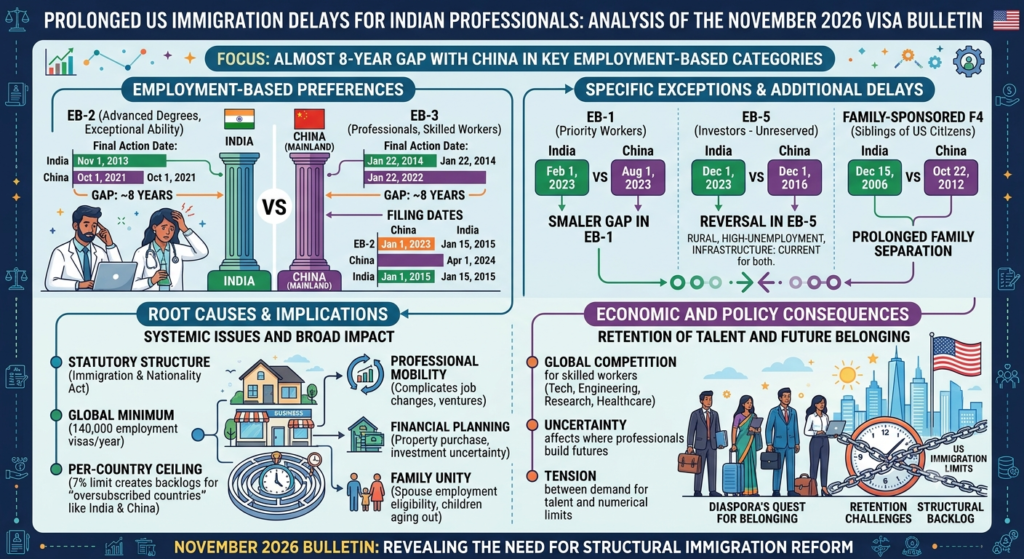
The sharpest differences appear in the employment-based second preference (EB-2) and third preference (EB-3), two major pathways used by employer-sponsored professionals.
India’s EB-2 final action date stands at November 1, 2013, compared with October 1, 2021, for mainland China. In EB-3, India’s cutoff is January 22, 2014, against January 22, 2022, for China. Both categories therefore leave Indian applicants approximately eight years behind their Chinese counterparts.7ent in filing eligibility. China’s EB-2 filing date is January 1, 2023, while India’s is January 15, 2015. In EB-3, China has an April 1, 2024, filing date, compared with January 15, 2015, for India.
Advertisement
The figures underline a growing challenge for Indian professionals who have spent years building careers in American technology companies, research institutions, universities and healthcare organizations but remain unable to secure permanent residency.
The consequences extend beyond immigration paperwork. Prolonged waiting can complicate job changes, entrepreneurial ventures, property purchases and long-term financial planning. Families must also navigate uncertainty over spouses’ employment eligibility and children’s immigration status as they approach adulthood.
The comparison, however, is not uniformly unfavorable to India. Under employment-based first preference (EB-1), covering priority workers, India’s final action date is February 1, 2023, against August 1, 2023, for China. The difference is considerably smaller.
The investor-based fifth preference (EB-5) presents a reversal. India’s final action date for unreserved investor visas is December 1, 2023, compared with December 1, 2016, for China. Both countries also have current dates in the rural, high-unemployment and infrastructure investment categories.
The underlying problem is rooted in the statutory structure of US immigration. The Immigration and Nationality Act establish an annual worldwide minimum of 140,000 employment-based preference visas and a per-country ceiling of 7% of the combined family-sponsored and employment-based preference limits.
India and mainland China are among the oversubscribed countries identified by the State Department. When demand exceeds available visa numbers, applicants must wait according to their priority dates, even after their employment petitions have been approved.
For Indian applicants, the backlog is not confined to employment immigration. In the family-sponsored fourth preference (F4), covering siblings of adult US citizens, India’s final action date is December 15, 2006, compared with October 22, 2012, for China. Such delays can prolong family separation across generations.
The filing-date and final-action-date distinction is crucial. Filing eligibility can allow applicants to submit adjustment-of-status applications and seek certain interim benefits, subject to eligibility. It does not guarantee immediate green card approval. Applicants must also follow the monthly filing-chart instructions issued by US Citizenship and Immigration Services (USCIS).
The wider economic implications are difficult to ignore. The United States competes globally for skilled workers in technology, engineering, scientific research and healthcare. Yet prolonged immigration uncertainty can influence where internationally recruited professionals choose to build their futures.
The November bulletin does not offer a solution to the structural backlog. Instead, it exposes the tension between America’s demand for global talent and an immigration system constrained by numerical limits and country-specific allocation rules.
For the Indian-American diaspora, the green card queue has consequently become more than an administrative obstacle. It is a question of professional mobility, family security and the prospect of permanent belonging in the country where many have invested years of their lives.