Like all of Sooraj R. Barjatya’s films, this is a saccharine-sweet family and friendship drama. It looks at the balance between tradition’s good points and today’s values and stresses that regressive old beliefs, perpetuated blindly, should be junked forthwith. In one word, the film is progressive. And I mean that in the real sense, where even the older generation (represented by Dadu played by Anupam Kher and Nani, essayed by Supriya Pathak Kapur) has a progressive mindset.
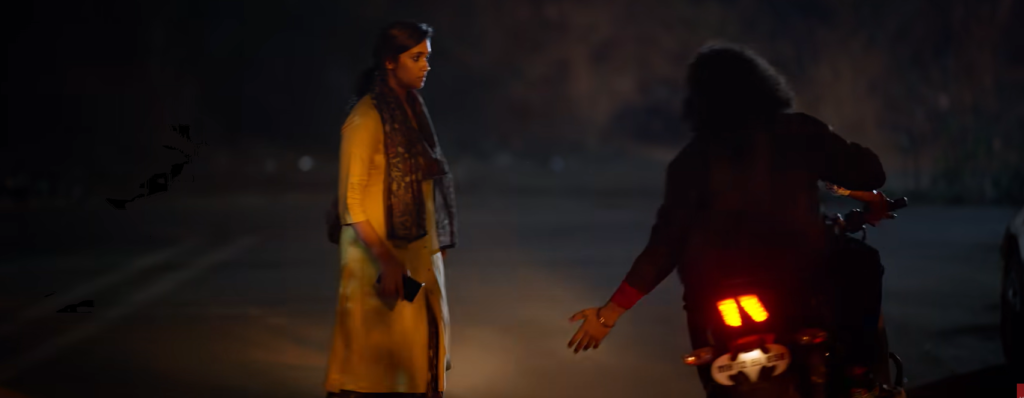
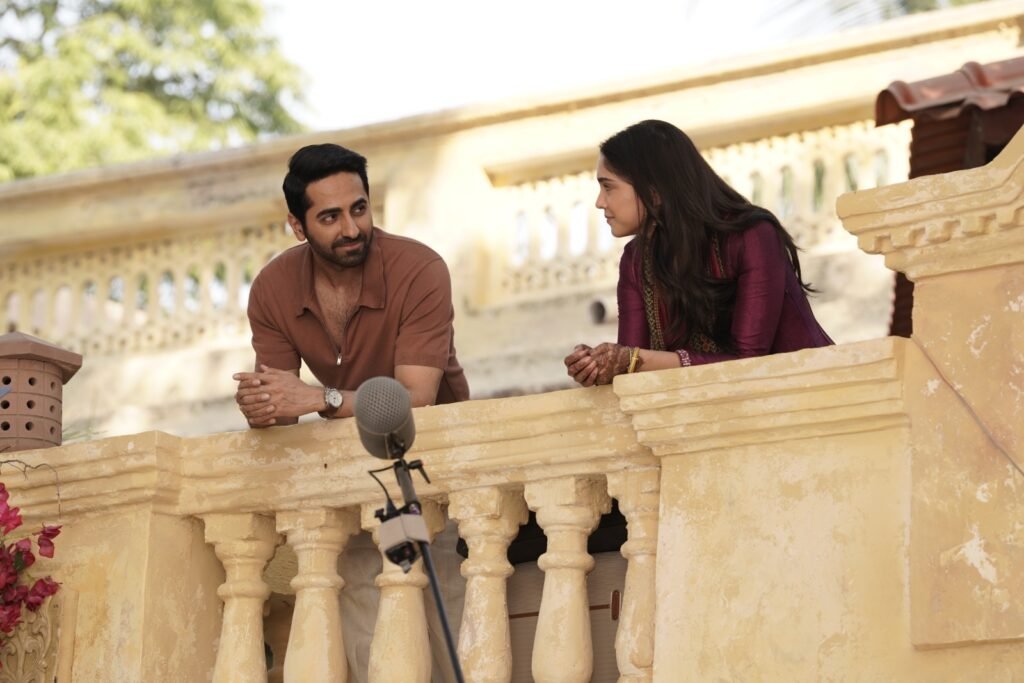
On the other hand, the younger generation remains respectful towards their elders but stands up for what it firmly believes in. Prem (Ayushmann Khurrana) has come to Mumbai from Patna because he wants to become a film composer (he is finally shown as composer-lyricist-singer). Purva (Sharvari) is the main breadwinner of an all-women household in a huge mansion. For Prem, it is love-at-first-might (please watch the film to know why I have used the last word). They get acquainted later.
Destiny plays a hand when Prem needs a peaceful place to work on his music, because he stays with his grandfather, Dadu a.k.a. Mukesh Mishra (Anupam Kher), parents Ved and Gayatri (Swanand Kirkire and Geeta Agarwal Sharma) and younger brother Rohit (Krish Rao) in a compact apartment. The estate agent (Girish Kulkarni) suggest tenancy in the same vintage mansion that has only women. Prem meets Purva and their rapport develops when they again meet at a ‘Dandiya’ event.
Through one of his compositions, Prem openly expresses his love for her. Purva replies that marriage would be an impossibility for her as she has to take care of her paternal grandmother (Seema Pahwa), who also suffers from Sleep Apnea, maternal grandmother Nani, and paternal aunts (Surbhi Tiwari and Saumya Tandon) and the widowed latter’s daughter, Rasgulli (Ashnoor Kaur Kuckreja).
Advertisement
However, she agrees to bring in Prem as a tenant. But around that time, the tenancy lease of his rented home is set to expire, and Prem gets a revolutionary idea—why can’t the Mishras move into Purva’s bungalow (which has nine bedrooms, four of which are unoccupied) for good, so that he can also marry Purva? The idea is encouraged by Dadu and Nani, though Prem’s sulky and perennially-discontented father does not like it. Ved has also broken all ties with his daughter, Megha (Shruti Seth), who has divorced her alcoholic husband, Anup (Shaad Randhawa) a decade ago, because of the divorce itself being a stigma to the family name.
The marriage is solemnized and the minor frictions began, including on expense-sharing matters. Dadu leaves for a thanksgiving pilgrimage to Benares. When he returns, major issues happen concerning Dadu, Rasgulli, Ved, Bua and Anup. Dadu takes Purva’s family to court, demanding a huge compensation.
The film opens with the court sequence and ends with the judge’s verdict. Finally, goodness prevails. Sacrifices are done, and unnecessary sacrifices avoided. Widow remarriage is encouraged, as is Prem’s dictum of maayka (parents’ home) and sasural (in-laws’ residence) both being considered as ghar (home) and not be discriminated against or separated, The bonds between father and daughter and father and daughter-in-law are sacred, as is the ‘toran’ tradition in Bihar and, of course, gender equality is supreme.
This time, Barjatya has left the scripting to Surabhi Horo (screenplay, and story by Horo and him), and dialogues to Abhsiehk Dixit, and it is great to know that the olde-worlde Hindi film is back with its warmth, positivity and values. This is a film that can be truly enjoyed by progressive and positive human beings of all ages. Not just the screenplay but even the dialogues are plain superb.
The flipside is that some sequences and angles still seem unreal. Logic is also surrendered in some aspects, like Prem missing a crucial professional assignment for a reason that could have been postponed, or Mumbai’s rains being almost omnipresent and yet the household members deciding to sleep on the terrace. The science of ‘Vaastu’ is also shown in a gimmicky manner. And the overall monthly household expense vis-à-vis the income factor does not tally in either the case of the ladies’ home or the Mishras. Prem has a completely equipped music studio in his room when he has barely made it and his father is later shown to have failed at his business due to his mental rigidity!
However, for the overall message it sends, this film is a wonderfully pleasant trip down family lane, highlighting that relationships are paramount. Technically in sync with today, it is elevated by Barjatya’s deft direction and a winsome score by Himesh Reshammiya. The title song is stunning, and Jhumka patola and Tum jeene ki wajah ho (despite the harsh and unsuitable for Khurrana voice of Vishal Mishra) work in particular.
Every actor is brilliant here, but I must make special mention of Sharvari, Swanand Kirkire, Anupam Kher, Ayushmann Khurrana, Geeta Agrawal Sharma, Seema Pahwa, Girish Kulkarni and Surbhi Tiwari, more or less in that order.
This is a must-watch, especially for today’s generation, both for its cinematic virtues and its core content.
Rating: ****
Rajshri Productions’ & Mahaveer Jain Films’ Yeh Prem Mol Liya Produced by: Kamal Kumar Barjatya, late Rajkumar Barjatya, Ajit Kumar Barjatya & Mahaveer Jain Directed by: Sooraj R. Barjatya Written by: Sooraj R. Barjatya, Surabhi Horo & Abhishk Dixit Music: Himesh Reshammiya Starring: Ayushmann Khurrana, Sharvari, Anupam Kher, Supriya Pathak, Seema Pahwa, Swanand Kirkire, Geeta Agarwal Sharma, Saumya Tandon, Surbhi Tiwari, Shruti Seth, Krish Rao, Girish Kulkarni, Ashnoor Kaur Kuckreja, Jameel Khan, Shaad Randhawa, Rajesh Kumar & others