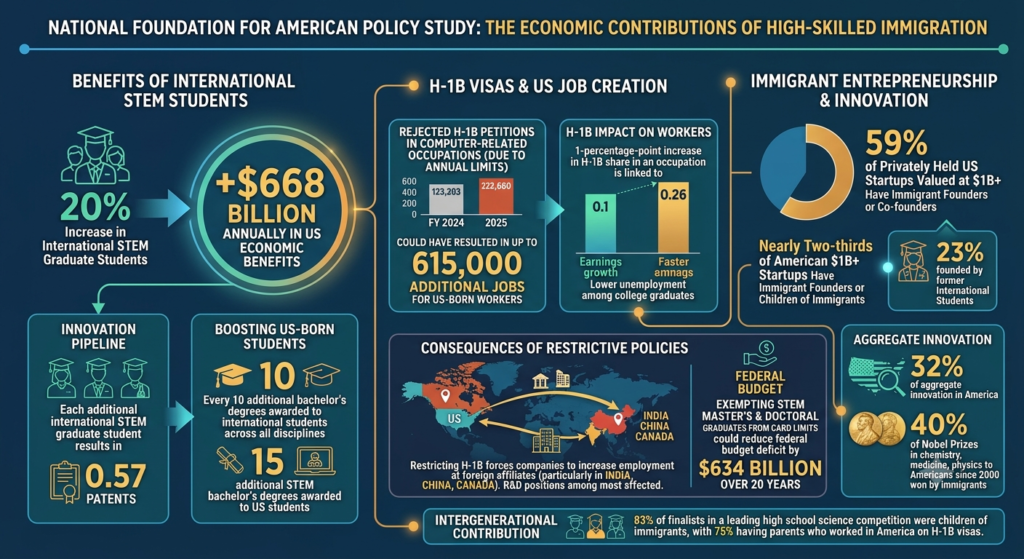
Restricting high-skilled immigration could cost the US economy as much as $668 billion annually in lost economic benefits from a 20 per cent decline in international STEM graduate students, while potentially denying American technology companies the opportunity to generate up to 615,000 additional jobs for US-born workers, according to a new study that warns Washington’s immigration curbs could end up benefiting competing economies, particularly India, China and Canada.
The findings carry particular significance for South Asia, especially India, which supplies a substantial share of the international students, engineers, technology professionals and H-1B visa holders who contribute to America’s technology and research ecosystem. The study argues that restricting foreign talent in the name of protecting American employment could produce the opposite outcome by discouraging investment, weakening innovation and encouraging companies to shift research and development operations overseas.
Released by the National Foundation for American Policy (NFAP), the study, titled The Economic Contributions of High-Skilled Immigration, draws on original research and an extensive review of economic literature to examine the contribution of immigrants, international students and H-1B visa holders to the US economy.
Its estimates suggest that a 10 per cent increase in international graduate students in science, technology, engineering and mathematics (STEM) programs could add $334 billion annually to the US economy, while a 20 per cent increase could generate $668 billion in annual economic benefits.
Advertisement
The findings are particularly relevant to India, whose students constitute one of the largest international student communities in American universities. The report estimates that each additional international STEM graduate student results in 0.57 patents, underlining the contribution of foreign students to the American innovation pipeline.
It also challenges the argument that international students compete with American students for educational and professional opportunities. Research cited in the study found that every 10 additional bachelor’s degrees awarded to international students across all disciplines are associated with 15 additional STEM bachelor’s degrees awarded to US students.
The employment argument is equally significant. Research cited by NFAP found that restrictions arising from the H-1B annual visa cap had constrained job creation in the American technology sector.
Economists Giovanni Peri, Kevin Shih, Chad Sparber and Angie Marek Zeitlin estimated that, had 178,000 H-1B applications rejected in 2007 and 2008 been approved, US metropolitan areas could have created as many as 231,224 additional jobs for US-born technology workers.
Building on that research, NFAP estimates that approving H-1B petitions in computer-related occupations rejected because of annual limits in fiscal years 2024 and 2025 could have resulted in as many as 615,000 additional jobs for US-born technology workers.
The findings challenge the political argument that restricting foreign professionals necessarily protects domestic employment.
Research by economist Madeline Zavodny, cited in the report, found that H-1B visa holders do not adversely affect American professionals. Their presence was instead associated with lower unemployment and faster earnings growth among college graduates, including recent graduates.
A one-percentage-point increase in the share of H-1B workers in an occupation was associated with an improvement of 0.1 to 0.26 percentage points in the earnings growth rate of workers in that occupation.
For India, the implications extend beyond the movement of individual professionals. The country’s technology services industry, research institutions and expanding digital economy are closely connected to American businesses through investments, outsourcing arrangements and skilled-worker mobility.
The study identifies a potentially unintended consequence of restrictive immigration policies: companies may move more operations abroad rather than abandon their demand for specialized talent.
Research by Britta Glennon of the University of Pennsylvania’s Wharton School found that companies facing H-1B immigration restrictions increased employment at their foreign affiliates, particularly in India, China and Canada. Research and development positions were among the most affected.
This presents a strategic dilemma for Washington. Measures intended to protect American jobs could encourage companies to expand research, engineering and technology operations overseas, transferring investment and employment to competing economies.
India, with its established technology workforce and expanding research capabilities, could benefit from some of that relocation. However, such a shift would not necessarily compensate Indian students and professionals for reduced access to American universities, employment opportunities and advanced research networks.
The contribution of immigrants to American entrepreneurship is another major finding. NFAP estimates that immigrants have founded or co-founded 59 per cent of privately held US startups valued at $1 billion or more. Approximately two-thirds of American billion-dollar startups have immigrant founders or founders who are children of immigrants.
Nearly one in four of these companies was founded by someone who initially entered the United States as an international student.
Immigrants also account for an estimated 32 per cent of aggregate innovation in America, according to research cited by the foundation. They have won 40 per cent of the Nobel Prizes awarded to Americans in chemistry, medicine and physics since 2000.
The report further estimates that exempting STEM graduates with master’s and doctoral degrees from employment-based green card limits could reduce the US federal budget deficit by $634 billion over 20 years.
The intergenerational contribution is also considerable. NFAP research found that 83 per cent of finalists in the 2016 Intel Science Talent Search, a leading US high-school science competition, were children of immigrants. Three-quarters had parents who worked in America on H-1B visas.
For South Asian families, the findings underline how immigration has shaped not merely the American workforce but also its next generation of scientists, entrepreneurs and researchers.
The larger question for India is whether tighter US immigration rules will accelerate the movement of technology investment and research activity towards the country even as they restrict the mobility of Indian talent.
The NFAP findings suggest that America’s economic interests and the political impulse to restrict immigration are increasingly at odds. In an economy where innovation depends on the movement of knowledge and specialized skills across borders, closing the door to foreign professionals could prove costly not only for immigrants but also for the country seeking to exclude them.