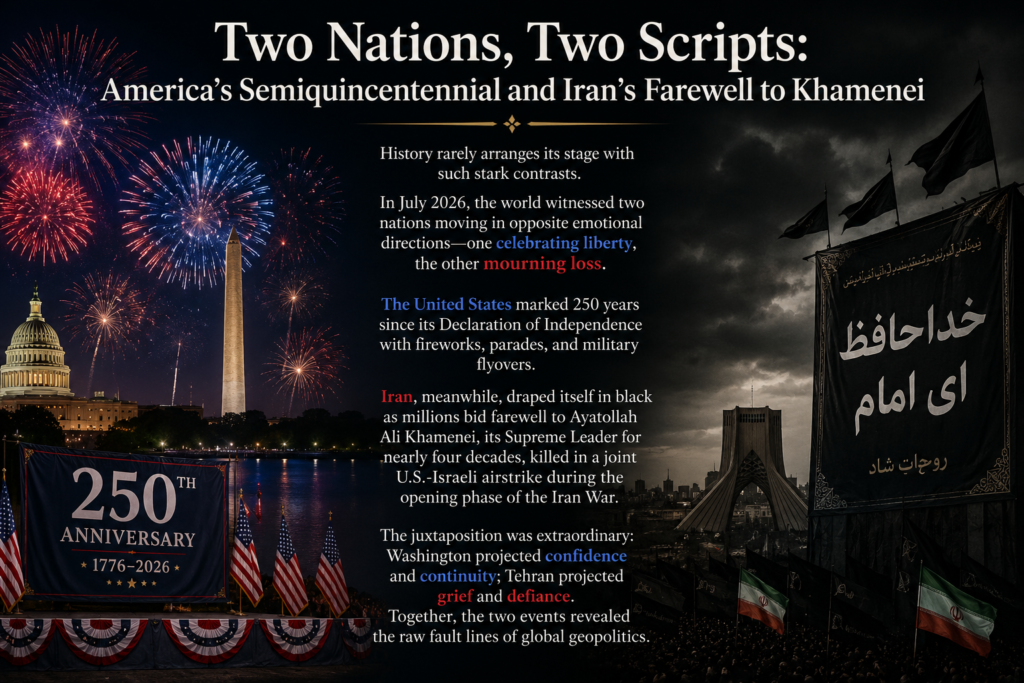
History rarely arranges its stage with such stark contrasts. In July 2026, the world witnessed two nations moving in opposite emotional directions—one celebrating liberty, the other mourning loss.
The United States marked 250 years since its Declaration of Independence with fireworks, parades, and military flyovers. Iran, meanwhile, draped itself in black as millions bid farewell to Ayatollah Ali Khamenei, its Supreme Leader for nearly four decades, killed in a joint U.S.-Israeli airstrike during the opening phase of the Iran War.
The juxtaposition was extraordinary: Washington projected confidence and continuity; Tehran projected grief and defiance. Together, the two events revealed the raw fault lines of global geopolitics.
The Irony of Timing: The simultaneity of the celebrations and the funeral was not merely coincidence—it was symbolism. America’s Semiquincentennial, presided over by President Donald Trump, was designed to showcase resilience, military supremacy, and democratic longevity. Iran’s week-long mourning was equally political, transforming Khamenei’s burial into a reaffirmation of the Islamic Republic’s revolutionary identity. One nation toasted its founding ideals; the other declared that assassination could not extinguish its revolution.
Advertisement
Why Iran Stretched Mourning into Six Days: Islamic tradition prescribes swift burial, often within 24 hours. Yet Iran delayed Khamenei’s interment for nearly a week. The reasons were both practical and political: ongoing conflict, fears of further strikes, succession uncertainties, and the sheer logistics of mobilizing millions. Religious dispensations allowed preservation of the body, but the delay served a deeper purpose—it transformed mourning into a national ritual of resistance. What might have been a single day of grief became a prolonged spectacle of defiance.
Tehran as a Stage of Resistance: The funeral was not a neutral religious rite. It was a political theatre. Black flags covered government buildings, giant portraits of Khamenei loomed over avenues, and chants of “Labbaik Ya Khamenei” mingled with denunciations of the United States and Israel. His coffin, carried through Tehran in a shrine-like vehicle, became a symbol of martyrdom. The ceremonies echoed the farewell to Ayatollah Khomeini in 1989, merging religion and politics into one seamless narrative: Khamenei had died as a martyr, and the revolution would endure.
Martyrdom as Political Capital: Shi’a Islam’s emphasis on martyrdom has long been central to Iran’s revolutionary identity. Officials drew parallels between Khamenei’s death and Imam Hussein’s sacrifice at Karbala, framing the Supreme Leader’s assassination as part of a centuries-old struggle against injustice. This narrative was not incidental—it was strategic. By elevating Khamenei’s death into a sacred sacrifice, Iran reinforced its legitimacy and mobilized its population for continued resistance against foreign aggression.
Leadership in Transition: The funeral also served as a stage for Iran’s post-Khamenei leadership. President Masoud Pezeshkian, Speaker Mohammad Bagher Ghalibaf, senior clerics, and Revolutionary Guard commanders appeared together, projecting unity. Yet the absence of Mojtaba Khamenei, the designated successor, raised questions. Officials cited security concerns and possible injury, but speculation inevitably followed. Still, the collective presence of Iran’s elite signaled continuity: the revolution was larger than any individual.
A Sacred Farewell: The coffin’s journey through Tehran, Qom, and finally Mashhad underscored the spiritual dimension of the funeral. Burial at the Imam Reza Shrine, one of Shi’a Islam’s holiest sites, elevated Khamenei’s legacy to near-sacred status. Whether his resting place becomes a permanent national memorial akin to Khomeini’s mausoleum remains uncertain, but its symbolic weight is undeniable. Mashhad now holds not only religious significance but also political resonance as the site of Iran’s most consequential burial in decades.
Global Eyes on Tehran: International delegations attended, though cautiously. China sent a senior representative; other nations calibrated their presence to balance diplomacy with political risk. Iran portrayed the attendance as proof that isolation had failed. Western governments, meanwhile, scrutinized the ceremonies for signs of Iran’s future trajectory. The funeral was thus not only a domestic event but also a geopolitical signal—Tehran was wounded but unbowed.
South Asia’s Delicate Balancing Act: India, Pakistan, Bangladesh, Sri Lanka, and Afghanistan faced difficult choices. Each maintains ties with Tehran but also strategic relationships with Washington. Their participation, muted or symbolic, reflected the tightrope of regional diplomacy. For South Asia, the funeral was not just about Iran—it was about navigating the shifting balance of power between America and the Islamic Republic.
Two Nations, Two Emotions: The contrast could not have been sharper. America celebrated constitutional democracy with fireworks and patriotic concerts. Iran mourned the violent death of its Supreme Leader. For Washington, the Semiquincentennial was a projection of endurance. For Tehran, the funeral was a declaration of resilience. Both nations used ritual to assert identity: one through celebration, the other through mourning.
The Geopolitical Image of July 2026: Historians may remember July 2026 less for speeches than for images. Fireworks over Washington monuments. Black banners over Tehran streets. A jubilant republic marking 250 years of independence. A grieving nation burying the man who embodied its revolution. The simultaneity of joy and grief captured the essence of geopolitics: triumph for some, tragedy for others, unfolding together in the same historical moment.
Conclusion: History’s Dual Script
July 2026 revealed the dual scripts of geopolitics. America celebrated its founding ideals, projecting continuity and supremacy. Iran mourned its fallen leader, projecting defiance and resilience.
The two events, separated by geography but united by timing, reminded the world that history is never linear. It is a mosaic of triumphs and tragedies, celebrations and funerals, liberty and martyrdom. And sometimes, as in those remarkable days, nations write their stories in parallel—one in fireworks, the other in black banners.
Disclaimer: The opinions and views expressed in this article/column are those of the author(s) and do not necessarily reflect the views or positions of South Asian Herald.