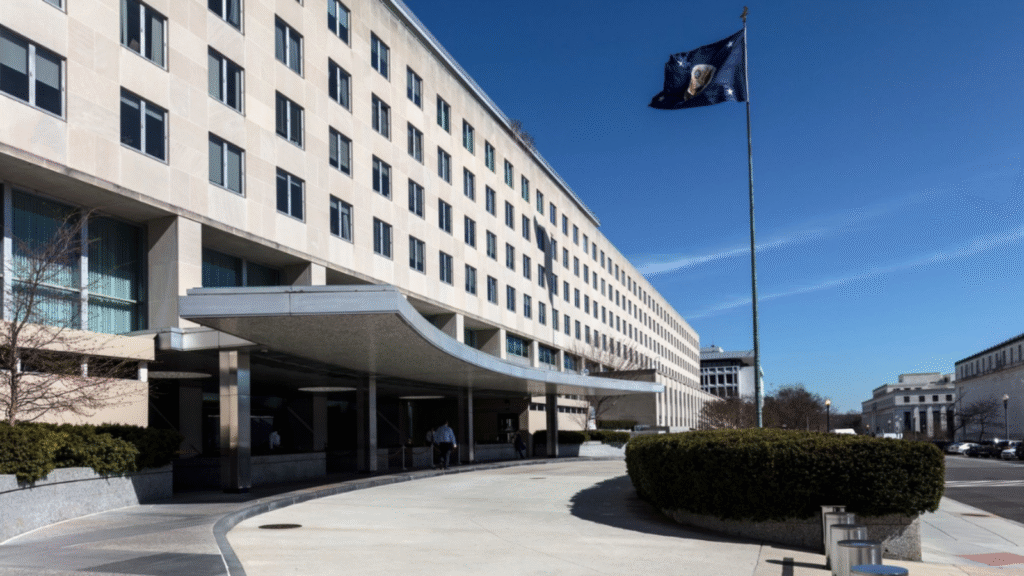
The Trump administration has paused immigrant visa appointments at US embassies and consulates worldwide as the State Department rolls out new “in-depth training” for consular officers, adding another layer to the administration’s sweeping immigration crackdown.
The State Department said that it had launched a global training initiative at US diplomatic missions and that visa appointments would be adjusted to accommodate the programme. It did not specify how long the training would continue or provide a timetable for when affected applicants would receive new interview dates.
The training is intended to ensure consular officers evaluate visa applicants “comprehensively and consistently,” with particular emphasis on identifying applicants who may be likely to depend on US public benefits.
Immigrant visa applicants who already had interviews scheduled at US embassies and consulates have reportedly received emails informing them that their appointments were being rescheduled. They were told they would receive further notification of new dates and times.
Advertisement
The administration is seeking to strengthen screening of applicants deemed likely to require US government assistance, bringing the so-called “public charge” standard into sharper focus.
Under US immigration law, consular officers can consider factors including an applicant’s financial circumstances, age, health, education, skills and family situation when determining whether the person is likely to become primarily dependent on government support.
The administration has argued that people seeking immigrant visas should be able to demonstrate that they can support themselves and are unlikely to rely heavily on public assistance.
The latest move comes days after a federal judge struck down another Trump administration policy that had suspended immigrant visa issuance for applicants from 75 countries.
US District Judge Jeannette Vargas in Manhattan ruled Friday that the State Department had exceeded its legal authority by imposing the categorical suspension based on applicants’ nationalities.
The policy, announced in January, affected applicants from countries including Pakistan, Bangladesh, Brazil, Colombia and Uruguay, as well as nations across the Balkans, Africa, the Middle East and the Caribbean.
Vargas described the policy as unlawful and said federal immigration law requires consular officers to assess immigrant visa applications under the statutory framework rather than impose a blanket prohibition based solely on nationality. Vargas ruled that Secretary of State Marco Rubio had exceeded his statutory authority by imposing a categorical suspension based on applicants’ nationalities.
The ruling marked a legal setback for the Trump administration, which has sought to expand executive authority over immigration and introduce broader restrictions on both legal and illegal immigration.
The January policy had been justified by the administration on the grounds that it would prevent the admission of immigrants likely to become dependent on US welfare and public benefits.
The latest move comes as President Donald Trump’s administration has expanded its immigration enforcement agenda, targeting both undocumented and legal immigration through tougher screening, visa and green-card revocations, deportations and restrictions on immigration benefits.
The administration says the measures are intended to strengthen domestic security and protect US public resources.
Moreover, the State Department is also planning to revoke the business and tourism visas of those who have claimed asylum after arriving in the country, as per US media reports, marking the latest effort by the Trump administration to curb migration to the United States.
The move is expected to apply to those granted B1 and B2 visas typically issued for tourism and business travel between 2016 and 2026, who have sought asylum or are now seeking asylum. The State Department said the process would take place on a rolling basis and could ultimately affect tens of thousands of visas. Officials familiar with internal estimates have indicated that the number could reach or exceed 200,000.
State Department spokesman Tommy Pigott said the agency is coordinating with the Department of Homeland Security to “identify and revoke the nonimmigrant visas of foreigners who have come to the United States claiming to be short-term visitors but then file for asylum to stay here permanently.”
The plan marks the latest tactic by President Donald Trump’s administration to curb immigration. The controversial efforts have included attempts to limit birthright citizenship, impose higher fees for skilled visas and refuse visas to applicants who say they fear returning home to their countries. Many of the moves have been struck down by courts or face legal challenges.
B1 and B2 visas are issued for short stays for reasons including business ventures and travel. Nearly 6.5 million B1 and B2 visas were issued in fiscal 2024, according to State Department figures. A B-1 temporary business visa allows the holder to stay up to six months in the country for commercial activities, while B2 tourism visas can be used for holidays or medical treatment.
Deputy Secretary of State Chris Landau also criticized what he described as “bogus asylum claims,” saying asylum should not be used as a way to circumvent US immigration law.
It remains unclear whether visa cancellations alone will result in foreign nationals being removed from the United States. Where an individual has an active asylum application, the claim would generally have to be adjudicated and denied before removal proceedings could advance.