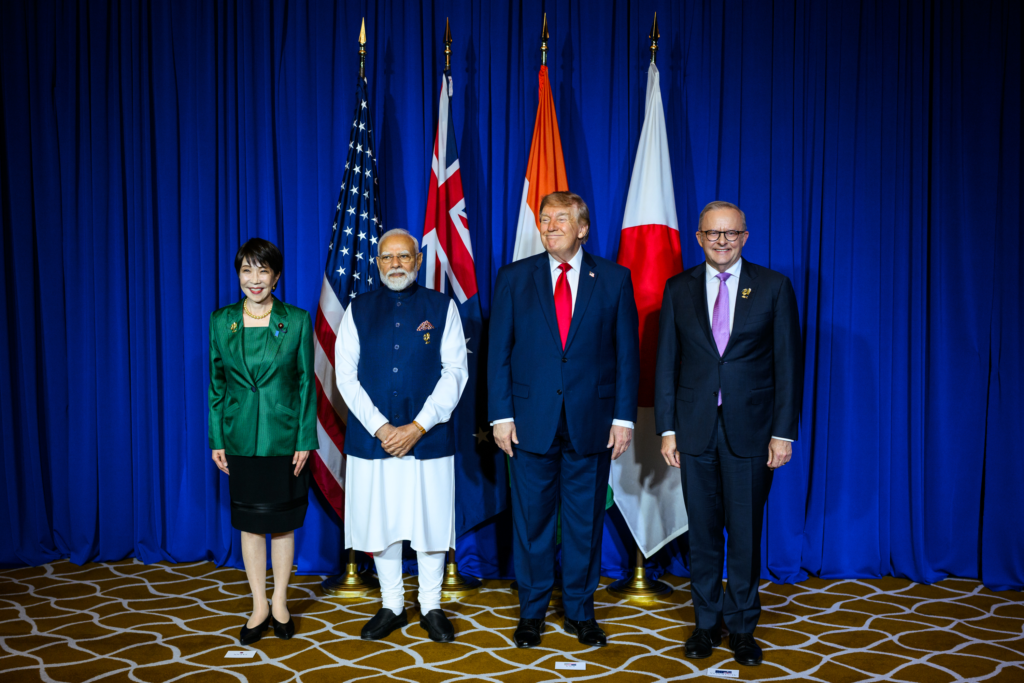
Australian Prime Minister Anthony Albanese described the Quad as bringing together “four great democracies: Australia, the United States, Japan, and India,” after meeting President Donald J. Trump of the United States, Prime Minister Narendra Modi of India and Prime Minister Sanae Takaichi of Japan for a Quad Leaders’ Summit in Manila on November 17, 2026.
Speaking to media after the summit, Albanese said the leaders had held “a very constructive meeting” and “a good discussion with some real outcomes.” He said the four countries represent a combined GDP of nearly $35 trillion and almost one fifth of total global trade, and that together they “can offer the region more than the sum of our parts, and that is the power and potential influence of the Quad.” He noted it was the first time the Quad leaders had met in Southeast Asia.
In his opening remarks at the summit, Albanese recalled that he attended his first Quad meeting “literally the day after I was sworn in as Prime Minister,” adding that the grouping “has a particular affection for me.” He named critical minerals and rare earths, artificial intelligence and maritime security among the issues on the leaders’ agenda.
In a joint press release distributed by the U.S. Embassy in Canberra, the leaders said the summit marked “nearly a decade since the Quad was revived” and the tenth anniversary of the vision of a Free and Open Indo-Pacific, first set out by the late Japanese Prime Minister Shinzo Abe in 2016.
Advertisement
Takaichi opened the summit by saying the four countries had always contributed to the peace and stability of the region and stressed the commitment to the complete denuclearization of North Korea, according to Japan’s Ministry of Foreign Affairs (MOFA). She thanked the governments of the United States, Australia and India for their consistent support toward the immediate resolution of the abductions issue, and said Japan will further contribute to the region’s economic and energy resilience through its POWERR Asia and POWERR Gulf initiatives.
The leaders said they “strongly oppose any destabilizing or unilateral actions that seek to change the status quo,” including by force or coercion, and expressed grave concerns about economic coercion, including through arbitrary export restrictions.
Albanese said he had raised Iran during the meeting, saying “we are not protagonists in the war, but it is having an impact, and we want to see de-escalation because of the economic impact that it’s having.”
Among the outcomes with a direct Australian contribution, Albanese announced the extension of Australia’s Cable Connectivity and Resilience Centre, which he said will expand its current focus on data cables to include electricity cables, “strengthening regional energy security and connectivity, with a renewed focus on Southeast Asia.” The leaders welcomed the expansion of Australia’s contribution to the Quad Partnership for Cable Connectivity and Resilience, as well as upcoming undersea cable projects in the Indian Ocean.
The leaders announced the Indo-Pacific Maritime Surveillance Collaboration, a new initiative to enhance information sharing and maritime domain awareness. “Our respective P-8 and P-3C maritime surveillance aircraft will operate together in a Quad exercise,” Albanese said, adding that the first joint exercise will be conducted in early 2027. Asked what he would tell President Xi about the need for Quad military exercises, Albanese said they were about maritime surveillance, including illegal fishing, and added, “It’s not about any one country.” He described Australia’s approach to China as to “cooperate where we can, disagree where we must, but engage in our national interests.”
The leaders also announced the inaugural Quad Business Leaders’ Forum, scheduled for early 2027, which they said will bring together business leaders, government officials and policy experts from the four countries to “foster greater business ties across our private sectors.”
Citing “the rapid increase in the number and scale of cyber incidents in the region,” the leaders announced enhanced Quad Cybersecurity Cooperation aimed at an open and secure cyberspace. They unequivocally condemned terrorism and violent extremism in all its forms and manifestations, specifically “including cross-border terrorism,” and committed to strengthening the Quad’s cooperation on counterterrorism.
The leaders affirmed the importance of an artificial intelligence accelerator announced by Quad Foreign Ministers in Atlanta (the leaders’ statement calls it the “Super Intelligence Accelerator” and notes that in Australia, India and Japan, “Super Intelligence” refers to “artificial intelligence”). The leaders said the accelerator is intended to coordinate and fund efforts to support trusted artificial intelligence access, deployment and technical assistance across the Indo-Pacific.
The leaders reaffirmed their “unwavering support for ASEAN centrality and unity” and their commitment to “upholding a free and open Indo-Pacific.”