Join WhatsApp Channel

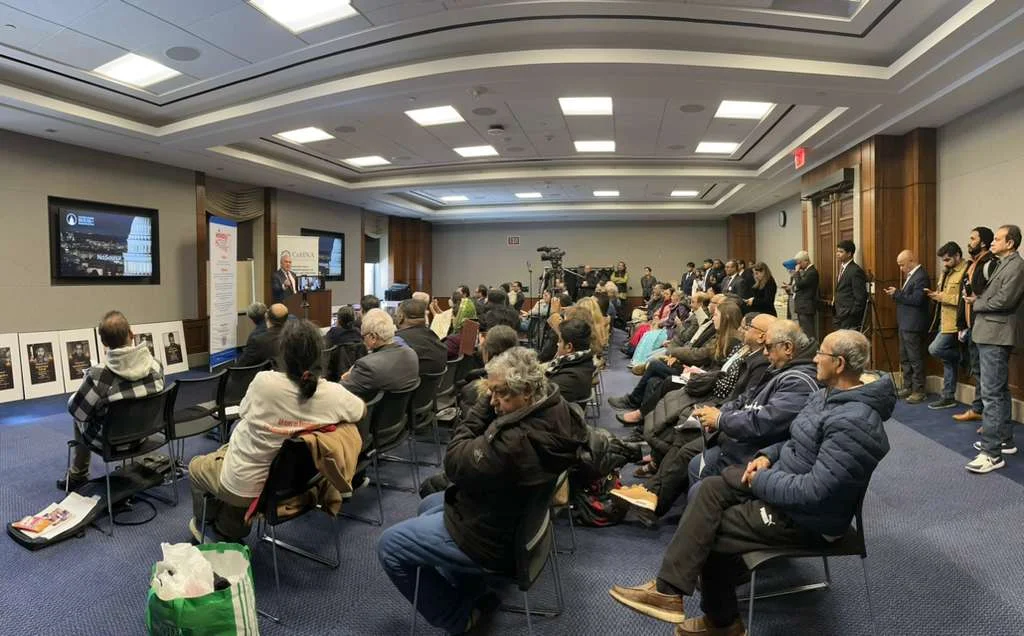
The Coalition of Hindus of North America (CoHNA) and HinduACTion convened a congressional briefing to present testimony on what they described as escalating “persecution of religious minorities” in Bangladesh under Chief Advisor Muhammad Yunus. The event took place ahead of what the organizations called a “deeply contested” national election scheduled for February 12.
According to a February 11 statement from CoHNA, the briefing featured journalists, human rights advocates, survivors, and young members of the Bangladeshi Hindu diaspora. Speakers described what they characterized as a worsening climate of fear, institutional breakdown, and impunity.
“We need to listen to victim voices”, said CoHNA board member Sudha Jagannathan, citing concerns about state failure in Bangladesh. “Silence is not an option and the congressional briefing is one important way to draw attention to the pogrom underway.”
The statement said speakers presented data and urged Congress and the U.S. State Department to publicly condemn the violence in Bangladesh, hold congressional hearings, designate Bangladesh as a Country of Particular Concern, designate the Jamaat-e-Islami as a foreign terrorist organization, and apply Magnitsky sanctions on Yunus.
Michael Rubin, senior fellow at the American Enterprise Institute, delivered the keynote address and called for sanctions against Yunus under the Global Magnitsky Human Rights Accountability Act, which authorizes the U.S. government to freeze assets and deny entry to foreign individuals accused of human rights violations.
Rubin also compared what he termed an “Islamist crisis” in Bangladesh to developments in Turkey and Iran. He cautioned that the U.S. risks repeating what he described as a mistake made in Myanmar by embracing Aung San Suu Kyi, whose commitment to liberal principles he called “a complete fabrication,” according to the statement.
Congressional Engagement
Rep. Tom Barrett (R-MI), a former U.S. Army officer, acknowledged that while major battlefronts have wound down globally, extremist threats persist. “I know that’s a big reason why you’re here today. I encourage you to continue to advocate, and I appreciate the awareness that you’re raising to bring about a shift in policy,” he said.
Rep. Suhas Subramanyam (D-VA) questioned whether the February 12 elections would be “truly free and fair,” noting they would proceed without participation from Sheikh Hasina’s Awami League, which has been banned since May 2025. The party’s student wing was declared a “terrorist organization” in October 2024.
In a recorded message, Samuel Brownback, former U.S. Senator and co-chair of the International Religious Freedom Summit, spoke about the broader implications of state-sanctioned violence against minorities. “If Bangladesh goes in the wrong direction, you’re going to see them drive out most of their religious minorities,” he said.
The event drew more than 70 attendees, including staff from the offices of Sen. Cory Booker (D-NJ), Rep. Mike Levin (D-CA), Rep. Young Kim (R-CA), and Rep. David Min (D-CA), as well as diplomatic officials. Organizers described the turnout as reflecting “broad legislative and diplomatic concern” over the “deteriorating human rights” situation in Bangladesh.
Witness Testimony
Two witnesses, identified as SriRam and human rights advocate Shubho Roy, shared personal accounts of living as Hindus in Bangladesh. SriRam spoke under an alias for security reasons.
Both said they were in the country in December 2025, when they reported heightened tensions, the statement pointed out.
In a recorded testimony, SriRam described what he characterized as coordinated violence and institutional takeover by Islamist groups. He recounted an incident in which his mother was surrounded by neighbors who allegedly chanted that Hindus were traitors and should leave the country. He also said his brother, a doctor, saw his family’s hospital taken over and now faces ongoing threats due to his religious identity.
Roy testified: “I witnessed it, I went through the trauma. From 1971 till today—we are facing the same. They are going after Hindus. They’re targeting minorities.”
Both witnesses warned of what they described as an existential threat. “Hindus will not survive another decade in Bangladesh,” SriRam said. “We will be erased from our homeland.”
Diaspora Youth Advocacy
Several young members of the Hindu diaspora also addressed the briefing.
Ritvik Hari, a policy analyst at CoHNA, called on Congress to publicly condemn the violence, hold hearings, and designate Bangladesh as a Country of Particular Concern.
Puja Debi, a student at Stony Brook University and co-founder of Bengali Hindus of New York City, said she began documenting reported attacks after observing what she described as limited mainstream coverage.
Pramit Acharjee, a senior at Bronx High School of Science, alleged that “minority families are being forced to vote a certain way, and they are killed or displaced if they do not comply.”
Swastika Biswas, a Queens high school student, emphasized the role of rhetoric in fueling violence. “When words strip people of their humanity, violence follows.”
Sayan Shil, a New York-based engineer, described what he called the collapse of “psychological safety” for minorities in Bangladesh.
Expert Warnings
According to the CoHNA statement, multiple speakers documented what they termed a “systematic breakdown” of state institutions and “complicity” of security forces in “violence against minorities.”
Priya Saha of the South Asian Minorities Collective cited cases she said pointed to state involvement, including the killing of Hindu police officer Santosh Chowdhury, garment worker Deepu Chandra Das, and a crackdown in Hazari Goli in which more than 80 peaceful Hindu protesters were reportedly beaten and arrested.
Arifa Rahman Ruma, associate professor at Bangladesh Open University, said Islamist militants had been released from prison with indemnity. Farida Yasmin, president of the National Press Club of Dhaka, described what she called the dismantling of a free press, including attacks on newspaper offices in December 2025.
Rana Hassan Mahmud of the Center for U.S.–Bangladesh Relations warned that Bangladesh was heading toward “a sham election with predetermined results.” He cautioned that by allowing Yunus to remain in power, “we are enabling the creation of a new hub of terrorism whose repercussions will extend far beyond Bangladesh’s borders.”
Utsav Chakrabarti of HinduACTion described the situation as historically significant, warning that “the ongoing pogrom risks escalating into a full-scale repeat of the 1971 genocide—wherein, over the course of 10 months, millions of Hindus were systematically targeted and slaughtered in an orgy of state-backed violence.”
He urged the U.S. to hold Jamaat-e-Islami accountable, stating that it is “the very party that collaborated with the Pakistan Army in perpetrating the 1971 genocide, and its return to influence poses a grave threat to regional stability.”
The briefing was part of what CoHNA described as an ongoing grassroots campaign across North America aimed at raising awareness and advocating for Hindus in Bangladesh.
Related posts:
 South Asian Hindu Americans Protest Near the White House Demanding Justice for Hindus in Bangladesh
 CoHNA Hosts 4th Annual Hindu Day of Advocacy at U.S. Capitol, Highlights Rising Hindu American Voice
 Hindu groups and US lawmakers condemn violence against Hindus in Bangladesh
 Hindu American groups express concern over the plight of Hindus in Bangladesh