Join WhatsApp Channel

In my colony, when everyone is in a rush to leave for office in the morning, there is always a ruckus. The subject: Wrong car parking and blocking exit points of others’ cars. People not only do not follow parking lines, but they would also engage the hand brake so that the cars behind cannot come out. No civic sense or sensitivity towards others.
A couple of hours later, the high decibel voices switch sides. This time, the commotion originates from woman residents taking out their ire on the anonymous, as if there was a disclaimer saying, ‘To Whomsoever This May Concern.” This outburst comes up for a totally different reason. Some families drop their trash (Ghar ka Kachra) in the staircase or near the ground floor entrance. The result is dogs and monkeys (who also reside in our colony, pun unintended) come and make a mess of those trash packets. Again, no civic sense. Read that as Who cares?
Thanks to government apathy and some activism by ambitious people, walking doggies within the colony has become common. That is fine. What is not is that they just choose any block and let their doggie’s poop or relieve themselves just anywhere, and of course car tires are their favorite. The owners of the pets don’t give a … well, you know that stuff. No trace of civic sense here as well.
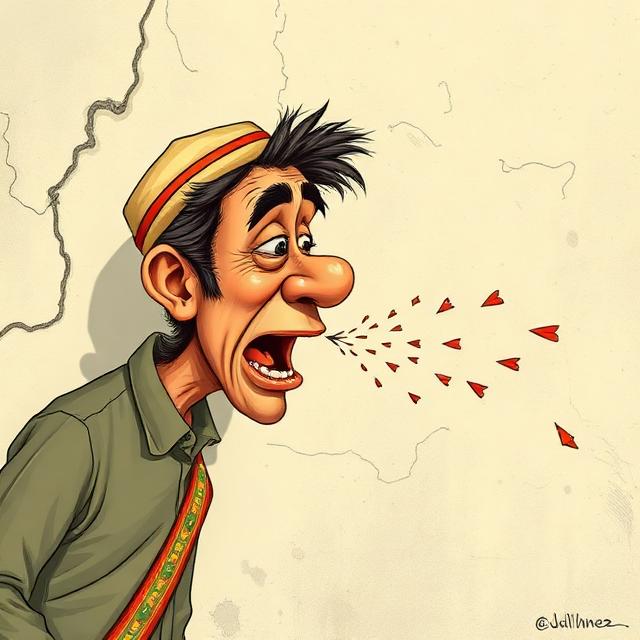
Defacing walls with posters and spitting Paan on corners, walls and just about anywhere is increasing at a rate higher than India’s fiscal deficit. This morning, while driving to office, there was considerable amount of traffic, so every car was going slow motion. In about 5-6 minutes, I saw the cab driver before me spitting Paan liquid on the road at least 8 times. Who can stop him, baap ka rasta hai. Absolutely no civic sense.
These are just a few snapshots of the apathy people have towards rules and other people’s discomfort, inconvenience and annoyance.
But these responsible citizens cannot be blamed in isolation. We, Indian citizens by nature have a rebellious instinct (in a very negative way), built into our system from birth. Traffic light signals are supposed to be violated, the entire stretches of roads have to be littered by either spitting Paan, or food leftovers or empty food packets either while sitting in the roadside or tossed out the car window. Government buildings in Delhi made a valiant attempt to address this.
Their intelligent move was putting tiles with pictures of gods on staircases so that it will deter people from relieving their mouths. Even that did not work in a nation where religion is a priority. There is much more, like parking a car anywhere in the road, and honking when the remaining lanes have not a single vehicle. I am not even talking about driving on the roads which will take a full new story.
Who has to be blamed for this? The residents themselves. The government too, to some extent. It is basically the mindset that makes our bodies go on an Auto Pilot and commit these atrocities without blinking an eye. Which is why every overseas visitor brings in a stack full of hankies or masks when they travel around India and takes back horror stories on what they see here.
Recently, I went to Tokyo, and I sincerely felt that I was in a different planet. The roads were sparklingly clean, and despite that, cleaning trucks were brushing what was already very clean surfaces even further. In a bus, I saw another part of Japanese brilliance. In the bus, I was a bit intrigued to see a small, bio-degradable bag, tucked into the front seat back pocket. And that was in every seat.
I asked a local, what was the purpose of that. What he said really shook me. Those packets were placed by the previous occupants of those seats to ensure that if you had some eateries or knick knacks during your journey, the leftovers should be put in that bag at the end of the journey, and one was obliged to take out the packet and place a new one. What a beautiful gesture and a message that we care for our country.
Sorry to say, I myself was taken to task for being a true Indian, in Japan. While travelling on the Shinkanshen train, like a true Indian, I was talking a bit loud. The Ticket Inspector came in thrice and sked me to either lower my volume or just shut up. All these very politely too.
Back home, the chaos continues. A couple of days later, my wife and I were standing in a queue at a bill counter to pay for our wares. There were about two people before us. Suddenly, a couple came, pushed their way through and reached the payment counter and demanded that they should be attended first.
Where do these people come from?
Obviously, this comes from education and family values for those who are educated. But even here, there is always a Locha. An IIM-A graduate and I were having cutting chai at the roadside. When we finished, he just tossed the mud cup on the road. The dustbin was just a few feet away. While I was a bit shocked, it just did not matter to him – BAU.
But there is a silver lining though. The Gen Z and Gen Alpha, with exposure to the good practices of Europe or USA, have started recognizing the virtues of good civic sense. What is even better is that they do not care about Log Kya Kahenge, they are driven by conscience and how they will feel about their own actions at the end of the day.
The Postscript: Last week, I was in Indore in Madhya Pradesh. I was amazed at how clean the city was. The roads were almost dirt and trash less and the road brushing trucks were in operation even at 8 pm. One of the city’s attractions is a place called Chappan Dukan, which literally means 56 shops. And most of them were food joints. In other words, it was a recipe for disaster.
But surprise, surprise, despite the madness of those 56 food havens, not a single drop of trash or leftovers was seen on the ground. When I asked for a tissue, the man at the counter said that the government had banned tissues because people just throw it anywhere. Wow! Who thinks like this in today’s world of consumerism?
The role model is here right in our hinterland. So, there is no excuse for the rest of India not to emulate it. Even supposedly evolved metros like Delhi and Mumbai are nowhere close to this. So, who should push this among people? Of course, the government can help with legislation, but we, the larger mass of people, have to take the initiative on our own hands.
Finally, to end, I quote Indore’s most famous name, the late Rahat Indori:
“हम से पहले भी मुसाफ़िर कई गुज़रे होंगे, कम से कम राह के पत्थर तो हटाते जाते।“
(“Hum se pehle bhi musafir kai guzre honge, Kam se kam raah ke patthar to hataate jaate.”)
Disclaimer: The opinions and views expressed in this article/column are those of the author(s) and do not necessarily reflect the views or positions of South Asian Herald.