Join WhatsApp Channel

The U.S. State Department’s October 2026 Visa Bulletin, opening the 2027 fiscal year with a fresh allocation of immigrant visa numbers, offers some filing opportunities for South Asian immigrants but also underscores the structural divide confronting Indian professionals compared with applicants from China and other South Asian countries.
The bulletin shows that while the arrival of new fiscal-year visa numbers has moved several employment- and family-sponsored categories forward, Indian applicants remain subject to exceptionally long waits in the employment-based second and third preference categories. By contrast, applicants born in Pakistan, Bangladesh, Nepal and Sri Lanka are generally charged to the broader “All Chargeability Areas” pool, where employment-based cutoffs are substantially ahead of India’s.
The October bulletin also illustrates a different pattern for mainland-born Chinese applicants. China faces substantial employment-based backlogs of its own, but its cutoff dates in EB-2 and EB-3 remain years ahead of India, while Chinese investors face a much older queue in the unreserved EB-5 category.
The distinction is important for the South Asian diaspora because visa eligibility is determined primarily by country of birth, or chargeability, rather than citizenship. A Pakistani- or Bangladeshi-born professional working in the United States, for example, is generally not placed in the India-specific employment queue merely because that person may hold Indian citizenship or work for an Indian company.
India’s employment backlog remains the central South Asian problem
For Indian-born professionals, the October bulletin leaves the most consequential employment categories substantially behind both China and the rest of the world.
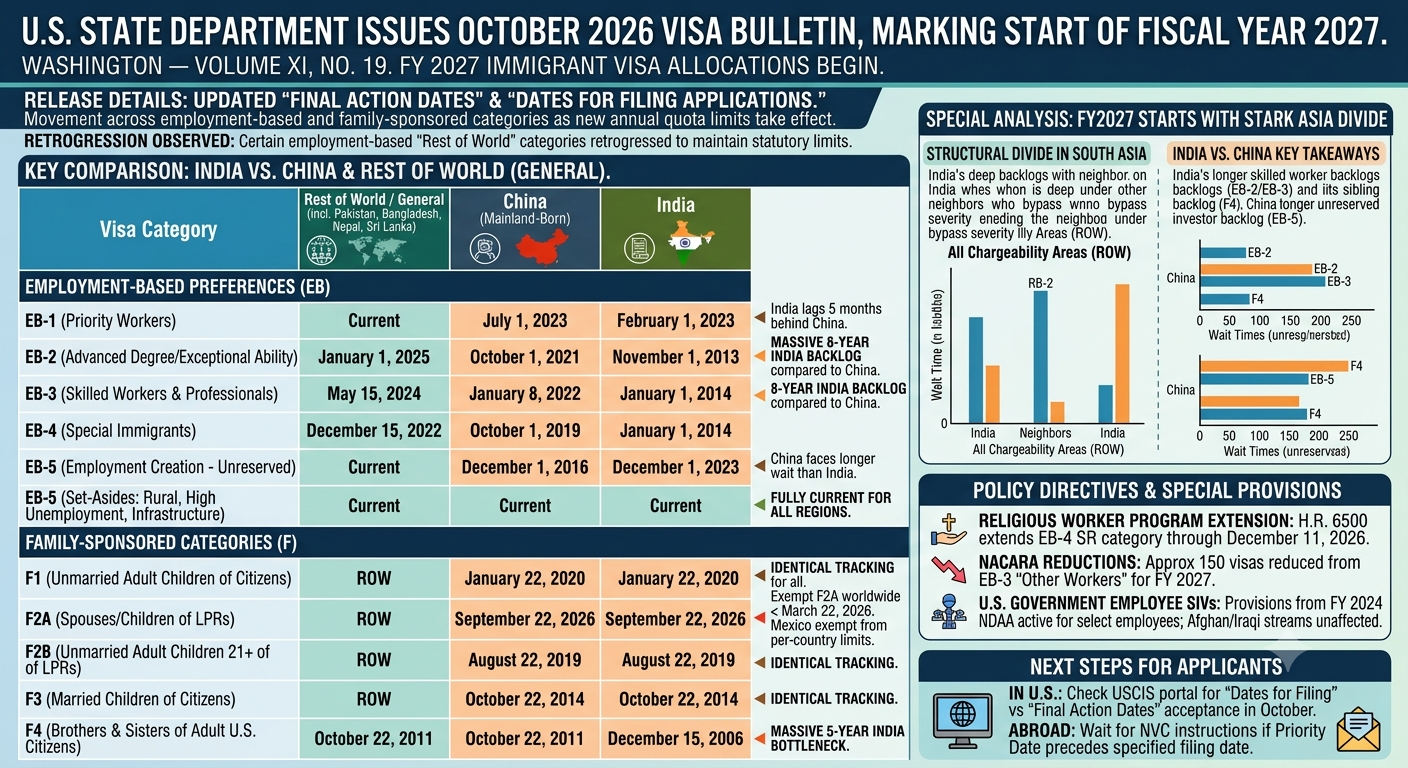
The EB-1 category for priority workers is current for most countries, but the final action date for India is February 1, 2023, compared with July 1, 2023, for China and current status for most other countries.
The gap becomes much wider in EB-2, the principal category for professionals with advanced degrees and people of exceptional ability. India’s final action date is November 1, 2013, compared with October 1, 2021, for China and January 1, 2025, for most other countries.
That represents almost eight years between India’s and China’s cutoff dates and more than 11 years between India and the general worldwide cutoff.
The EB-3 category shows a similar pattern. India’s final action date is January 1, 2014, against January 8, 2022, for China and May 15, 2024, for most other countries.
For highly skilled South Asian workers who are not India-born, the difference can therefore be decisive. Pakistan-, Bangladesh-, Nepal- and Sri Lanka-born applicants generally fall under the worldwide category and face the substantially newer EB-2 and EB-3 dates rather than the India-specific queues.
That does not mean applicants from those countries have an unrestricted path to green cards. Their petitions still compete for numerically limited visas and can become subject to worldwide demand. The distinction is that they are not currently confronting the extraordinarily old India-specific cutoff dates created by demand from one heavily oversubscribed country.
China presents a different immigration squeeze
China provides the most useful comparison because mainland-born Chinese applicants, like Indians, are subject to a separate chargeability column under the U.S. immigration system.
But the October numbers show that the two countries’ backlogs are not symmetrical.
In EB-2, China’s cutoff of October 1, 2021, is nearly eight years ahead of India’s November 1, 2013. In EB-3, China’s January 8, 2022, cutoff is similarly far ahead of India’s January 1, 2014.
China’s advantage reverses in EB-5, however. The final action date for the unreserved investor category is December 1, 2016, for mainland-born Chinese applicants, compared with December 1, 2023, for India. Most other countries remain current in the unreserved category.
The EB-5 set-asides tell another story: rural, high-unemployment and infrastructure allocations are current for India, China and other chargeability areas. The set-asides represent 32 percent of the EB-5 annual allocation—20 percent for rural areas, 10 percent for high-unemployment areas and 2 percent for infrastructure projects.
For South Asian investors, that makes the set-aside channels particularly relevant going into FY2027, although eligibility requirements, investment rules and USCIS adjudication remain separate issues from visa-number availability.
Family immigration offers less differentiation
The India-China divide is much less pronounced in most family-sponsored categories.
The October final action dates for F1, unmarried adult sons and daughters of U.S. citizens, are January 22, 2020, for India, China and the general chargeability area.
F2A, covering spouses and children of lawful permanent residents, is September 22, 2026, for India, China and most countries, although Mexico has a separate March 22, 2026, cutoff.
F2B is August 22, 2019, and F3 is October 22, 2014, for India, China and the general chargeability area.
The sharp exception is F4, the sibling category for adult U.S. citizens. India’s final action date is December 15, 2006, compared with October 22, 2011, for China and the general chargeability area.
For the South Asian diaspora, the F4 difference is particularly relevant because family-based migration chains can span generations, leaving U.S. citizens waiting years to reunite with siblings born in India.
FY2027 begins with opportunity — but not a solution to the backlog
The October bulletin makes clear that the opening of a new fiscal year does not eliminate accumulated demand.
The INA establishes a worldwide annual minimum of 140,000 employment-based preference immigrants and a minimum family-sponsored preference level of 226,000. The statutory per-country limit is generally 7 percent of the combined annual preference limits, although the law contains mechanisms that allow unused numbers and certain categories to be allocated differently. The State Department currently identifies China-mainland born, India, Mexico and the Philippines as oversubscribed chargeability areas.
That architecture is at the heart of the Indian backlog. India’s large population of employment-based applicants means that demand far exceeds the number of visas that can ordinarily be allocated to the country under the statutory framework. New fiscal-year numbers can therefore move the dates, but cannot by themselves resolve the underlying imbalance between demand and supply.
The State Department has also warned that some worldwide employment-based categories have retrogressed in October despite the arrival of new FY2027 numbers, reflecting the need to keep issuances within quarterly and annual statutory limits. It said demand would continue to be monitored and dates adjusted when necessary.
That warning is important for applicants who interpret the beginning of the fiscal year as a guarantee of steady forward movement. Visa Bulletin dates remain an allocation mechanism, not a timetable for individual green-card approval.
Filing opportunities may be more significant than the final dates
For applicants already inside the United States, the distinction between Final Action Dates and Dates for Filing is critical.
The October bulletin’s employment-based Dates for Filing chart gives India a date of July 1, 2024, for EB-1, January 15, 2015, for EB-2, and January 15, 2015, for EB-3. China’s corresponding dates are July 1, 2024, January 1, 2023, and April 1, 2024. For the worldwide category, the dates are current for EB-1, March 15, 2026, for EB-2 and August 1, 2024, for EB-3.
These dates can create a valuable filing window even when a green card itself cannot yet be approved. For employment-based adjustment-of-status applicants, filing an I-485 can potentially provide access to associated benefits and greater flexibility while the underlying priority date waits for final action, subject to USCIS rules and individual eligibility.
The State Department bulletin specifically directs applicants to check USCIS to determine which chart the agency will permit for adjustment-of-status filings during October.
What it means for South Asian employers and families
The longer-term implication is that the immigration backlog is increasingly becoming an issue not merely for individual applicants but for the U.S. labor market and South Asian diaspora communities.
Indian technology professionals who entered the United States on temporary employment visas can remain tied to employers for years while waiting for their employment-based green cards. Families can face prolonged uncertainty over children’s immigration status, career decisions and international travel.
For employers, long green-card queues can complicate retention of experienced foreign-born workers because the employment-based sponsorship process becomes a years-long commitment rather than a predictable transition to permanent residence.
The contrast with other South Asian birth countries also has strategic consequences for highly skilled migration. A worker’s country of birth can produce dramatically different green-card timelines even when two employees have identical qualifications, work for the same company and perform the same job.
That disparity is likely to remain a central issue for Indian-American advocacy groups, technology employers and immigration lawyers in FY2027.
The October bulletin therefore provides some immediate movement, particularly through the new fiscal-year allocation and the filing dates, but it does not fundamentally change the mathematics behind India’s employment-based backlog.
For the Indian diaspora, the central question entering FY2027 is consequently not whether the October bulletin has moved the dates, but whether the U.S. immigration system can eventually increase visa supply or otherwise alter the country-specific allocation structure sufficiently to bring India’s decades-long employment queues closer to the timelines faced by workers born elsewhere.
For Pakistanis, Bangladeshis, Nepalis and Sri Lankans in the United States, meanwhile, the October bulletin reinforces the importance of country of birth as a determinant of immigration timing: they generally remain in the worldwide pool rather than the India-specific queue, although worldwide demand and future retrogression can still change that advantage. China demonstrates that oversubscription can produce substantial backlogs even outside India, but the October data show that the severity and location of those bottlenecks differ considerably by category.
FY2027 thus begins not with a uniform reset of the U.S. green-card system, but with a sharply differentiated landscape in which India remains the deepest employment-based bottleneck among the major Asian chargeability areas, China faces significant but category-specific queues, and much of the wider South Asian diaspora continues to benefit from the broader worldwide allocation pool.