Join WhatsApp Channel

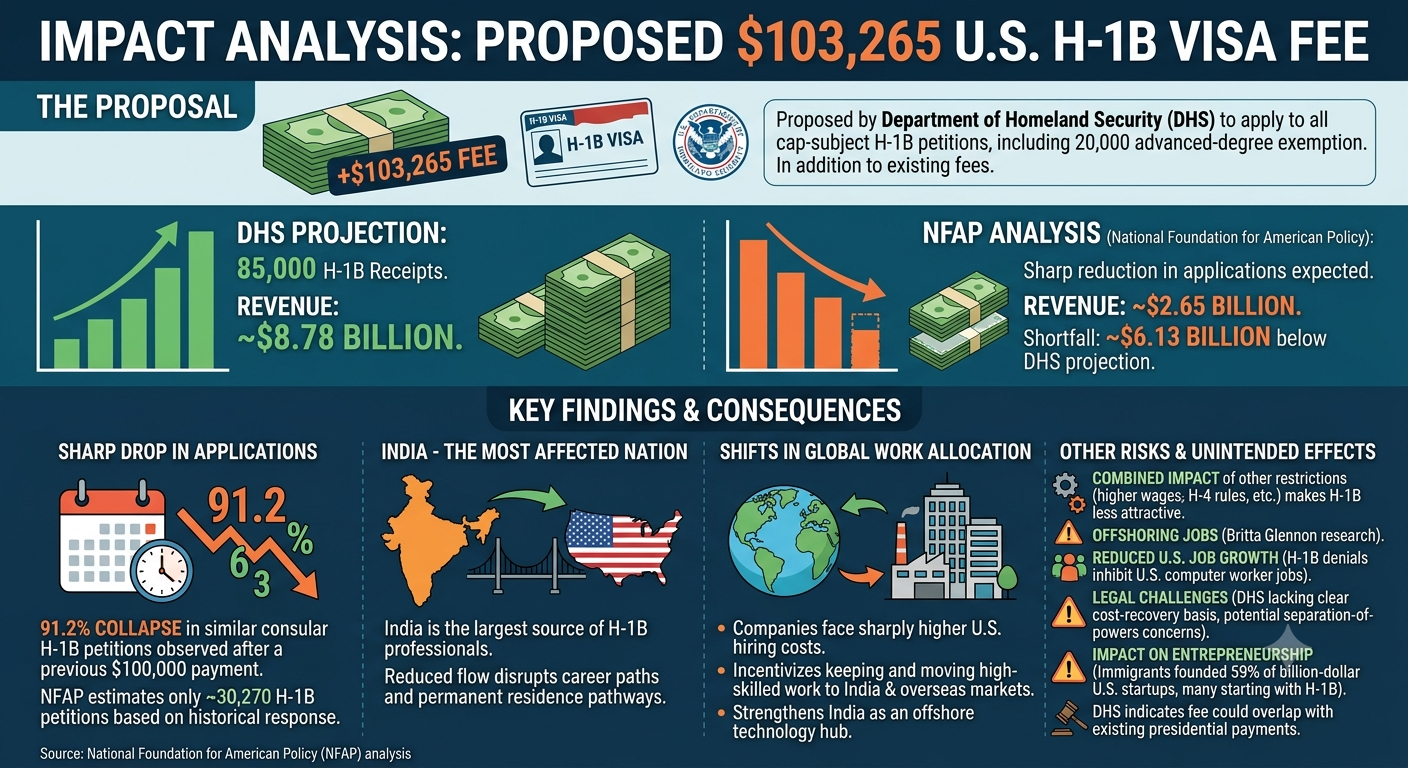
A proposed $103,265 U.S. fee on new H-1B visas could sharply reduce the flow of Indian technology professionals to the United States, while encouraging companies to keep more high-skilled work in India and other overseas markets, according to an analysis by the National Foundation for American Policy (NFAP).
The fee, proposed by the Department of Homeland Security, would apply to all cap-subject H-1B petitions, including the 20,000 advanced-degree exemption, and come on top of existing fees and other payments. NFAP argues that the measure could produce far fewer applications than the administration expects, undermining its projected revenue while altering how companies allocate skilled jobs globally.
DHS has projected 85,000 H-1B receipts and about $8.78 billion in revenue from the fee. NFAP, however, estimates that only about 30,270 petitions could be filed if the 91.2 percent collapse in initial consular H-1B petitions seen after the previous $100,000 payment is applied to the latest registration numbers. That would generate about $2.65 billion, roughly $6.13 billion below the government’s projection.
The potential impact is particularly acute for India, which has long been the largest source of H-1B professionals. A sustained reduction in U.S. placements would affect not only Indian technology workers but also the business model connecting Indian IT services companies, multinational technology firms and the expanding network of global capability centers in India.
NFAP’s analysis points to the sharp behavioral response already visible after the $100,000 payment introduced in September 2025. Comparable 245-day periods showed initial consular I-129 H-1B petitions falling from 13,823 to 1,212, a 91.2 percent decline.
The latest H-1B registration pool had 343,981 eligible registrations for fiscal 2026. Applying that decline would leave about 30,270 potential petitions. NFAP cautions that even this may overstate demand, noting a White House proclamation in September 2026 that said more than 700 petitions had paid the $100,000 charge since its introduction.
For Indian professionals, the implications extend beyond individual visa costs. A smaller H-1B channel could reduce opportunities for workers to move to the United States, build careers and eventually pursue permanent residence. At the same time, companies facing substantially higher U.S. hiring costs could have greater incentives to locate work where skilled employees are already available.
That could strengthen India’s position as an offshore technology and engineering hub, but with a different employment mix. More work may remain in India, while fewer Indian professionals gain direct experience in U.S. operations and fewer workers make the transition from temporary visas to permanent residence.
The proposed fee comes as the administration is pursuing other restrictions affecting skilled foreign workers, including higher prevailing-wage requirements, possible changes to H-4 employment authorization and potential restrictions on international students and other employment pathways. NFAP argues that the combined effect could make the H-1B route substantially less attractive rather than merely more expensive.
The economic debate also extends to whether foreign skilled workers displace U.S. employees. DHS cited research by economist George Borjas indicating that H-1B workers earn 16 percent less than comparable U.S. workers. Economist Ethan Lewis Clemens, cited by NFAP, disputes that interpretation and says that after additional controls H-1B workers earn about 6 percent more, while identifying methodological concerns with the Borjas analysis.
Research cited by NFAP also suggests restrictions can have unintended effects. Britta Glennon has found that tighter H-1B restrictions can encourage companies to offshore jobs. Other research cited by NFAP found that H-1B denials inhibited job growth for U.S.-born computer workers, while another study linked H-1B employment with lower unemployment and faster earnings growth among college graduates.
For India, the longer-term implications could also reach entrepreneurship. NFAP says immigrants founded or co-founded 59 percent of U.S. privately held startups valued at more than $1 billion, with many founders having initially entered through the H-1B system before obtaining green cards.
The proposed fee is also headed for a legal challenge. NFAP argues that DHS has not established a clear cost-recovery basis for a charge of this scale. It also points to a June 2026 ruling by U.S. District Judge Leo T. Sorokin that vacated the separate $100,000 H-1B payment and raised separation-of-powers and taxing-power concerns.
The outcome could therefore reshape more than the annual H-1B intake. For India and the wider South Asian talent pipeline, the central question is whether the United States remains a destination for globally mobile skilled workers when the cost of bringing them in rises sharply, while companies have increasingly viable alternatives in India and other offshore centers.
DHS has also indicated that the proposed $103,265 fee could apply in addition to any presidential H-1B payment that remains in force, leaving employers potentially facing overlapping costs.