 Join WhatsApp Channel

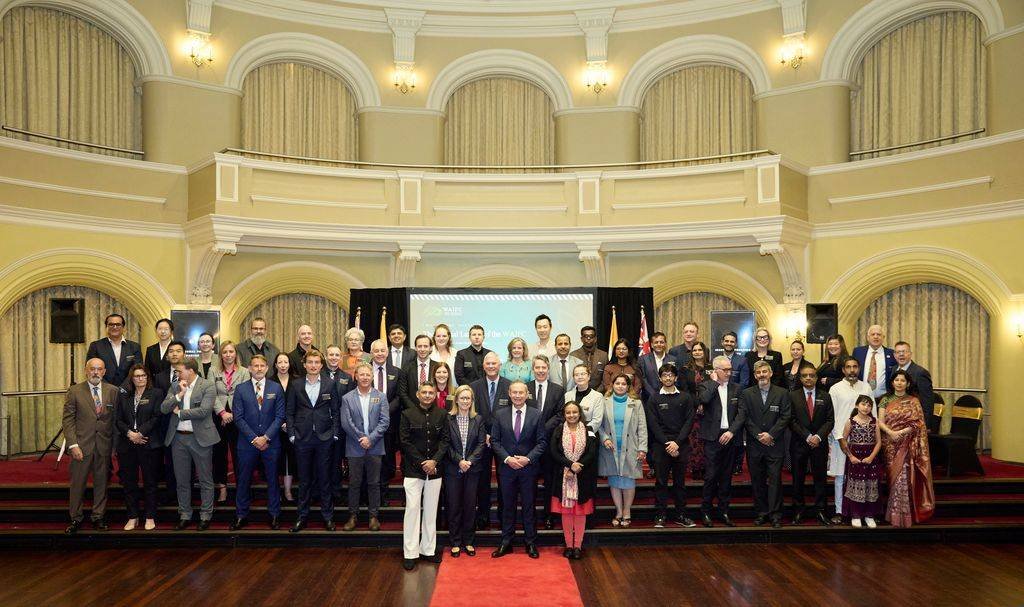
Nearly a century after Perth’s Fearless Nadia, the West Australian Indian Film Council (WAIFC) launched at the Government House Ballroom in Perth on September 11, 2026, with her story providing a fitting historical backdrop. Mary Ann Evans, the Perth born woman behind that name, moved to India in the early twentieth century and, by the 1930s, was known there as Fearless Nadia, one of the pioneering figures of early Indian action cinema.
Master of ceremonies for the day was Michael Carter, head of International Trade and Investment Services at the Chamber of Commerce and Industry of Western Australia and an International Advisor to WAIFC. Carter was posted to Chennai as a trade commissioner earlier in his career and drew on that experience more than once through the morning. He told the story of Fearless Nadia, the screen name Evans took after moving from Perth to India, where she became known for playing a masked, whip wielding adventurer in a string of 1930s action films, a genuinely unusual role for a woman at the time, in India or anywhere else. It’s that history WAIFC points to as its own inspiration: according to the council’s account of its founding, Evans’ grandnephew, the choreographer Shiamak Davar, now serves as its Founding Cultural Connect Ambassador, an honor WAIFC ties to his National Film Award for choreography and his work choreographing two Commonwealth Games ceremonies.
Carter had his own, lighter brush with that same world. While posted in Chennai, he once went to collect his son from an after-school party and got chatting at the door with a friendly stranger, only to find out that evening, from his own wife, that the stranger was Kamal Haasan, one of Indian cinema’s biggest stars. It echoed a point he returned to through the morning about creative industries. “It comes down to people-to-people engagement, and that’s what creative business is all about,” he said, describing their role in “connecting people, and connecting nations.” Later, introducing Nilesh Makwana, WAIFC’s Chair and Director, Carter recalled once describing him at a book launch by three P’s, perseverance, passion, and purpose, and said he’d update that for WAIFC’s launch to three C’s: connection, culture, and cinema.
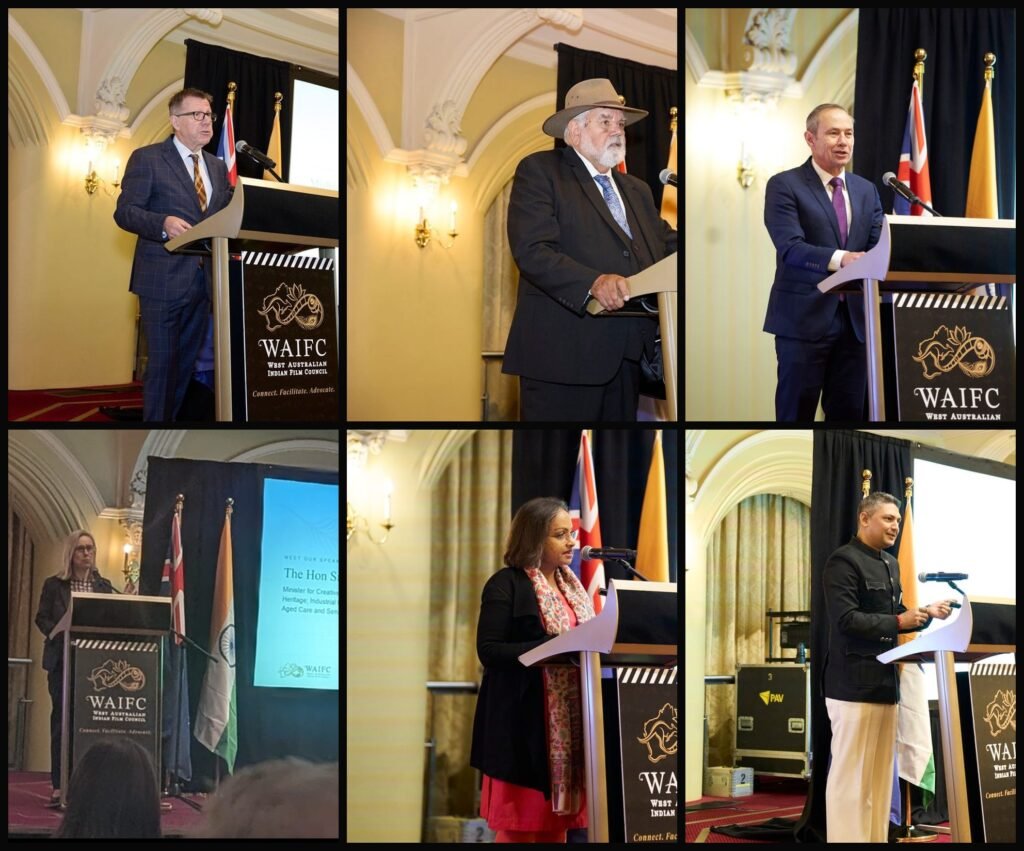
Makwana has spent close to a decade building cross cultural programs in Perth, including West Tech Assemblage and the Borderless Gandhi initiative. In his own remarks, he said Western Australians have engaged with India through its food, cricket, and culture for years, but not yet, to the same degree, its films. “That’s where the real connection happens,” he said, describing the goal as movement in both directions, more Western Australians traveling to India to collaborate and tell stories, more of India’s industry engaging with Perth. “What we’re building here is more than co-production,” he said. “It’s about culture and the arts, performing arts, music, exhibitions, real cultural connection, of which film is only a part.”
Premier Roger Cook welcomed the establishment of WAIFC, linking its potential to the 2023 Australia India Audiovisual Co-production Agreement. Screen content has “an extraordinary ability to build connections between people and places,” Cook said, and the council “can be the bridge between our two screen industries.” He noted that India is Western Australia’s seventh largest trading partner, with two-way trade reaching AU$7.72 billion in the last financial year and pointed to the newly completed AU$290 million Perth Film Studios, which includes four sound stages and more than 8,200 square meters of production space, with a backlot Cook said is 22 percent larger than the turf at Optus Stadium and the largest in the Southern Hemisphere.
Creative Industries Minister Simone McGurk said the state was backing that infrastructure with record investment in the screen sector. “We’re sending a message that Western Australia is open for business,” she said, noting that free tickets to this week’s Perth Film Studios open day were claimed within four hours of release.
Kajari Biswas, Consul General of India to Western Australia and the Northern Territory, described WAIFC as the “brainchild” of Makwana and a potential “pivot point in India-Western Australia relations.” She said the council could draw on Perth’s Indian community, many of whom retain organic ties to film hubs including Mumbai, Andhra Pradesh, Kerala, Tamil Nadu, and Punjab, and pointed to incentives already built into the Australia India co-production framework, including reimbursement caps of up to 40 percent for qualifying international projects in India.
Bruce Reynolds, Lord Mayor of Perth, confirmed the City of Perth as an inaugural WAIFC member. Reynolds said that Perth was a natural gateway between Australia and the Indian Ocean region, and that the city was working toward Screenwest accreditation as a film friendly destination.
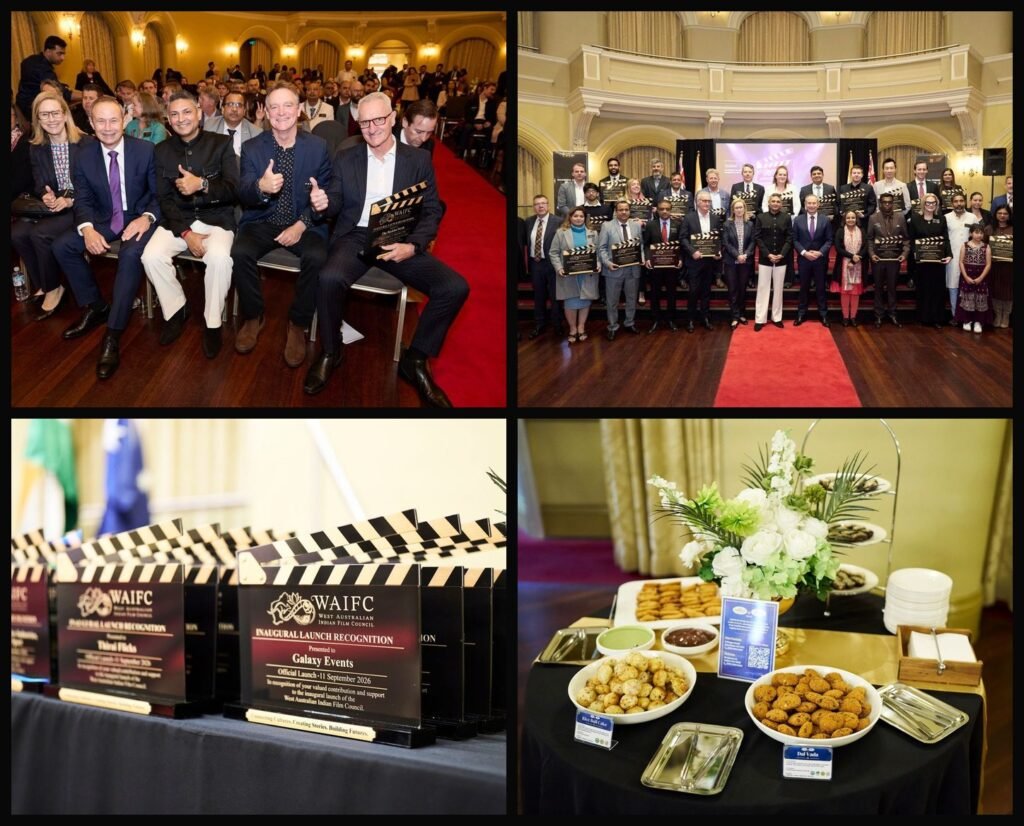
Behind Makwana sits a governance team built out over the past year: Ian Hale as Deputy Chair and Director, Timothy Duffy as Director, Christopher Watson as Board Advisor, Neha Shinghal as Secretary, and Malav Oza as Treasurer, alongside a Screen Industry Advisory Council, a Strategic Advisory Council, and dedicated First Nations and youth advisory groups. It is considerable infrastructure for a council only just formally launched, and Makwana used his closing remarks to make clear that building the organization would be a longer-term undertaking.
WAIFC’s inaugural founding partners include the Consulate General of India in Perth, the Department of Creative Industries, Tourism and Sport, Tourism Western Australia, the University of Western Australia, and NiA Pharma, with the City of Perth, Murdoch University, the Australia India Business Council, and the Chamber of Arts and Culture WA among its strategic partners.
Makwana said he plans to travel to Mumbai next week, where he will personally deliver a memento marking the Government House launch to Western Australia’s trade and investment representatives in India. It will be an early test of the task WAIFC has now set itself: turning the connections celebrated at Government House into enduring relationships, and ultimately, projects.
It was a note Noel Nannup had already struck before anyone else took the podium. The Whadjuk Noongar elder, who opened the morning with the Welcome to Country, told the room that his people are “the greatest and longest storytellers on this planet.” WAIFC, in its own way, is now in that same business.
As Makwana put it: “This is just the start of the journey. It may take years before we see a film actually shot as a result of this council, that’s the nature of this industry, but we can do it together.”
Related posts:
 WA Parliament Highlights Indian Australians’ Contributions at 80th Independence Day Celebration
 Western Australia-India Ties in Focus at India’s 80th Independence Day Reception in Perth
 Australia and India Mark National Days with Flag Raising in Western Australia
 Australia Celebrates 11th International Day of Yoga with Over 55 Events Nationwide
