Join WhatsApp Channel

Perhaps because many members of my family have been lawyers, I have been attracted to autobiographies of people in the legal profession, lawyers and judges both, since my teens. It’s hard to say whose life stories are more interesting because these books usually comprise two elements: experiences on the one hand and ruminations on the law on the other.
There is, however, also a third kind, fortunately in a tiny minority, that makes an autobiographical book like either a solicitor’s brief or a constitutional judgment. Those are very irritating, and I shall avoid them because they remind me of retired cricketers, who should know better, saying how the team should have played. It serves no purpose, and it infuriates the players.
I have taken only a handful below, but there are many more that are well worth reading because they were involved in some major cases. As an astonishing aside, I must note here that of the 13 judges who gave India its absolutely most important legal doctrine in 1973, that of the ‘basic structure’ of the Constitution, only two have written their memoirs. One is Justice HR Khanna and the other is P Jagmohan Reddy. The rest have kept their counsel.
It was Justice Khanna’s judgment that tipped the balance after the justices were tied at six each. The basic structure doctrine saved the country from arbitrary executive-legislature-led changes in the way India had to be governed. He relied on what he called the ‘foundational values’ of the Constitution. In his book recounts how the government tried to negate the Kesavananda Bharati ruling. Another case that he ruled upon has come to be known as the 1976 habeas corpus case. He said in his dissenting judgment that personal liberty could not be suspended when an emergency had been declared.
Another case that has had a huge impact was the SR Bommai case of 1993, in which the Supreme Court curtailed the powers of the central government to dismiss state governments at will, more-or-less. Sadly, none of the nine judges who comprised the constitutional bench has written their autobiographies. Autobiographies by people who make a real difference are always valuable.
Yet another very important case, this time in 2019, was the one about the land in the Ayodhya Ram temple. The Court had to decide who would get it, the Hindus or the Muslims. The then chief justice, Ranjan Gogoi, who headed the five-judge bench, has written his autobiography. He says he told his fellow judges on the bench that although everyone had agreed to a unanimous judgment, it was his idea to have an anonymous one. And that’s what was done.
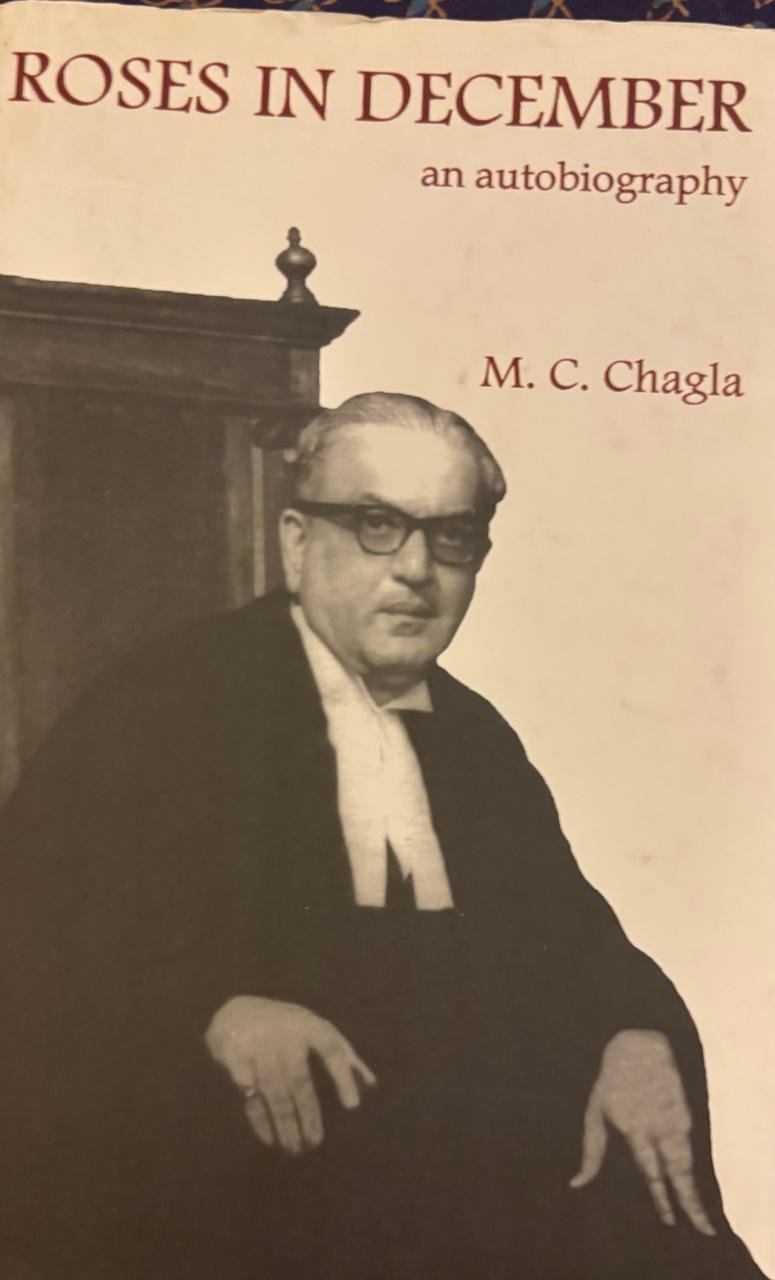
My favorite autobiographies, however, are by Justice M Hidayatullah, who went on to become vice president of India and MC Chagla, who had served as education minister. The reason why I often refer to them is that both remind us of long-forgotten events that have a huge bearing on current events.
Justice Hidayatullah was a part of the 11-judge bench which ruled in 1967 that Parliament couldn’t amend fundamental rights. He also ruled against the government when it tried to abolish privy purses. There were a few other cases from that era which have determined the course of Indian rights. Justice MC Chagla, along with Justice PB Gajendragadkar, who became Chief Justice later, ruled in 1952- yes, 1952- that the law preventing Hindus from indulging in bigamy was valid.
I would be remiss if, in conclusion, I didn’t mention a book that’s not an autobiography but is of great importance because it talks about a centuries-old problem, namely, the conflict between governments and the judiciary. It’s actually the PhD thesis of an American scholar called George H Gadbois Jr who died some years ago.
Gadbois says that the constitutional power of judicial review is a problem for governments, who have sought to curb it. The question is whether it is an absolute power, as the judiciary believes, or a constrained one. Gadbois’s answer is below:
“The ease with which the (Indian) Constitution may be amended… indicates that while the Court’s jurisdiction is extraordinarily wide, its ultimate power is limited… the Constitution means what the Congress party says it means… judicial review has certainly not meant judicial supremacy.”
This was written, sit tight, in 1962!
Disclaimer: The opinions and views expressed in this article/column are those of the author(s) and do not necessarily reflect the views or positions of South Asian Herald.