 Join WhatsApp Channel

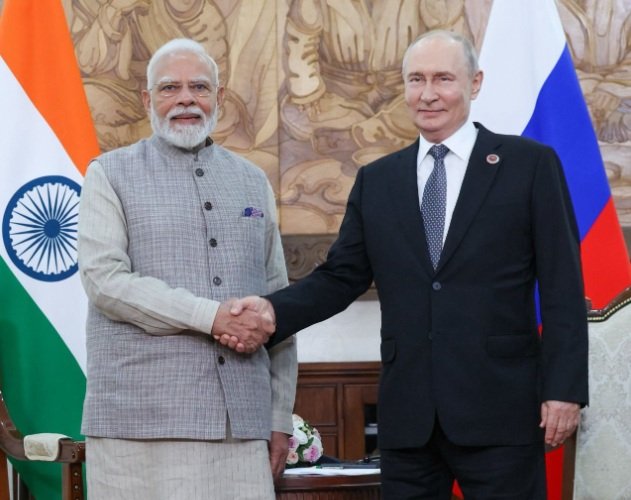
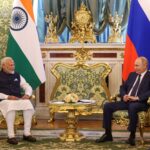
Russian President Vladimir Putin and Indian Prime Minister Narendra Modi are expected to use bilateral talks on the sidelines of the BRICS summit in New Delhi on September 11 to deepen economic and defense ties, while discussing the wars in Ukraine and Iran.
The meeting will focus on expanding Indo-Russian co-operation in areas including nuclear energy, defense production and trade, according to Kremlin spokesman Dmitry Peskov, who was speaking to the Indian media at a presser organized by Russian News Agency Sputnik’s Indian arm. Moscow has also indicated that it is prepared to offer India access to some of its most advanced military technology, including potential co-operation on the Su-57 fifth-generation fighter aircraft.
The BRICS summit, where the leaders of the original members of the organization – India, Russia, China, Brazil and South Africa – will meet along with leaders of a number of other countries which have joined BRICS, such as Iran, Saudi Arabia, Egypt, Indonesia, UAE and Ethiopia, is slated to be held later this week.
“We have very good military equipment. Some of that equipment is the best in the world, and we are ready to share that equipment with our Indian partners,” Peskov told Indian journalists in an online briefing.
New Delhi has a longstanding strategic relationship with Moscow, and the talks come at a time when it is busy managing growing pressure from Washington over trade with Russia. The two countries are also looking for ways to expand bilateral commerce despite financial restrictions imposed on Russia as punishment for its war with Ukraine, which has dragged on since 2014.
Peskov said Moscow was seeking to expand its presence in the Indian market and was gradually drawing down the rupee balances accumulated through the two countries’ rupee-rouble trading arrangements, which India uses to buy crude. New Delhi bought a record 2.82 billion barrels of crude in July this year, or about 55 per cent of all its imports, though that figure dipped to 2.08 million barrels in August, or 45 per cent of Indian imports in that month.
The issue of payments is likely to feature prominently in the wider BRICS discussions. Peskov rejected the description of Russia’s policy as a campaign towards “de-dollarization” saying Moscow was simply seeking payment mechanisms that served its national interests.
Russia now conducts about 90 per cent of its trade with BRICS countries in national currencies, he said.
“We are not in favor of any de-dollarization policy,” Peskov said. “We are simply doing what better corresponds with our national interests.”
His comments come as BRICS members explore alternatives to dollar-based payments, while US President Donald Trump has repeatedly warned the grouping against efforts to undermine the dollar’s international role. The move away from the dollar comes as countries around the world find that pegging their trade to the dollar is sharply inflating bills.
Trade in most commodities and goods has increasingly tended to be settled in dollars since the end of the Second World War, a trend which accelerated in the middle of the 1970s after the oil price shock.
The Kremlin spokesperson Peskov also sought to portray BRICS as part of a broader shift towards a more multipolar international system, arguing that the dominance of the post-Cold War order was weakening.
Ukraine is expected to be another important item on the Modi-Putin agenda, officials here said. India has repeatedly called for an end to the conflict while maintaining close relations with Moscow. Putin’s visit comes as US and Russian officials continue efforts to explore a possible settlement. US envoys Steve Witkoff and Jared Kushner held talks with Putin in Moscow earlier this month as Washington seeks to revive negotiations between Russia and Ukraine.
Peskov said Moscow welcomed “all steps” aimed at ending the war, including those involving India and the US. He reiterated Russia’s position that sanctions against Moscow should form part of negotiations on any eventual settlement.
Earlier last month, Modi had met Putin at Bishkek on the sidelines of the Shanghai Cooperation Organisation summit and pressed for an end to the Ukraine conflict.
“We do want the solution of the Ukrainian conflict by peaceful means, and Russia is open for this process,” he said.
India’s balancing act is complicated by its reliance on Russian energy and defense supplies, as well as by US sanctions and the wider restructuring of global trade. Analysts feel the Modi-Putin meeting offers both sides an opportunity to reinforce economic ties while “signaling that Western pressure has not fundamentally altered their strategic relationship.”
The Iran conflict and its impact on global energy markets are likely to provide another point of convergence. Peskov warned that the continuing conflict around the Persian Gulf was already damaging the global economy and said Russia supported unrestricted commercial shipping through the Strait of Hormuz.
“The situation, unfortunately, and the atmosphere in the Strait of Hormuz are still very tense,” he said, calling free passage for merchant vessels and oil tankers “very important.”
The concern has particular resonance for India, one of the world’s largest energy importers. Rising oil prices and renewed disruption around the Strait have already put pressure on the rupee and India’s external balance.
Peskov also dismissed President Trump’s recent suggestion that the Moon belonged to the US, saying Moscow opposed the privatization of outer space.
“I don’t think that we can support the idea of privatization of space,” he said. “It should be free of that.”
Related posts:
 Ukraine-India Relations: Navigating Historical Ties and Russian Disinformation in a New Geopolitical Era
 Putin’s Delhi Gambit: How a High-Stakes Visit Could Redraw India’s Geopolitical Map
 Putin Lands in New Delhi as India Reasserts Strategic Autonomy Amid Global Pressure
 US expresses concern over India-Russia relationship
