Join WhatsApp Channel

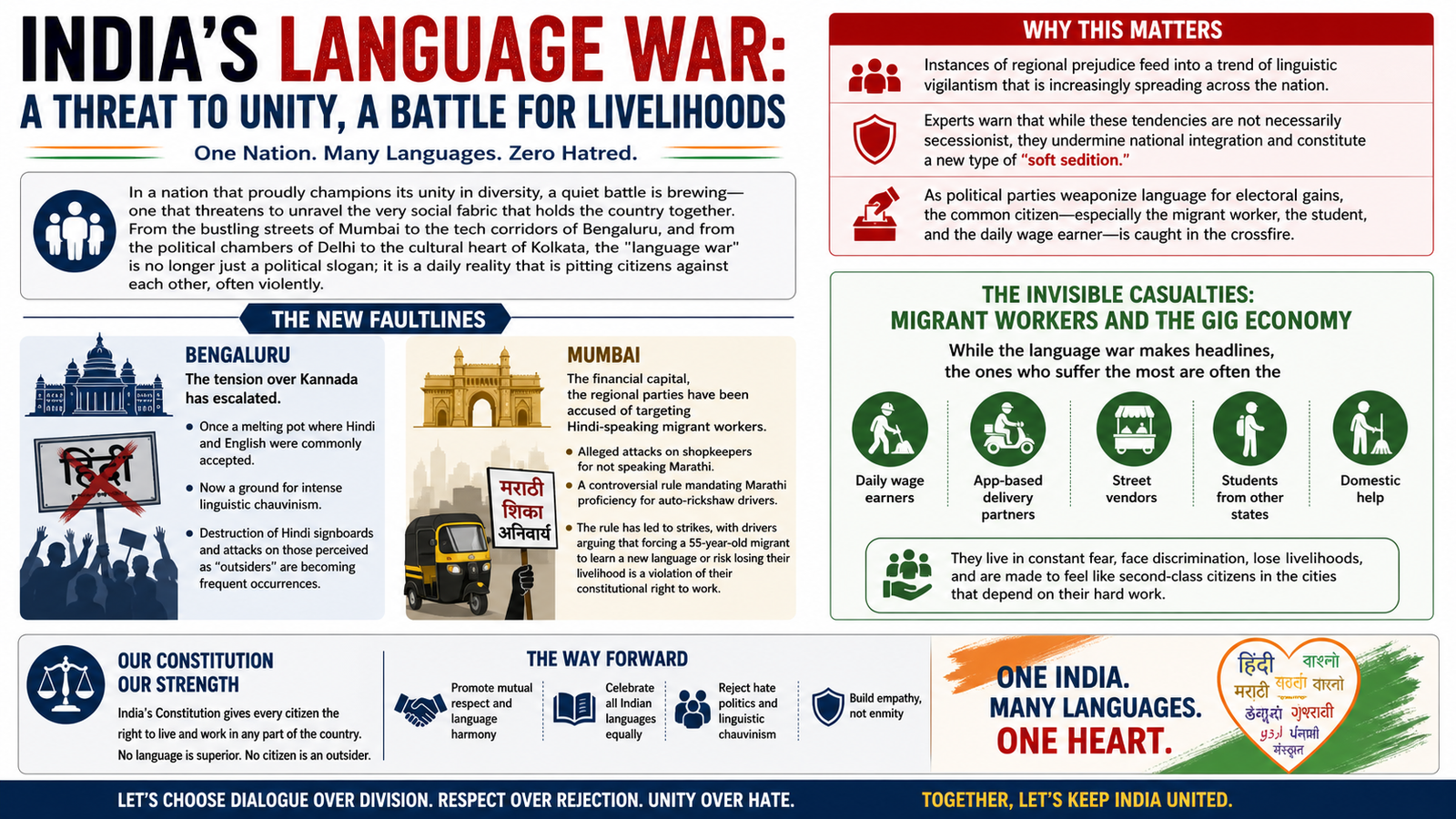
In a nation that proudly champions its unity in diversity, a quiet battle is brewing—one that threatens to unravel the very social fabric that holds the country together. From the bustling streets of Mumbai to the tech corridors of Bengaluru, and from the political chambers of Delhi to the cultural heart of Kolkata, the “language war” is no longer just a political slogan; it is a daily reality that is pitting citizens against each other, often violently.
Instances of regional prejudice feed into a trend of linguistic vigilantism that is increasingly spreading across the nation. Experts warn that while these tendencies are not necessarily secessionist, they undermine national integration and constitute a new type of “soft sedition.” As political parties weaponize language for electoral gains, the common citizen—especially the migrant worker, the student, and the daily wage earner—is caught in the crossfire.
The New Faultlines
The friction is most visible in India’s cosmopolitan hubs. In Bengaluru, often hailed as the “Silicon Valley of India,”the tensions over Kannada have escalated. What was once a melting pot where Hindi and English were commonly accepted has become a ground for intense linguistic chauvinism. The destruction of Hindi signboards and attacks on those perceived as “outsiders” are becoming frequent occurrences.
Similarly, in Mumbai, the financial capital, the regional parties have been accused of targeting Hindi-speaking migrant workers. Recent incidents include alleged attacks on shopkeepers for not speaking Marathi, and a controversial rule mandating Marathi proficiency for auto-rickshaw drivers. The rule has led to strikes, with drivers arguing that forcing a 55-year-old migrant to learn a new language or risk losing their livelihood is a violation of their constitutional right to work.
The Invisible Casualties: Migrant Workers and the Gig Economy
While the language war makes headlines, the ones who suffer the most are often the ones who make the city function—the poor workers, auto-rickshaw drivers, construction laborer’s, and gig economy delivery personnel who migrate from Bihar, Uttar Pradesh, Odisha, and other states in search of a better life. They are the backbone of India’s urban infrastructure, yet they find themselves at the receiving end of hostility, discrimination, and economic exclusion.
For Auto-Rickshaw Drivers: A Daily Battle for Survival
Auto-rickshaw drivers are among the most visible victims of linguistic policing. In Mumbai, the recent push to mandate Marathi proficiency for auto permits has left thousands of drivers in a state of panic. Many of these drivers are migrants who have spent decades navigating the city’s chaotic streets, ferrying Mumbaikars to work, hospitals, and railway stations. Now, they face the prospect of losing their only source of income.
Rajesh Kumar, a 52-year-old auto driver from Uttar Pradesh who has been driving in Mumbai for over 25 years, expressed his anguish: “I came here as a young man. I have never been in trouble with the law. I pay my taxes, I send my children to school, and I have served this city faithfully. Now they say I cannot drive unless I speak Marathi fluently. Where will I go? Who will employ a 52-year-old with no other skill?”
In Bengaluru, the situation is equally grim. Munna Yadav, a 35-year-old auto driver from Bihar, narrated a terrifying incident: “A group of men surrounded my auto near Majestic and started shouting at me because I couldn’t reply in Kannada. They smashed my rearview mirror and told me to leave Karnataka. I was terrified for my life. I didn’t even know what I did wrong. I just wanted to earn my daily bread.”
A study by the Centre for Sustainable Employment at Azim Premji University found that over 60% of auto-rickshaw drivers in Mumbai and Bengaluru are inter-state migrants. Many of them are semi-literate and lack the formal education required to learn a new language quickly. For them, language isn’t a matter of pride—it’s a matter of survival.
Construction Workers: Building the City, Being Driven Out
Construction laborers form the invisible army that builds India’s skyscrapers, metro networks, and flyovers. Yet, they are among the most vulnerable to linguistic violence. Working on sites that are often temporary, they live in cramped labor colonies on the city’s fringes. Their lack of fluency in the local language makes them easy targets for harassment by local authorities, contractors, and even vigilante groups.
Suresh Ram, a 40-year-old construction worker from Odisha working on a high-rise project in Bengaluru, shared his experience: “We build these beautiful buildings, but we are treated like we don’t belong. Last month, a local politician came to our site and started yelling at us in Kannada. We didn’t understand, and he threatened to get our work permits cancelled. My supervisor had to beg him to let us continue. We are not here to take anyone’s job; we are here because there is no work in our villages.”
In Delhi, which receives a massive influx of migrant workers from Uttar Pradesh and Bihar, the hostility often takes a different form—subtle exclusion rather than overt violence. Rameshwar Paswan, a construction worker from Bihar, said: “In Delhi, people look down on us. Even though I speak Hindi, they know I am from Bihar and treat me like I am less than them. But at least no one threatens me for speaking Hindi. I have heard stories about what happens in Bengaluru and Mumbai. I was planning to go there for better wages, but now I am scared.”
Gig Economy Workers: The New Foot Soldiers of the Language War
The rise of the gig economy—delivery partners for Zomato, Swiggy, Amazon, and Flipkart—has created a new class of migrant workers who are increasingly caught in the language crossfire. These workers are predominantly young men from smaller towns and villages who migrate to cities for better earning opportunities. They operate on tight schedules, delivering food and packages to customers across the city. A complaint about language can result in a one-star rating, which directly affects their incentives and future earnings.
Vikram Singh, a 24-year-old Swiggy delivery partner from Jharkhand working in Bengaluru, described his daily ordeal: “I have to deliver to apartments in Indiranagar and Koramangala. Sometimes, the security guards refuse to let me enter because I can’t speak Kannada. I have to call the customer repeatedly, and if they don’t pick up, I waste 15-20 minutes, which means I lose money.”
In Mumbai, Deepak Chaurasia, a 28-year-old delivery partner from Uttar Pradesh, recounted a harrowing experience: “I was delivering to a housing society in Andheri. The security guard stopped me and started shouting in Marathi. I told him I don’t understand, and he called two other guards. They surrounded me and said, ‘This is Maharashtra, speak Marathi or leave.’ I had to call my team leader to sort it out. I was shaken.”
A 2024 report by the India Gig Workers Association found that over 40% of gig workers in Bengaluru and Mumbai had faced some form of verbal or physical harassment related to language in the previous year. The report also noted that these workers often avoid going to certain areas of the city out of fear, limiting their earning potential.
Voices from the Ground: “We Feel Unwanted”
The impact on ordinary citizens is profound and personal. A resident of Delhi recalled a harrowing experience in Chennai: “I went to an auto stand and started asking about the route. The driver got riled up. He said, ‘Yeh Hindi nahi hai, yahan Hindi nahi hota’ (This is not Hindi land, Hindi is not spoken here). It made us feel different, unwelcomed, and unwanted.”
Similarly, a student in Bengaluru recounted being lectured by an auto driver near a metro station, allegedly for not speaking Kannada. However, he also acknowledged that migrants often refuse to adapt. “Most people who come to the state refuse to adapt,” he said, noting that even learning basic phrases like “anna” instead of “bhaiyya” can signal respect.
In Mumbai, a protester participating in the auto-rickshaw strike voiced his despair, saying he has spent two decades behind the wheel, communicating in Hindi and basic English, but now finds his livelihood threatened by a language he never had the opportunity to learn formally. A senior citizen from North India living in Mumbai added, “I love Mumbai, but the hostility is growing. Talking to my neighbors who prefer speaking in Marathi is an everyday struggle. We are all Indians, shouldn’t that count?”
In Kolkata, the situation is characterized by subtle exclusion alongside a defensive assertion of linguistic identity. A native Nepali speaker from the hills of Darjeeling expressed deep unease regarding the government’s push for Bangla or Hindi in official communication. Referring to past protests related to the imposition of a single language, he said: “We love our state, but we also love our mother tongue. Why must we choose?” A student in South Kolkata added: “We welcome everyone, but there is a growing sentiment that if you live here, you should respect Bangla. We don’t want to become a minority in our own city.”
Expert View: Pride vs. Parochialism
Experts believe the conflict is fueled by rigid attitudes on both sides. According to her, the friction intensifies when migrants insist on speaking Hindi in Kannada-speaking regions without making any effort to adapt. At the same time, she points out that locals often exhibit an equal lack of patience toward outsiders, creating a cycle of mutual resentment and hostility.
A former NCERT Official attributes the problem to the ineffective execution of the Three-Language Formula. He expressed greater concern about the implementation gaps than the policy itself. While emphasizing that the National Education Policy 2020 provides sufficient flexibility, he lamented that many states have failed to embrace its spirit, reducing language education to a superficial checkbox rather than fostering genuine multilingual competence.
The Political Powder Keg: The Three-Language Formula
The recent controversy over the Malayalam Language Bill, which sought to make Malayalam compulsory in border districts, highlights the sensitivity of the issue. Karnataka Chief Minister vehemently opposed it, stating: “For children of linguistic minorities, language is not a ‘subject’ alone, it is identity, dignity, access and opportunity… India’s unity rests on respecting every language.”
This debate mirrors the larger row over the National Education Policy (NEP) 2020’s three-language formula. Tamil Nadu has been at the forefront of opposition, with the former Chief Minister M.K. Stalin refusing to implement it, calling it a “Hindutva policy” designed to promote Hindi. The Centre’s decision to withhold funds worth over Rs 2,500 crore from Tamil Nadu has turned the academic debate into a full-blown political showdown, exacerbating the North-South divide.
As one political analyst from Delhi pointed out: “The major national parties are hesitant to address this problem for fear of alienating their state units. Meanwhile, regional parties exploit the issue to consolidate their vote banks.”
The Economic Cost of Linguistic Intolerance
What is often overlooked is the economic cost of this linguistic vigilantism. Migrant workers are the lifeblood of India’s urban economy. Without them, construction projects would halt, goods would remain undelivered, and the city’s essential services would collapse. Yet, they are being systematically made to feel unwelcome.
A 2023 report by the Reserve Bank of India noted that inter-state migration contributes nearly 60% of the labor force in India’s top five metropolitan cities. In sectors like construction, transport, and logistics, the share of migrants is even higher—often exceeding 80%. By alienating this workforce, cities are not just committing a moral wrong; they are shooting themselves in the foot economically.
A noted economist issued a stark warning: the rising tide of linguistic intolerance is actively discouraging labor mobility across state borders. If workers from poorer states begin avoiding economic hubs like Bengaluru and Mumbai out of fear, the resulting labor shortages could drive up costs in construction and services, fueling inflation. This, he cautioned, is not merely a social problem but an economic time bomb waiting to explode.
A Time to Look Ahead
In a world where technology is rapidly erasing barriers, forcing people to speak a particular language seems anachronistic. India’s ambition to become a global leader, especially in AI and technology, hinges on inclusivity, not uniformity. Experts and citizens alike are calling for a shift in focus.
“It is time we stopped fighting over languages and started using them to solve bigger issues,” said a corporate professional from Delhi. Experts emphasize that small gestures can go a long way: “If a migrant says ‘Namaskara’ instead of ‘Namaste,’ it shows an intent to integrate. And conversely, if a local sees a migrant struggling, a bit of patience can defuse the situation.”
The call is for a constitutional morality that respects the right of every Indian to reside, work, and speak freely anywhere in the country. The time has come to transcend linguistic parochialism and recognize that India’s strength lies not in its uniformity, but in the harmonious coexistence of its myriad voices.
Conclusion: Unity in Diversity is Not a Slogan, It’s a Promise
India’s founding fathers envisioned a nation where every language would be respected, and no citizen would be discriminated against for the language they speak. Article 29 of the Constitution guarantees the right to conserve one’s distinct language and culture. Article 21 protects the right to life and livelihood—a right that is being violated when a worker is threatened for not speaking the local language.
The language war is not just about words; it is about dignity, livelihood, and the very idea of India. As the country aspires to become a global superpower, it cannot afford to turn its back on the very people who build its cities, deliver its food, and drive its economy. The time has come to move beyond petty linguistic chauvinism and focus on the real issues that affect the common citizen. After all, a nation that cannot protect its own workers within its borders cannot claim to be a leader on the world stage.
Disclaimer: The opinions and views expressed in this article/column are those of the author(s) and do not necessarily reflect the views or positions of South Asian Herald.
Related posts:
 Permanent Mission of India to the United Nations Observes “Hindi Diwas 2024” at the United Nations
 Marathi Directors for Hindi Cinema: The Sudden Success
 Opinion: Regional Cinema Cannot Thrive Through Coercion and Quotas
 From Australia and New Zealand to Fiji and Pacific Islands, Hindi Finds a Collective Voice in Brisbane