Join WhatsApp Channel

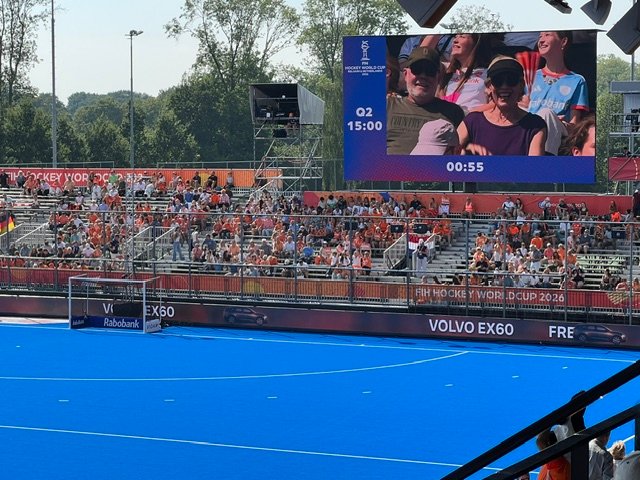
India concluded its FIH Women’s Hockey World Cup 2026 campaign on a winning note, defeating Germany 3-1 to secure fifth place, the team’s best finish at the tournament since the inaugural edition in 1974.
Navneet Kaur scored twice and Ishika added another goal, while goalkeepers Bichu Devi and Savita produced strong performances to help India close its campaign with an impressive victory.
India will now turn its attention to the Asian Games in Japan, where winning the gold medal would secure direct qualification for the 2028 Los Angeles Olympic Games.
India delivered a largely encouraging performance at the World Cup, recording victories over South Africa and Germany. The team defeated South Africa 6-1 and Germany 3-1, while its only loss came against host Netherlands, which won 2-0. India also earned draws against Olympic silver medalist China, England and Australia.
India created an early opportunity in the fourth minute when Navneet initiated a promising move and sent the ball across the goalmouth, but Salima Tete was unable to make contact.
A slow clearance then resulted in Germany earning the first penalty corner of the match shortly before the end of the opening quarter. India unsuccessfully challenged the decision through a video referral. Germany received another penalty corner soon afterward but failed to capitalize, leaving the match scoreless at the end of the first quarter.
India had another opportunity to take the lead in the 18th minute, but a shot from the top of the circle went well wide. A minute later, India conceded its third penalty corner following another poor clearance, although Germany was unable to control the injection.
India came close again in the 22nd minute, producing four attempts in quick succession. German goalkeeper Finja Starck, however, prevented India from breaking the deadlock.
The first half ended scoreless, with India holding a slight territorial advantage as both teams searched for the opening goal.
Germany threatened in the 34th minute when Lena Micheel found space inside the striking circle, but Bichu Devi made an effective clearance.
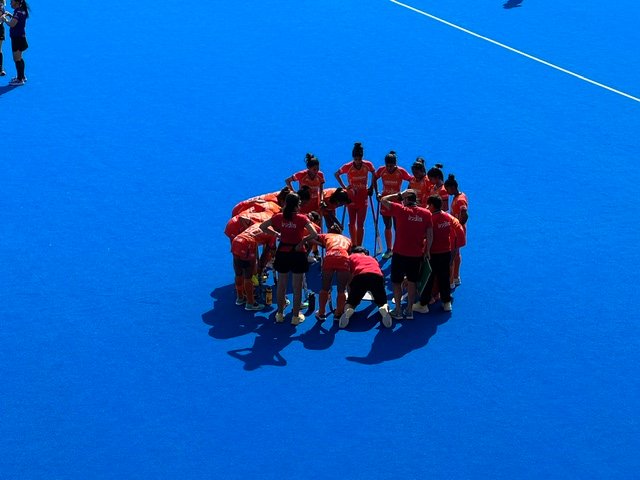
India finally took the lead in the 43rd minute when Ishika beat the German goalkeeper to make it 1-0.
India then earned a penalty corner after Navneet’s strike hit German defender Ines Wanner’s foot. Navneet converted the opportunity with a low shot to double India’s advantage.
Navneet scored again shortly afterward during a goalmouth scramble, lifting the ball over the goalkeeper and a defender to give India a commanding 3-0 lead.
Germany earned penalty corners in the 48th and 53rd minutes, but India’s defense successfully dealt with both opportunities.
The Germans eventually reduced the deficit in the 59th minute when Lyn Krings found the target after Savita’s attempts to stop the German attack were unsuccessful.
Germany earned another penalty corner in the final minute, but India’s defense held firm to preserve the 3-1 victory and complete a strong finish to the tournament.
India’s fifth-place result was its best at the Women’s Hockey World Cup since the inaugural tournament in France in 1974, when the team finished fourth.
At the 1974 World Cup, India was the only team to defeat eventual champion Netherlands during the group stage. Although India lost 2-0 to Belgium, it defeated Mexico 3-0, Spain 4-1 and the Netherlands 1-0 to finish atop its pool.
India then lost 1-0 to Argentina in the semifinals before falling 2-0 to Germany in the bronze medal match. No Indian women’s team has matched or surpassed that fourth-place finish.
India later won the Asian Games gold medal in 1982, along with titles at other continental competitions. At the truncated 1980 Moscow Olympics, the Indian team, led by Rupa Saini, narrowly missed a bronze medal after finishing fourth.
India’s next major breakthrough came at the Tokyo Olympics, where the women’s team also finished fourth after narrowly missing the country’s first Olympic medal in women’s hockey.
Both Indian teams arrived in the Netherlands with high expectations, but the women produced a significantly stronger campaign than the men. Sjoerd Marijne’s team secured its best World Cup finish in more than five decades and will carry renewed confidence into the Asian Games.
India finished third at the previous Asian Games, but its 2-2 World Cup draw against Asian champion China could strengthen the team’s belief that it can challenge for gold this time.
Despite losing only once in Amstelveen and holding higher-ranked China, England and Australia to draws, India struggled to convert its scoring opportunities. Its inability to capitalize consistently in front of goal remains an area requiring attention.
Since Gurjit Kaur’s departure, India has also struggled to find a dependable replacement for its former penalty-corner specialist. The team has increasingly relied on Deepika and Navneet to convert penalty corners. Both players recorded some success at the World Cup, scoring two penalty-corner goals each, but India’s overall conversion rate remained below expectations.
In contrast, India’s defense delivered a disciplined and dependable performance throughout the tournament. Led by S. Chanu, the defensive unit repeatedly held firm against formidable opponents. Even the Netherlands’ powerful attack had to work hard to score its two goals against India.
That resilience was again evident against world No. 5 Germany, with India’s defenders and goalkeepers limiting the opposition to a single late goal.
Germany was coached at the World Cup by Janneke Schopman, a former India head coach who also served as Marijne’s assistant when India finished fourth at the Tokyo Olympics.
With the Asian Games scheduled to begin in the middle of next month, India will have limited time to evaluate its World Cup performance. The team management and players will need to focus on improving penalty-corner conversion and finishing while maintaining the defensive discipline displayed throughout the tournament.
Finding solutions before the Asian Games could significantly strengthen India’s chances of winning the continental title and earning direct qualification for the 2028 Olympics.