Join WhatsApp Channel

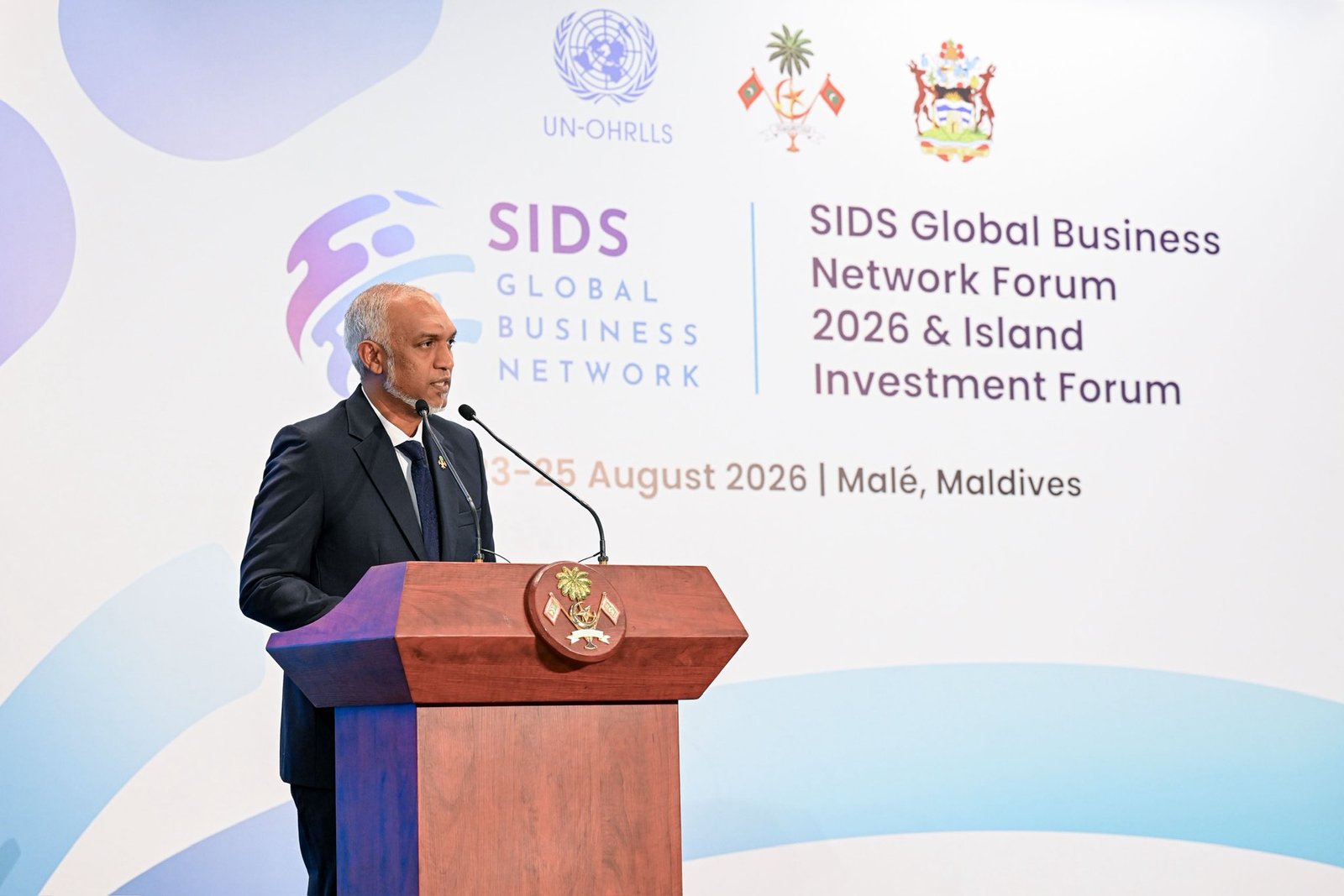
Maldives President Mohamed Muizzu has called for island nations to be viewed as investable economies rather than solely as climate-vulnerable states seeking international assistance.
Speaking at the UN-backed Small Island Developing States (SIDS) Global Business Network Forum in Malé, Muizzu said SIDS should attract greater investment in renewable energy, digital services, sustainable tourism, logistics, financial technology and the blue economy.
His remarks come as island states gain strategic importance but continue to face high financing costs and limited access to capital.
“Our islands may be small. Our markets may be small, too. But our ideas do not have to be small. An idea born on one island can reach customers, investors, and markets far beyond its shores,” Muizzu said at the forum.
The event brought together representatives from nearly 50 countries, including 29 SIDS nations, nearly three-quarters of the 39 officially recognized by the United Nations. Government officials, investors and business leaders from outside the island group also attended.
Although these countries have relatively small land areas, they are significant economic and strategic actors at sea. According to the United Nations, SIDS manage 19.1 percent of the world’s exclusive economic zones. UN Trade and Development reported that their ocean-based exports reached $160 billion in 2022, representing about 16 percent of their collective gross domestic product.
The Maldives views technology as a way for island states to expand their global economic reach. Digital infrastructure can connect communities and businesses separated by oceans, improve access to services and help island-developed products and expertise reach international markets.
“For SIDS, digital connectivity is no longer simply a communications issue; it is economic infrastructure that can enable trade, financial services, tourism, creative industries, education and new forms of employment. Our scale can therefore become an advantage. SIDS can serve as laboratories for innovation and incubators for ideas, technologies and solutions. The challenge is turning that creativity into economic opportunity,” Muizzu said.
Google’s Dhivaru project with the Maldives, announced in November 2025, reflects that ambition. The new subsea cable will connect Oman, the Maldives and Christmas Island. A connectivity hub in Addu City will support cable switching, content caching and colocation, strengthening regional connectivity and enabling emerging digital and artificial intelligence-driven services.
The Maldivian government is aiming for digital and creative industries to contribute 15 percent of the country’s GDP by 2030. It has also launched $71.5 million in financing for startups and youth enterprises.
The focus partly reflects Muizzu’s professional background. An engineer who later entered politics, he holds a doctorate in civil engineering from the University of Leeds and earned Project Management Professional certification from the U.S.-based Project Management Institute. He previously served as infrastructure minister and as the directly elected mayor of Malé, overseeing major transportation, housing, land reclamation, water and sewerage projects.
The environmental and strategic considerations are closely linked. Investments in clean energy and resilient infrastructure could help protect island communities from rising sea levels, coastal erosion and damage to marine ecosystems while creating commercial opportunities.
As middle powers increasingly organize to protect their interests, Muizzu has argued that SIDS should also work collectively to attract investment, strengthen their negotiating position and avoid being defined solely by their vulnerabilities.