Join WhatsApp Channel

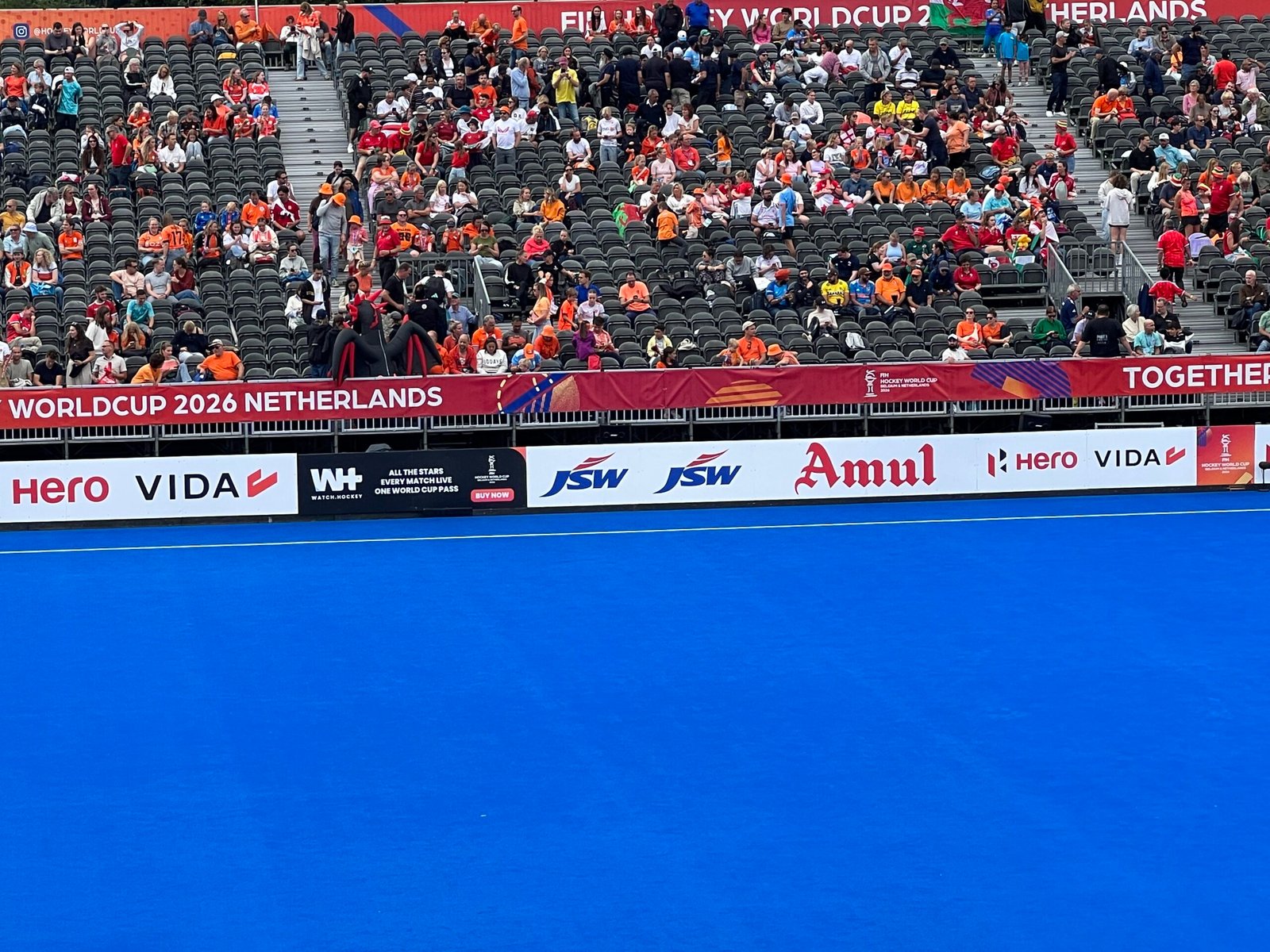
Major international sporting events, including the Olympics and World Cups, depend heavily on sponsorships and broadcasting rights for their financial success. Like the recently concluded FIFA World Cup, the ongoing men’s and women’s FIH Hockey World Cups do not have a title sponsor.
There was a time when India’s Hero Group served as the title sponsor of nearly all major International Hockey Federation tournaments worldwide. Although Hero Group and its electric two-wheeler brand, VIDA, remain among the leading sponsors of the World Cups in the Netherlands and Belgium, several other Indian companies also figure prominently on the sponsorship roster.
Gujarat-based dairy cooperative Amul is among the tournament’s major sponsors, along with JSW, another prominent Indian corporate group.
Rabobank, meanwhile, has been a longtime sponsor of the Royal Dutch Hockey Association and major FIH events held in the Netherlands and elsewhere.
Although the men’s and women’s FIH World Cups, whether held separately or jointly, are considerably smaller than the FIFA World Cup, corporate support from other leading hockey-playing nations remains limited. The response from companies in countries such as England, Spain, France, Australia, Pakistan and New Zealand ranges from poor to lukewarm.
Australian hockey legend Richard Charlesworth acknowledged that field hockey receives nowhere near the level of government or corporate support enjoyed by soccer.
“Even Australian media does not give enough space to field hockey. I am here as a representative of Australian media to create both awareness and increased following for the sport in the Australian continent,” he said.
The International Hockey Federation, better known as the FIH, has become increasingly involved in organizing tournaments, limiting the ability of national and continental federations to hold independent competitions. The international governing body also seeks a financial share when allocating one of its sanctioned tournaments.
At the same time, the increasingly crowded FIH calendar leaves national and continental federations with little room to plan their own events.
“Hockey is nowhere near soccer in getting sponsorship, which has much larger appeal for the masses,” Charlesworth said, noting that soccer players earn significantly more and its major competitions attract support from numerous corporations.
European hockey enjoys several advantages, including geography. Distances between countries are relatively short and manageable, allowing players in nations such as Germany, Belgium and the Netherlands to assemble regularly, including on weekends, for training and practice.
Australia faces a different challenge. Its vast distances make it more difficult for players to gather and train together frequently.
A key consideration for companies entering sports sponsorship is the visibility and commercial advantage they expect to gain. Businesses are more likely to invest when they are assured of substantial brand exposure.
Hero has followed this approach as one of the world’s leading two-wheeler manufacturers, using international hockey to reach consumers across global markets.
Amul has also joined Hero in sponsoring major international sporting events as its products, particularly dairy goods, expand their presence among customers worldwide. JSW has adopted a similar strategy through its support for sports.
In addition to corporate backing, Hockey India has received significant support from the central and state governments. Odisha, for example, has been the largest supporter of Indian hockey for nearly two decades. Uttar Pradesh, Jharkhand, Chhattisgarh and Tamil Nadu have also attempted to follow Odisha’s sponsorship model.
Punjab is the latest state to join this growing group of hockey supporters. It has offered to host the Asian Champions Trophy in Mohali and Jalandhar in October or November. The tournament is expected to feature the top six teams from the upcoming Asian Games.
Related posts:
 Argentina Dominates Pan American Cup, Books Double Berth for 2026 Hockey World Cups
 India Clinches Asia Cup Hockey 2025, Secures Spot in FIH Hockey World Cup 2026
 Indian Hockey’s Road to LA 2028: Tejinder Singh Aujla on Qualification Challenges, Transition, and Governance
 India, Pakistan Drawn Together in 2026 FIH Men’s Hockey World Cup; Netherlands, Belgium to Co-Host Dual Tournament