Join WhatsApp Channel

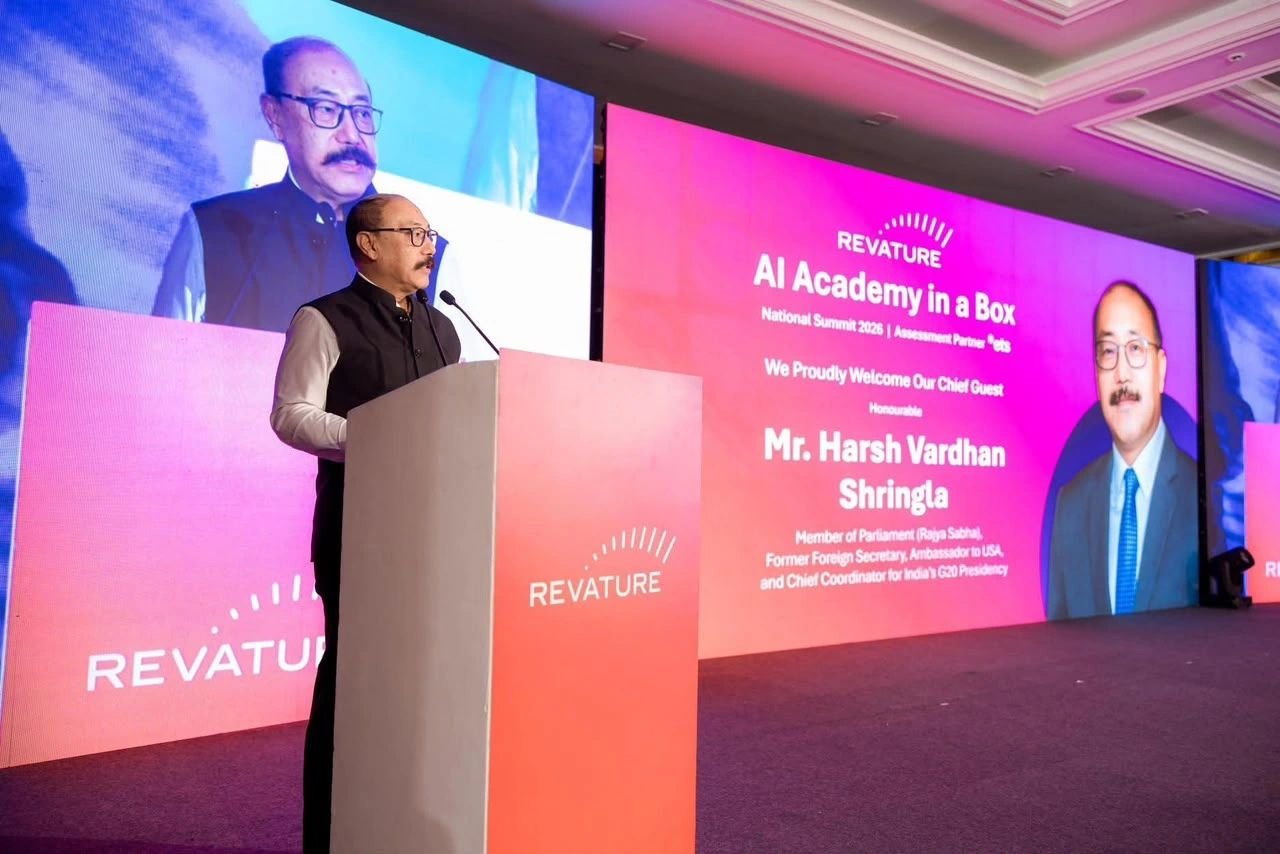
India’s Member of Parliament (Rajya Sabha), Harsh Shringla, has said that Artificial Intelligence (AI) is reshaping India’s job market, with an estimated 2.73 million new technology jobs expected by 2028.
Speaking at the National Summit on “Engineering India’s Next Engineer,” in Chennai, on August 4, Shringla said the anticipated growth will be “fueled” by the rapid adoption of AI across industries, emphasizing the need for “upskilling and reskilling” to remain relevant in a rapidly evolving workforce.
“India’s situation is not too few jobs, but too few of the right engineers. I believe that is a solvable problem, and I believe the leaders here are precisely the people who can solve it,” Shringla said. “I am witnessing a methodical transformation spanning the entire AI stack, from foundational energy and infrastructure to the chips, models, and applications that drive them.”
Shringla, who has served in several key positions, including Chief Coordinator for India’s G20 Presidency, Foreign Secretary, and Ambassador of India to the United States, said data from the Competition Commission of India shows that the global AI market has grown from USD 103.6 billion in 2020 to nearly USD 289 billion today.
“Our own domestic sector has mirrored this trajectory, climbing from USD 2.97 billion to USD 7.63 billion in that same window. We are looking at a future where India’s AI economy is projected to reach USD 131.31 billion by 2032, propelled by a staggering annual growth rate of 42.2 per cent,” he added.
Shringla said the government has played an active role in supporting the country’s AI transition. He noted that the IndiaAI Mission represents a sovereign investment of Rs 10,371.92 crore to fund “compute infrastructure, foundational models, and national skilling simultaneously,” adding that these initiatives should be viewed as “one connected effort,” rather than separate programs.
He said the foundation for India’s next decade of growth is already being laid as Global Capability Centers (GCCs) shift toward advanced AI and cloud expertise. At the same time, national initiatives such as the IndiaAI Mission and FutureSkills are helping democratize technical education from “early schooling” through “advanced research,” creating a talent pipeline that educational institutions must embrace.
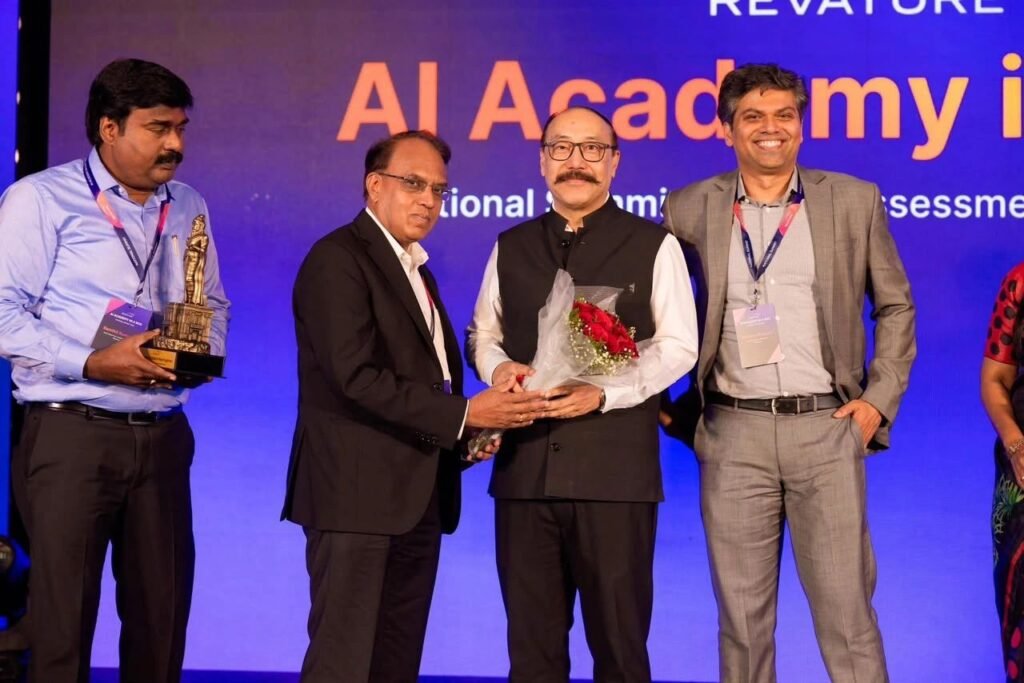
Shringla also urged stakeholders to look beyond software, saying India’s engineering ambitions now extend into several emerging sectors.
“Our space sector has been thrown open to private enterprise since the 2020 reforms, and the results speak for themselves,” he said. “I mention this deliberately. The same reforming instinct that built the IndiaAI Mission is now opening space, semiconductors, nuclear energy and advanced manufacturing to a new generation of Indian engineers, and I believe our engineering colleges must train for all of these frontiers, not software alone.”
Congratulating the chancellors, vice chancellors, deans, and academic leaders for convening the summit, Shringla also thanked Revature for hosting the event in Chennai. He described Chennai as a city that has not only witnessed but also actively shaped India’s technological evolution.
Shringla said the summit represents a critical moment for India’s higher education system, calling for a shift away from “legacy models” toward producing engineers capable of building, managing, and governing AI systems. He said such a transformation will play a defining role in India’s global technology leadership over the next three decades.
“I have watched this industry grow from close range, and I want everyone to understand why it matters as much as it does,” he said. “India’s services sector today contributes over 55.3 per cent of our GDP. Within it, the software and IT industry alone accounts for roughly 7 to 8 per cent of GDP in its own right, an industry the size of entire national economies, built inside three decades.”
Shringla said India’s technology story is not merely an economic success but also a social transformation. “I do not think this is an economic story, but a social one,” he said. “This industry took the sons and daughters of clerks, teachers, and farmers and turned them, within a single generation, into the first truly white-collar, globally mobile middle-class India has ever produced. It changed which families could send a daughter abroad for a master’s degree, and which small towns began to see themselves as part of the world rather than apart from it.”
He also highlighted the importance of software services to India’s economy. “I would remind you that our software services remain the backbone of India’s export economy, accounting for well over 40 per cent of our total services exports,” he said, adding that India aims to capture a 10 per cent share of global services trade by 2047.
“That is not a modest goal, and I do not intend for this room to treat it as one,” he emphasized.
Reflecting on the evolution of India’s engineering ecosystem, Shringla said understanding the country’s past is essential to shaping its future. He noted that India’s engineering education sector expanded alongside the outsourcing industry, growing from 337 colleges in 1990 to nearly 5,875 today.
“I have always believed that industry, not only the government, carried much of the weight of that expansion,” he said. “For thirty years, companies ran what were, in effect, the world’s largest corporate finishing schools, training and absorbing a quality gap that our colleges were never asked to close themselves.”
Calling for bold reforms, Shringla said India now needs a “UPI moment” in engineering education. “It needs to be deliberate, fast, and nationally coordinated,” he said, “exactly as UPI was when the world doubted it could be built at all.”
He also advocated for an industry-aligned AI curriculum, practitioner-led teaching, and a structured pathway from the classroom to workforce-ready skills. He said the transition would not have to begin from scratch because successful models already exist and are operating in institutions similar to those participating in the summit.
“I ask you to adopt industry-co-designed curricula built jointly with employers, portfolio-based assessment that judges what a student has built, not merely what they can recall in an examination hall,” he added.
Related posts:
 India Inc Clocks $10.6 Billion in October Deals, Led by Banking and Infrastructure Sectors
 In Conversation with Rajesh Mehta: Harsh Vardhan Shringla
 Economic Stability Improves in Nepal as Inflation Eases, Trade Expands
 Trump’s Nomination of Sergio Gor as U.S. Ambassador to India a “Very Positive Step,” Says Harsh Shringla