 Join WhatsApp Channel

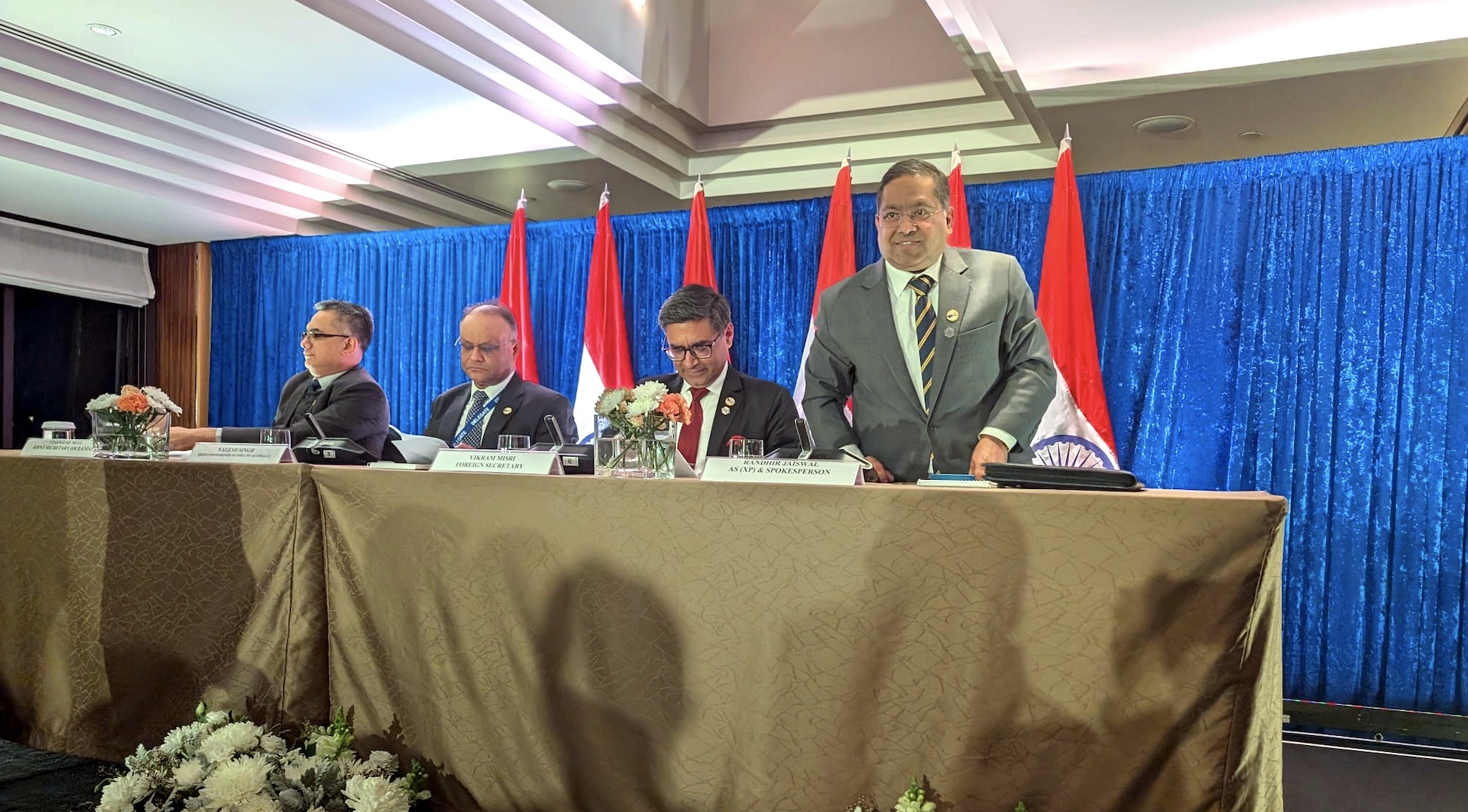
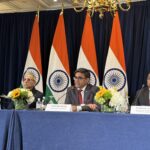
Melbourne, Australia: India’s Foreign Secretary Vikram Misri said India’s engagement with its diaspora is an ongoing process during a special press briefing on July 9, 2026, held as part of Prime Minister Narendra Modi’s official visit to Australia.
In response to questions from South Asian Herald, Misri said the outreach is not limited to large public events, such as the community reception at Marvel Stadium earlier that day but is instead carried out by Indian missions “with the assistance and involvement of community organizations” and media organizations on a day-to-day basis.
On what concrete steps India and its missions abroad are taking to engage diaspora media and community voices, Misri said Indian missions work to communicate both bilateral priorities and developments in India while also focusing on improving services for the diaspora. He said missions are “increasingly in many areas” using technology “in a much more intensive fashion” to reach community members, adding that engagement with media organizations is essential to ensuring outreach extends beyond the two or three cities where much of it has traditionally been concentrated.
The briefing, was moderated by Ministry of External Affairs Spokesperson Randhir Jaiswal and was also joined by High Commissioner to Australia Nagesh Singh and Joint Secretary Vishwesh Negi, who oversees the Australia portfolio at the ministry.
Engaging the Diaspora Beyond Set-Piece Events
On the question of reaching Indian communities outside major hubs such as Sydney and Melbourne, Singh pointed to the opening of a Consulate General in Brisbane as evidence of India’s push to extend engagement to what he called the “sub-national” level, alongside the High Commission in Canberra and consulates in Perth, Melbourne and Sydney. Singh said the linking of Indian and Australian states, a point he noted Modi himself had raised earlier that day at the CEOs Forum reception, reflects a broader effort to deepen ties beyond the national level, citing Queensland Premier David Crisafulli’s business delegation visit to India the previous year as an example of outcomes spanning trade, manufacturing and education.
Summit Outcomes and the Road Ahead
The briefing followed a day of high-level engagements between Modi and Australian Prime Minister Anthony Albanese, including the India-Australia CEOs Forum, a ceremonial welcome at Government House by Victoria Governor Margaret Gardner, and delegation-level talks marking the sixth year of the India-Australia Comprehensive Strategic Partnership. Misri said the two leaders directed negotiating teams to conclude the proposed Comprehensive Economic Cooperation Agreement “at the earliest,” building on the 2022 Economic Cooperation and Trade Agreement, which he said had delivered a 55 percent increase in two-way trade since it took effect.
Among the outcomes announced were a Joint Declaration on Defense and Security Cooperation, an India-Australia Maritime Security Collaboration Roadmap, and the Australia-India Partnership for Cyber, Critical Technologies and Supply Chains. Misri also confirmed a new administrative arrangement enabling uranium supply from Australia to India, which he said builds on the two countries’ 2014 civil nuclear cooperation agreement and had taken nearly two years of negotiation to finalize over reporting and safeguards protocols. He said actual supply contracts would now be negotiated directly between private Australian uranium companies and their Indian counterparts. Misri linked the arrangement to India’s target of 100 gigawatts of installed nuclear capacity by 2047 and pointed to the SHANTI Act, which he said opens India’s nuclear sector to private and foreign investment.
Misri said the leaders also reaffirmed support for the Quad and discussed shared concerns over terrorism, with both countries condemning it “without any double standards,” according to Misri. Asked about a recent Chinese intercontinental ballistic missile launch into the South Pacific, Misri said Albanese raised the issue with Modi, and that both leaders affirmed a shared interest in peace and stability in the Indo-Pacific.
Misri said the visit also concluded with the repatriation of Indian artifacts. According to the official list of outcomes released by the Prime Minister’s Office, three ancient items from the Indian state of Tamil Nadu are being repatriated: a granite sculpture of Nandi, the bull associated with Lord Shiva, dating to the 11th or 12th century; an 11th century bronze trident featuring Bhadrakali; and a 12th century basalt sculpture of the six-headed Skanda, also known as Karttikeya. Misri also cited an Australian Super commitment, which he attributed to CEO Forum Australian co-chair Paul Schroder, of what he believed was $500 million into India’s National Investment and Infrastructure Fund. Nearly 25,000 members of the Indian community attended the community event at Marvel Stadium earlier that day, which Modi has previously described as a “living bridge” between the two countries, according to Misri.
Modi’s visit to Australia continued on the morning of July 10 with a meeting with Australian Opposition Leader Angus Taylor, followed by a visit alongside Albanese to the Melbourne Cricket Ground, where the two leaders unveiled the India-Australia Sports Collaboration Roadmap, with both countries pointing to India’s hosting of the 2030 Commonwealth Games and Australia’s hosting of the 2032 Olympics as an opportunity for expanded cooperation. Modi has since continued to the last leg of his trip to New Zealand.
Related posts:
 Modi’s Melbourne Visit Puts India Australia Ties in Focus
 Thousands Fill Marvel Stadium as Modi, Albanese Headline Melbourne Meets Modi Reception
 President Trump Hosts Pakistan Army Chief Amid South Asia Tensions; PM Modi Rejects Mediation, Clarifies India’s Position
 India and the United States to Finalize First Phase of Bilateral Trade Agreement by Fall 2025
