The first thing the mountains stole from us wasn’t our breath.
It was our hurry.
Barely a few hours after leaving Gurugram, where every traffic signal seemed to demand another glance at the clock, time began to dissolve into winding roads, drifting clouds and endless ridges of pine. Conversations became slower. Phones stayed in our pockets longer. Even our children, usually glued to their screens during long drives, found themselves counting waterfalls and spotting monkeys instead.
Sometimes, travel doesn’t begin when you reach a destination.
Advertisement
It begins when you stop rushing.
That was exactly what happened during our four-day journey through Tehri, Kanatal and Dhanaulti in Uttarakhand’s Garhwal region—a landscape that offers far more than postcard-perfect lakes and Himalayan peaks. It offers perspective.
Our home for the first two nights was a modest wooden cottage overlooking Tehri Lake. The accommodation wasn’t luxurious, but every morning we woke to something infinitely richer—a vast emerald lake slowly emerging from the morning mist as the first rays of sunlight climbed over the surrounding mountains.
The caretaker, who had spent his entire life in these hills, smiled as he handed us steaming cups of tea.
“You people come here looking for silence,” he said. “For us, silence is everyday life.”
It was difficult to argue.
Back home, silence is something we actively seek. Here, it arrives naturally with dawn.
Later that morning we met boat operators preparing their jet skis before the first tourists arrived. Only a generation ago, many families living around the valley depended almost entirely on farming. Today, the lake created by the Tehri Dam has transformed local livelihoods, bringing opportunities in tourism, hospitality and water sports.
One young instructor laughed while tightening a life jacket.
“My office has the best view in India,” he joked, pointing towards the lake.
He wasn’t exaggerating.
Flying over the water during a parasailing session, the lake appeared almost unreal—its deep blue-green surface surrounded by steep mountains disappearing into the clouds. The excitement lasted only minutes, but the view lingered for much longer.
The following day, our journey climbed towards Surkanda Devi Temple through forests scented with deodar and pine.
Halfway through the trek, we met an elderly woman climbing steadily with a walking stick.
She was making the pilgrimage for the sixth time.
“We come for blessings,” she said between measured breaths. “But the mountains also teach patience.”
Watching her disappear steadily uphill while younger trekkers paused to catch their breath, her words carried unexpected weight.
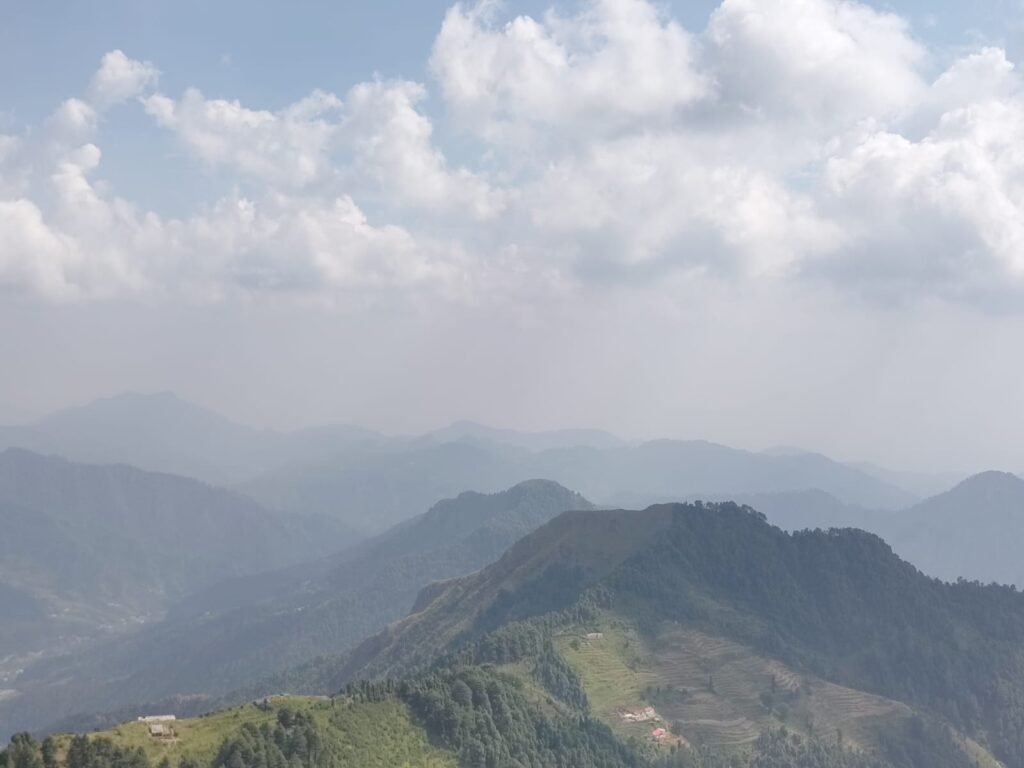
At the summit, pilgrims stood shoulder to shoulder with photographers and backpackers, all temporarily united by the sweeping panorama of the Garhwal Himalayas. Snow-clad peaks shimmered in the distance while temple bells echoed across the valleys below.
Nobody seemed in a hurry to leave.
If Tehri is defined by water, Dhanaulti and Kanatal belong to the forests.
Walking beneath towering deodar trees in the Eco Parks, we encountered local families picnicking, children chasing butterflies and elderly couples quietly sitting on wooden benches, saying very little.
Perhaps the mountains make conversation unnecessary.
The loudest sounds were birdsong, rustling leaves and an occasional breeze passing through the trees.
For city dwellers accustomed to constant background noise, the silence itself became an experience.
One afternoon, while stopping at a small roadside restaurant opposite the Eco Park, the owner insisted we try the local thali before ordering anything else.
“You have come all the way to Garhwal,” he said with mock seriousness. “You cannot leave without eating what we eat.”
He was right.
Mandwa ki Roti, Gahat ki Dal, Kafli, Aloo ke Thechwani and green walnut chutney arrived one after another, each dish prepared from ingredients grown in nearby villages. There was nothing elaborate about the meal, yet every bite reflected generations of mountain traditions shaped by climate, geography and self-sufficiency.
When we complimented the food, the elderly cook simply smiled.
“We cook like this every day.”
That sentence perhaps summed up Garhwal better than any tourism brochure ever could.
Throughout the journey, what stayed with us was not only the scenery but the people.
The young adventure guide proudly explaining how tourism had created employment in his village.
The woman selling handmade woolens outside the temple, hoping visitors would take home more than photographs.
The café owner discussing snowfall patterns that had changed noticeably over the past decade.
Each conversation revealed a region quietly adapting to a changing world while holding firmly to its traditions.
The landscapes, of course, remained unforgettable.
The emerald waters of Tehri Lake.
The endless pine forests of Dhanaulti.
The sunsets at Fagu Top.
The panoramic ridges around Chamba.
Yet it was these everyday human encounters that transformed a pleasant holiday into something far more meaningful.
Travel often encourages us to chase landmarks.
Garhwal quietly reminds us to notice the lives unfolding around them.
The region is becoming increasingly popular as road connectivity improves and more travelers discover destinations beyond Mussoorie. Yet it still possesses something many famous hill stations have gradually lost—an unhurried rhythm that allows visitors to experience mountain life rather than merely photograph it.
As we began the drive back towards the plains, traffic gradually returned, mobile notifications resumed and the familiar urgency of urban life crept back into the car.
But something had changed.
Perhaps it was the memory of conversations with strangers who measured wealth differently.
Perhaps it was the mornings when birds replaced alarm clocks.
Or perhaps it was simply the mountains reminding us that life’s richest journeys are rarely measured in kilometers travelled or attractions visited.
Sometimes, they are measured in the people we meet along the way.
Garhwal gave us magnificent landscapes.
Its people gave us something far more enduring—a reminder that the greatest luxury modern travelers can find is not a five-star resort, but a place where time slows down enough for us to notice the world, and each other, again.
Disclaimer: The opinions and views expressed in this article/column are those of the author(s) and do not necessarily reflect the views or positions of South Asian Herald.