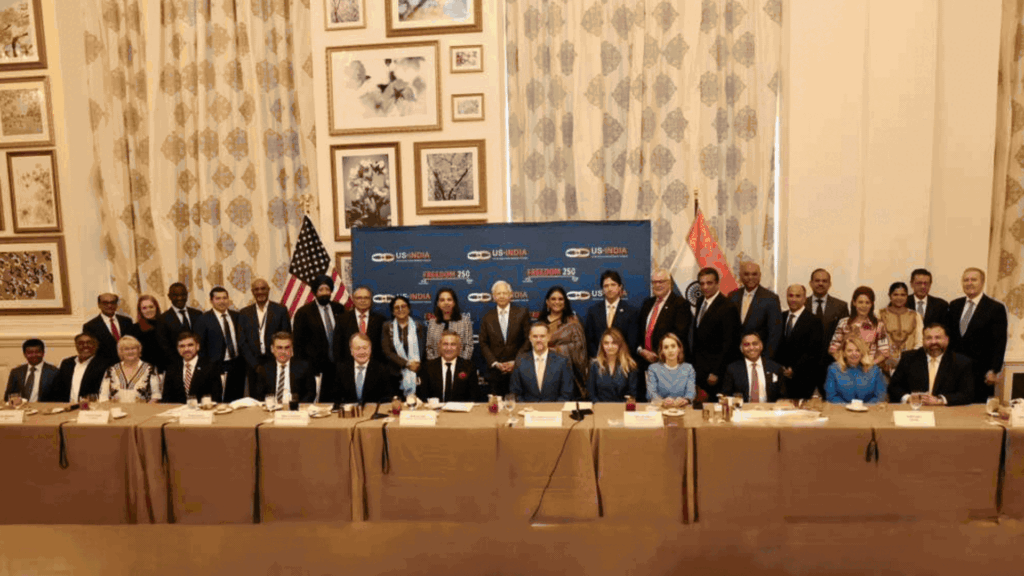
The U.S.-India Strategic Partnership Forum (USISPF) convened its IX Leadership Summit in Washington, D.C., bringing together senior government officials, business leaders, policymakers, diplomats, academics, and strategic experts to reaffirm the strength of the U.S.-India partnership while celebrating America@250.
As the United States prepares to celebrate Independence Day, the summit marked the nation’s 250th anniversary and the enduring relationship between the world’s oldest and largest democracies, according to a USISPF statement.
Discussions throughout the day focused on “bilateral trade, defense cooperation, critical and emerging technologies, energy security, advanced manufacturing, resilient supply chains, and cross-border investment,” the statement said.
The summit opened with a closed-door discussion between USISPF Board Members and U.S. Trade Representative Ambassador Jamieson Greer, who recently returned from India. Greer briefed attendees on the progress of ongoing U.S.-India trade negotiations and efforts to finalize an interim trade agreement.
Advertisement
USISPF welcomed Ambassador Sergio Gor, U.S. Ambassador to India and Special Envoy for South and Central Asia; Ambassador Vinay Mohan Kwatra, India’s Ambassador to the United States; and Ambassador Mark D. Wiseman, Canada’s Ambassador to the United States.
Reflecting on his return to the United States for the Freedom 250 celebrations, Ambassador Gor said, “U.S. and India have a bilateral trade goal of over $500 billion over the next few years; that is an astounding number that is unmatched. We are ready to do so much with India. India exports more to the United States than anywhere else by far. When it comes to defense exercises, we have more defense exercises together than any other country India participates with.”
Ambassador Kwatra highlighted the transformation of the bilateral relationship between Washington and New Delhi. He said, “Under the leadership of Prime Minister Narendra Modi, since 2014, there have been a series of economically transformative measures on the ground that have resulted in the consistently high growth of 7-plus percent, which is uniquely driven by domestic demand. It has externalities, but not really that strong. The Prime Minister has propounded and driven on-ground the initiative of Atmanirbharta, a mixture of self-reliance and self-sufficiency, but an ecosystem that has positive externalities.”
Ambassador Wiseman emphasized the value of trilateral cooperation among the United States, Canada, and India, saying, “North America should be viewed as a shining example of how trade integration can benefit countries and indeed citizens across the border. Today $2.4 billion in trade cross the Canada-US border each and everyday, 120 million people cross the border each year.”
Speaking about India’s role in the partnership, Wiseman said, “What India brings to the table, is an incredibly talented base of human resource, research, flexibility and an ability to innovate very quickly. Canada is a center for AI research and a center of energy, so there is an important part of the partnership.”
“We saw this in the early days of the outsourcing BPO business, where you could work together for better outcomes and more cost-effective outcomes for North American businesses and Canadian businesses,” he added, noting that such collaboration also contributed to the growth of India’s middle class. “I think with AI, what this means is taking that model to the next level, and we have to work together,” he said.
The summit also featured a fireside conversation with Under Secretary of State Jacob Helberg, U.S. Under Secretary of State for Economic Growth, Energy, and the Environment, following the recent Pax Silica Summit.
Helberg discussed the growing importance of trusted technology partnerships and the role of the United States and India in advancing the global innovation ecosystem and critical mineral cooperation.
He said, “For us, India is a great partner and an early signatory to the Pax Silica declaration, and I had the privilege of traveling to India in February for the India AI Impact Summit. We not only marked India’s ascension to Pax Silica, but also published a joint statement on AI opportunity, which ended up shaping the statement that we co-signed with 35 countries last week,” adding “The way I think of Pax Silica is a coalition of capabilities, where each country brings to the table, their unique attributes and capabilities in their own ways. We see technology and AI being significant tailwinds to the global economy.”
During the summit, USISPF presented its 2026 Leadership Awards to three global business leaders for their contributions to strengthening economic ties between North America and India.
Sunil Bharti Mittal, Founder and Chairman of Bharti Enterprises, was recognized for his role in transforming India’s telecommunications sector. Accepting the honor, Mittal said, “Today USISPF honors some of us with a special leadership award and I want to take the opportunity to congratulate Chris and Prem who are my fellow awardees today.”
He added, “The Indian diaspora of 5 million in the United States acts as a bridge and between the India and the United States and helping the strategic relationship between trade, defense and in higher technologies.”
Christopher T. Calio, USISPF Board Member and President and CEO of RTX, was recognized for leading one of the world’s largest aerospace and defense companies.
Prem Watsa, Chairman and CEO of Fairfax Financial Holdings, received the award in recognition of his leadership in business and philanthropy.
During a fireside conversation, Watsa said, “The United States, in my mind, is a fantastic country, 250 years of democracy, the oldest democracy in the world, and India is the biggest democracy. If you put them together, it’s going to be a tremendous opportunity for all of us. India’s opportunity is massive, 300 million in the middle class, going to 600 million, those kind of numbers, massive opportunity. You saw it in China and you’re going to see it in India.”
USISPF also presented its Distinguished Public Service Award to Senator Steve Daines of Montana and Senator Mark Warner of Virginia for their bipartisan leadership in strengthening the U.S.-India strategic partnership.
Senator Warner, co-chair of the Senate India Caucus, said, “For a long time, I have fought to promote the United States and India relationship. In 2005, as Governor, I led the first ever trade delegation from our Commonwealth to India. I remember coming back from the visit with the conviction that the friendship between our two countries was one worth investing in for the long haul.”
Speaking at his third consecutive USISPF Leadership Summit, Senator Daines reaffirmed the importance of expanding cooperation in trade, agriculture, defense, and advanced technologies.
He said, “I made two trips to India before I came to the Senate, and two as a Senator. As we think about the geopolitical strategy for the world and think about the United States, we need a highly trusted counterweight as we think about what’s going on with China. It’s very clear to me, and I tell anyone who listens to me, when I travel to China, this phone does not go to Beijing with me. It stays on my desk in Washington, DC. When I travel to Delhi or anywhere in India, this phone is with me. It’s just a small example of a highly trusted ally and friend.”
Daines said that as both countries evaluate future strategic opportunities, India is the only nation with the scale to serve as a trusted partner alongside the United States in balancing China’s economic ecosystem.
The summit concluded with the launch of the second edition of We The People – 250 Voices: A Tribute to the 250 Voices that Shaped the U.S.-India Relationship. The commemorative coffee table book honors 250 distinguished individuals whose contributions across diplomacy, business, academia, science, public service, culture, and innovation have helped shape one of the world’s most significant strategic partnerships.