Join WhatsApp Channel

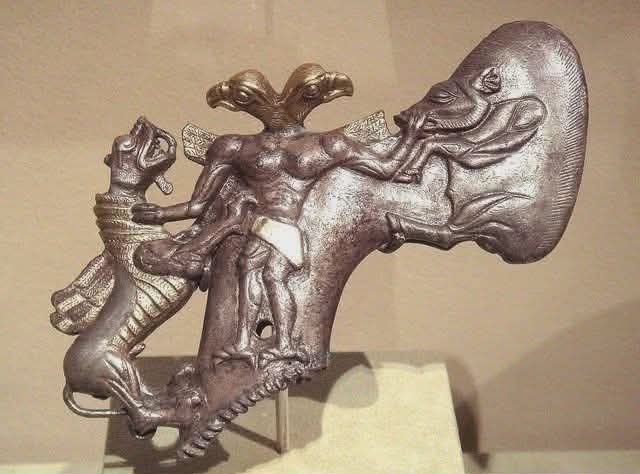
Recently, a post on X caught my attention. The post featured a gilded silver axe, one of the rarest and most remarkable works in Bronze Age metal, from the Bactria-Margiana Archaeological Complex (BMAC) dated to 2100-1800 BC.
In the exhibit, now housed at The Metropolitan Museum of Art in New York, modern scholars have identified the central figure of the icon with two eagle heads as a divine or demonic anthropomorphic being. He is, after all, naked, winged and has curved talons.
On the eagle-headed deity’s left, we see a winged tiger or the imaginary Griffin – a creature with the body of a tiger and an eagle’s wings, while on the right, we see a boar. The extraordinary icon was discovered in the 1980s within the BMAC, corresponding to northern Afghanistan and southern Turkmenistan.
Scholars believe that this artefact reflects a synthesis of artistic and religious influences from Mesopotamia, Elam, Indus Civilization, and cultural sphere of Aryana, particularly Bactria-Margiana, which flourished during the Middle and late Bronze Age. They also conjecture this artefact to the rulers of Aryana.
I offer a contrarian view and in order to support my hypothesis, I am sharing two images of Gandaberunda, an incarnation of Lord Vishnu, and another of Sharabha, an avatar of Lord Shiva.
Gandaberunda, as we can see in this image from the Chennai Museum, has two eagle heads and is winged. Gandaberunda, imagined as so powerful that he could even lift an elephant. We can also see a boar on the right of the deity.
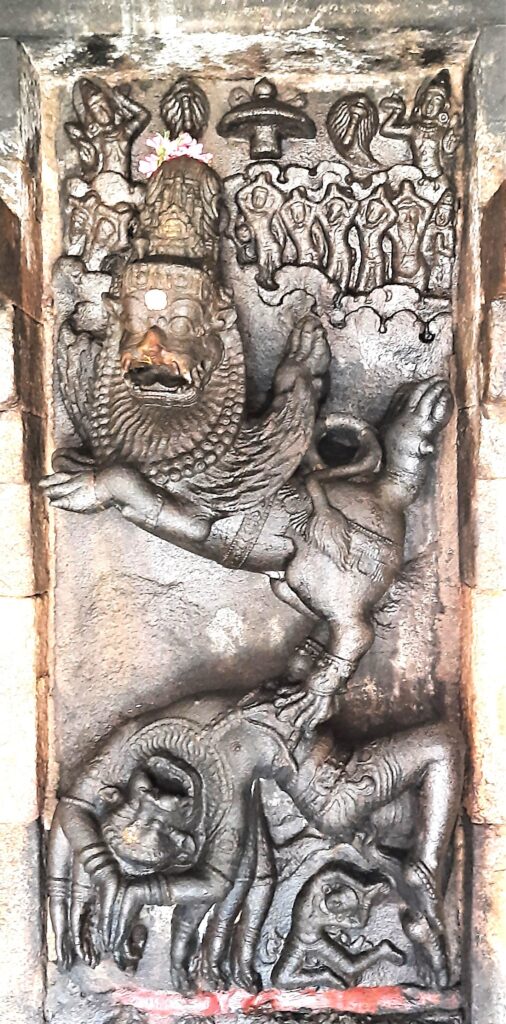
And, here’s an image of Sharabha, a part-lion and part-bird avatar of Lord Shiva, from the temple walls adjacent to the sanctum of the 12th century Airavatesvara shrine at Darasuram in Kumbakonam, Tamil Nadu. In this image, Lord Narasimha is prominent in defeat and perhaps, in death.
There’s a fascinating story involving Sharabha and Gandaberunda. The Shiva Purana says, even after disemboweling and slaying the demon Hiranyakashipu, Lord Narasimha’s wrath remained uncontrolled, and He was seen as a potential threat to the world.
Thus, at the request of the Gods, Lord Shiva sent his associate Veerabhadra to reason with Narasimha, but after that peace overture failed, Shiva had to manifest as the terrifying part-lion and part-bird Sharabha when He promptly attacked Narasimha and immobilized him – quelling the latter’s rage in this way.
Subsequently, Sharabha decapitated and de-skinned Narasimha so that Shiva could wear the lion-head as a pendant and the hide as garment. However, Sharabha’s account doesn’t end here.
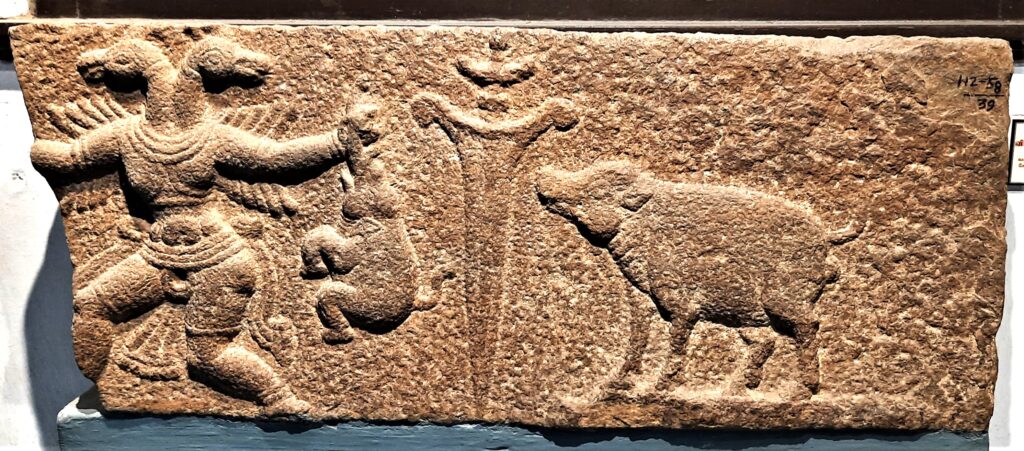
Followers of the Vaishnav order were obviously upset with such narratives about Sharabha defeating and killing Narasimha. So, they came up with their own texts that extended the Sharabha story. Such accounts say that while Sharabha held Narasimha in his claws and began carrying the latter high in the sky, Narasimha manifested as a huge two-headed eagle, Gandaberunda, who was even more powerful than Sharabha, and attacked the latter with renewed fury.
Another battle ensued; this time it was a more violent 18-day long battle. On the final day, Gandaberunda subdued Sharabha, who consequently lost his own fury and became calm.
While such sculptures show the deep schism that had once developed between the Shaivite and Vaishnav sects in the Indian subcontinent in the early Middle Ages, what’s fascinating is whether Tamil philosophers of that age had known of the more-ancient Bactrian mythology and infused the same in the Sharabha-Gandaberunda narrative.
The similarity in iconography is no doubt striking – to say the least!
Disclaimer: The opinions and views expressed in this article/column are those of the author(s) and do not necessarily reflect the views or positions of South Asian Herald.
Related posts:
 Norway Leads Medal Table as Seoul Sister Choi Gaon, and Lollobrigida Headline Day 6 at Milano Cortina 2026
 Canada’s Win Highlights Midway Stage as Kingsbury Claims Gold at Milano Cortina 2026
 Milano Cortina 2026 Day 10: Sarault Wins Third Medal as U.S.–Canada Women’s Hockey Final Set
 The Bhojshala Controversy: Historical Truth and Judicial Overreach