Join WhatsApp Channel

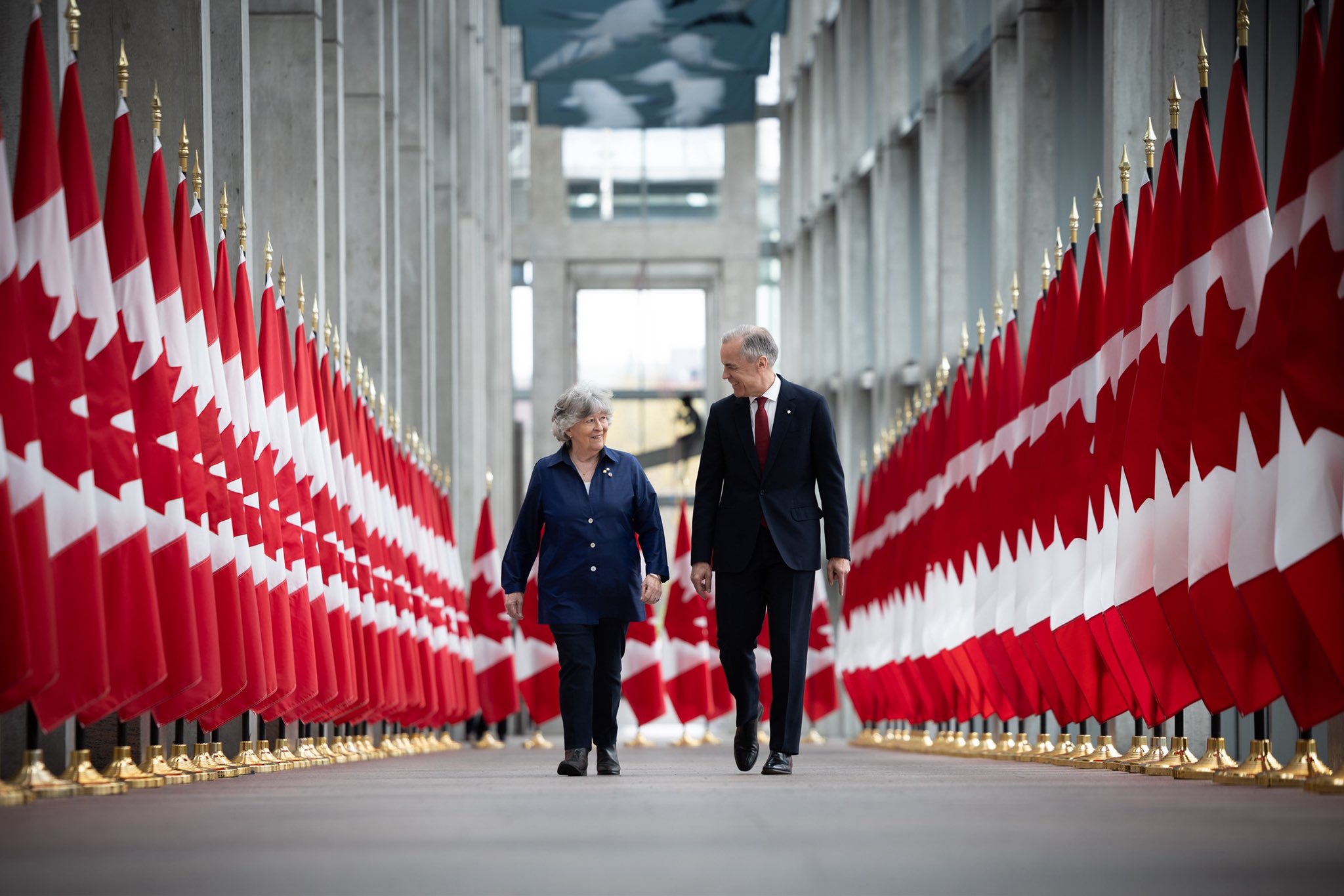
Canada is set to appoint a new Governor General, with former jurist Louise Arbour named to assume the role at the end of the current term.
At a recent news conference, Prime Minister Mark Carney announced that Arbour will succeed Mary Simon, whose tenure concludes this month. Arbour’s appointment comes amid renewed attention to bilingualism, particularly proficiency in French, one of Canada’s two official languages.
The transition follows debates surrounding Simon’s French-language proficiency, as well as broader concerns about the process by which the Governor General is selected by the prime minister.
“Canada was built on the foundations of three peoples—Indigenous, French, and British,” Carney said during a ceremony overlooking Parliament Hill, adding that “unity does not require uniformity, that our differences are a strength to be nurtured, not a risk to be managed. That insight has been sustained and reinforced generation after generation by our institutions—Parliament, the courts, the Crown, the treaties, the Charter, the public service, and a free press.”
Carney emphasized the constitutional role of the Crown in Canada’s governance. “The Governor General is the Crown’s representative in Canada,” he said. “Commander-in-chief of the Canadian Armed Forces, steward of our traditions—of peace, order, and good government—and above all, the governor general is the guardian of our constitutional order.”
Simon, who was born in Quebec and raised in Kuujjuaq in the Quebec Arctic, is the daughter of an English-speaking Canadian father and an Inuk mother. She entered office fluent in English and Inuktitut but not French. She is scheduled to step down later this month.
Arbour highlighted Canada’s institutional strengths and diversity in remarks following her appointment. “Canada is a wonderful country shaped by the diversity of its people, or perspective and experiences, but I think it is shaped also mostly by a common respect for strong public institutions and for the rule of law,” she said. “Above all, we all strive to provide for each other in the spirit of equality and generosity.”
Born in Montreal, Arbour earned her law degree from Université de Montréal in 1970. She became the first francophone appointed to the Ontario Court of Appeal in 1990. During her tenure, she led a landmark inquiry into conditions at the Kingston Prison for Women, uncovering a pattern of “cruel, inhumane, and degrading treatment,” which prompted resignations and policy reforms in Canada’s correctional system.
Arbour later served as United Nations High Commissioner for Human Rights from 2004 to 2008 and as the UN’s Special Representative for International Migration from 2017 to 2018. She also led a 2022 review into sexual misconduct within the Canadian Armed Forces and military colleges.
Simon had pledged to learn French after her appointment by former prime minister Justin Trudeau in July 2021. However, she did not achieve fluency, prompting criticism, particularly in Quebec. The Office of the Commissioner of Official Languages received more than 1,300 complaints regarding her language proficiency. Former commissioner Raymond Théberge later ruled that her appointment did not violate the Official Languages Act, as the position is not subject to its requirements.
Despite undertaking hundreds of hours of language training at a reported cost of $52,000, Simon did not become fluent in French. A 2024 visit to Quebec City, where she spoke limited French, further fueled criticism in French-language media.
The controversy has led to a clearer emphasis on bilingualism for future appointments. Carney indicated that Canada’s next viceroy would be fluent in both official languages.
Duff Conacher, co-founder of Democracy Watch, criticized the selection process, arguing it lacks transparency and independence.
“Given how important it is for the governor general to be independent of the prime minister and impartial, Carney should not have handpicked his appointee through a secretive, partisan process,” Conacher said.
“The governor general should have been chosen through a democratic process, and the prime minister should also have told King Charles who Canada chose and not asked his approval, and if he had accepted that as the new protocol, it would have become clear that Canada chooses its own head of state.”
Related posts:
 Canada Post to Honor Sikh Soldiers with Special Remembrance Day Stamp
 A New Chapter: Rebuilding the India-Canada Partnership
 Canada’s G7 Presidency Culminates in Niagara as PM Carney Pushes $1 Trillion Investment Vision
 G7 Summit 2025 Ends with Renewed Alliances, Sharp Divides, and a Surprise Exit by President Trump