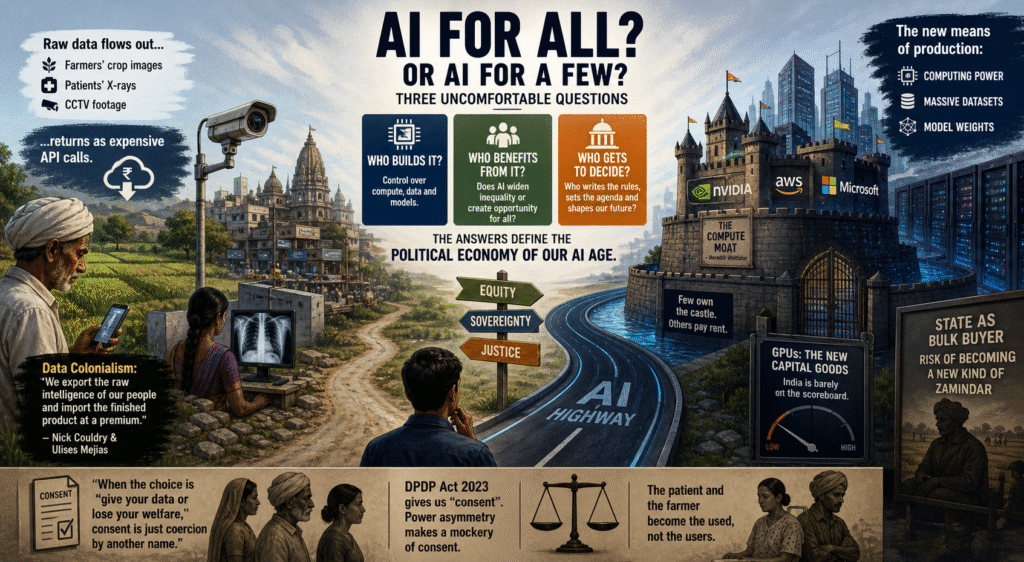
Living democracies, especially one as vast and vibrant as India, ought to pause to ask three uncomfortable questions about Artificial Intelligence. Who builds it? Who benefits from it? And who gets to decide?
The answers define the “political economy” of our AI age. In India, the contours of this future are being written right now, line by line, in compute contracts, data policies, and government tenders. Every era has its engine of production. In agrarian India, it was the soil beneath our feet. In industrial India, it was the capital. Today, while on the AI highway, the means of production are computing power, massive datasets, and model weights.
“AI for All” is a beautiful slogan and the India AI Mission’s ₹103.71 billion ($1.10 billion) outlay signals our soaring ambition. But slogans are not policies and infrastructure is not always synonymous with justice. These new “means of production” are not neutral. They are being trained in ways that may soon become irreversible.
Decades ago, economist C.T. Kurien warned that importing capital goods creates dependency, not freedom. Graphics Processing Units (GPUs) are the new capital goods and India is barely on the scoreboard. While we assert “digital sovereignty,” we are essentially renting the foundations. We buy Nvidia chips, rent cloud space from US giants and fine-tune models like Llama that are governed by American licenses. Meredith Whittaker calls this a “compute moat,” a world where a few firms own the castle and the rest of us are just paying rent.
Advertisement
Compute in India are a scarce resource, rationed out to a few. A startup in Bhopal doesn’t stand a chance against a Bengaluru unicorn backed by Microsoft credits. When compute is a luxury, “AI for All” becomes “AI for those close to the capital.” In this landscape, the state, as the bulk buyer of GPUs, risks becoming a new kind of Zamindar. The compute divide is simply the old digital divide with a faster processor.
We often hear that “India has data” like we once heard “India has a demographic dividend.” But data isn’t like oil. It doesn’t have value just sitting in the ground. It only gains value when it is cleaned, labeled, and modeled, usually by firms elsewhere.
This is what Nick Couldry and Ulises Mejias call Data Colonialism. Our farmers’ crop images, our patients’ X-rays and the CCTV footage of our streets flow outward as raw material. They return to us as expensive API calls. We are exporting the raw intelligence of our people and importing the finished product at a premium.
While the DPDP Act 2023 gives us “consent,” we know from the RTI movement that power asymmetry makes a mockery of consent. When the choice is “give your data or lose your welfare,” consent is just coercion by another name. The patient and the farmer become the used, not the users.
Perhaps most crucially, Ambedkar reminded us that technologies carry the social hierarchies of their makers. Indian AI is being shaped in labs and boardrooms that remain overwhelmingly rich, male and metropolitan.
If our AI is trained only on Wikipedia, government reports and English texts, it will speak only in the voice of the state and the elite. Where are the Dalit literatures? The Adivasi oral histories? The Bhojpuri feminist poems? When these are absent from the training set, the model becomes blind to them. This is “discrimination by design.”
The result is algorithmic untouchability. A model may flag a Muslim name as “high risk” for a loan or dismiss non-standard Hindi as an “error” simply because history, with all its prejudices, was its teacher.
Gandhi’s test for any technology was simple. Does it increase the autonomy of the last person? By that measure, our path is unfinished. We cannot simply copy Western regulations. We need a “Digital Public Infrastructure” for compute. We need “Algorithmic RTI” so a citizen can demand to know why a machine denied her a service. Most importantly, we need to treat our data as a “common” a public resource that must be protected from enclosure.
The political economy of AI will not be settled by technocrats alone. It is a struggle over who owns the machine, whose knowledge lives inside it and who is allowed to use it. When an AI system denies a farmer’s loan or a teacher’s promotion or picks up random few individuals from a government department for a personal audit, there is no appeal mechanism. No audit trial and no liability.
If we get it wrong, we will have inequality optimized at machine speed, where harms are individualized and profits are distributed to shareholders. But if we get it right, AI could finally extend the constitutional promise of fraternity and equality. The code is being written as we speak. The question for us is, whose AI and for which India?
Disclaimer: The opinions and views expressed in this article/column are those of the author(s) and do not necessarily reflect the views or positions of South Asian Herald.