Join WhatsApp Channel

As the global conversation on artificial intelligence intensifies within multilateral forums, the India-AI Impact Summit 2026 emerges as a defining moment for the Global South. With the United Nations Secretary-General António Guterres, Under-Secretary-General and Special Envoy for Digital and Emerging Technologies, Amandeep Gill, and other senior UN leadership set to participate, the Summit signals a significant convergence between national AI ambitions and the UN’s evolving framework on inclusive, responsible, and human-centric governance.
At the Summit, the United Nations Office for Digital and Emerging Technologies (ODET) is also hosting three high-level side events from February 18-20. The topics include Role of Science in International AI Governance; AI and Children’s Safety and Wellbeing; and How AI Will Reshape Global Development Beyond the SDGs.
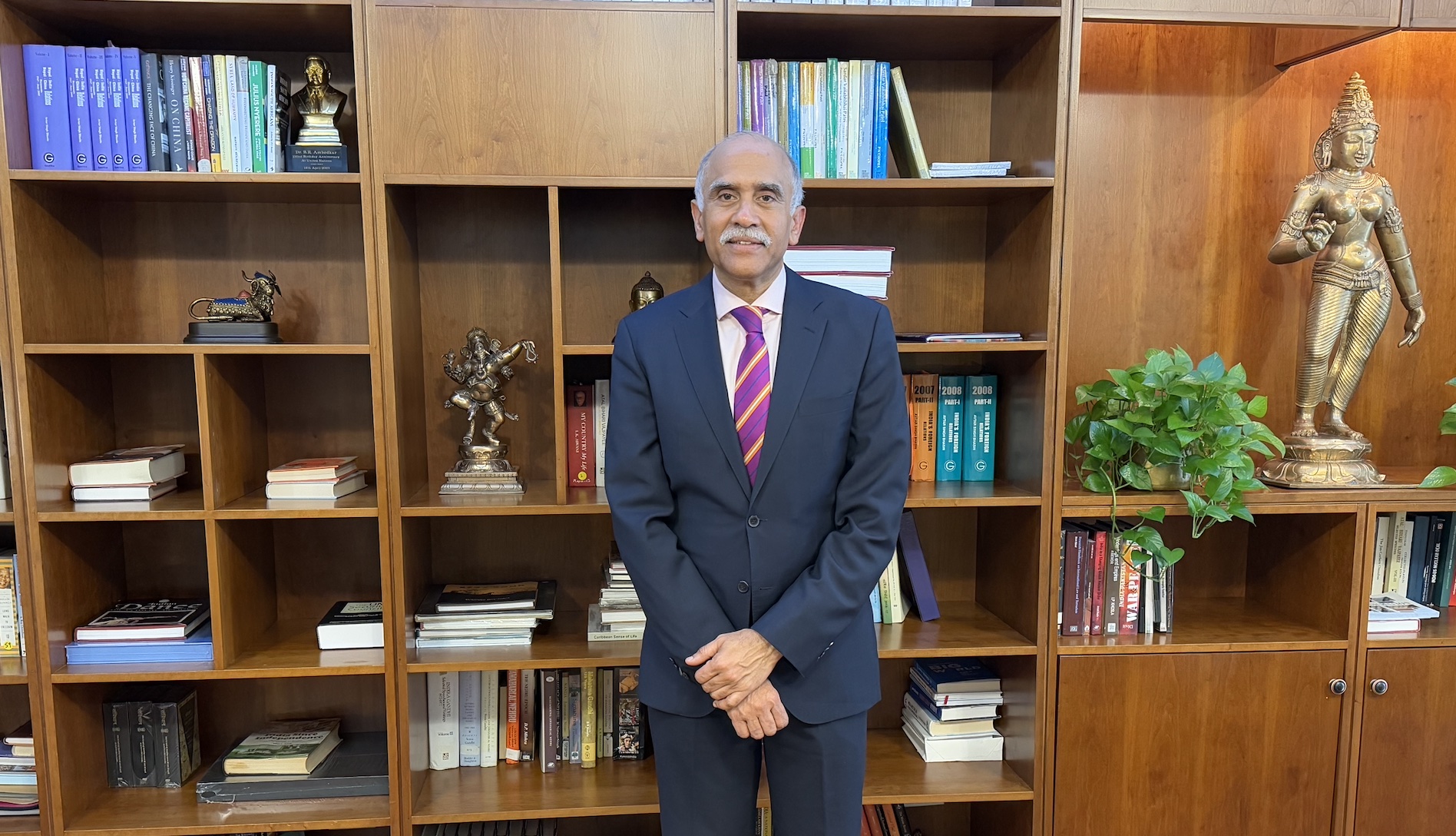
In this exclusive interview with South Asian Herald, on February 13, 2026, India’s Permanent Representative to the United Nations, Ambassador Parvathaneni Harish reflects on the Summit’s global significance, its alignment with the UN’s Global Digital Compact and the Pact for the Future, and how it seeks to democratize AI while advancing sustainable development priorities.
The India-AI Impact Summit 2026 will be the first major global AI summit in the Global South. What is the significance of this milestone?
AI has become the most consequential transformation of recent times, yet the narrative is primarily controlled by a few nations that produce highly capable AI models.
The Summit is significant because it brings the perspectives and priorities of the Global South to global conversations on artificial intelligence at a time when AI is rapidly shaping development trajectories worldwide. While AI adoption is expanding across regions, there remain clear gaps in access, capacity, affordability, and readiness, particularly for developing countries.
By hosting the AI Impact Summit, India aims to provide a credible multilateral platform where developing countries can articulate their development needs, practical challenges, and aspirations related to AI. The Summit’s agenda has been carefully structured to focus on issues of relevance to the Global South, including capacity building, access to AI resources, trust and safety, and inclusive deployment.
At the same time, the Summit is not limited in scope to any one region. It recognizes that the safe, responsible, and trustworthy development of AI is a global concern. By broadening participation and grounding discussions in development realities, the Summit seeks to strengthen mutual understanding that could benefit the international community as a whole.
Beyond its importance for the Global South, what does this Summit signify for the global AI ecosystem at large?
The Summit has many diverse elements. As Prime Minister Narendra Modi has said, AI should be human-centric, trustworthy, and inclusive, with technology serving humanity and enhancing human well-being. These principles resonate strongly with the work of the United Nations and the Global Digital Compact of the Pact for the Future, which leaders of UN Member States agreed upon in September 2024.
The Summit seeks to underscore that AI governance is not only about managing risks, but also about enabling innovation, access, and capacity building, particularly for countries that are still developing their AI ecosystems. By bringing together governments, industry, academia, and international organizations, the Summit focuses on practical collaboration and responsible use, contributing to an AI ecosystem that is innovative, safe, and inclusive.
Importantly, the outcomes of the Summit will help inform discussions, including the first UN Global Dialogue on AI Governance that will take place on the margins of the AI for Good Global Summit in July in Geneva. In this sense, the Summit marks an important milestone in the evolving global dialogue on AI, from which the UN ecosystem will also benefit.
The UN Secretary-General will be attending the Summit in person. Could you share more details about the UN delegation participating in the event?
The participation of senior United Nations leadership at the Summit reflects the strong alignment between the Summit’s objectives and the UN’s ongoing work on inclusive and responsible AI. In addition to the UN Secretary-General, the Summit will see the participation of the top leadership of ITU, UNESCO, IFAD, FAO, UNICEF, WFP, UNDRR, and UN Women, as well as the UN Secretary-General’s Special Envoy on Technology.
Their engagement highlights the growing relevance of AI across the UN ecosystem for development, inclusion, and human well-being. The implications for sustainable development, gender equality, youth empowerment, population issues, and human-centric governance are significant. It also underscores the recognition that AI can be a powerful enabler and multiplier of development if deployed responsibly and inclusively.
The presence of senior UN leadership will help ensure that the AI Impact Summit’s discussions and outcomes connect meaningfully with ongoing multilateral processes and contribute to advancing global development priorities under the UN’s multilateral framework. In fact, the UNSG’s participation in the panel on the role of science in international AI governance will certainly be food for thought. Other sessions on children’s safety and the SDGs will take ongoing conversations forward.
The AI Impact Summit 2026 is grounded in the principles of “People, Planet, and Progress.” Could you elaborate on what these principles represent and how they shape the Summit’s agenda?
The Summit is anchored in three pillars: People, Planet, and Progress — which together provide a development-oriented framework for global cooperation on AI. It is guided by a vision that AI must be human-centric, trustworthy, and inclusive, enhance access to services, protect rights, support jobs and skills, and build public trust.
At the same time, sustainability and resilience are important for the planet. Promoting energy-efficient AI systems, responsible use of resources, and AI applications that support climate action, disaster resilience, and environmental protection is vital.
Finally, inclusive growth and development are essential, through leveraging innovation, capacity building, and the use of AI to accelerate scientific discovery, productivity, and development outcomes.
The Summit’s themes cover safe and trusted AI, sustainable and resilient systems, AI for science, AI for social impact, and the impact of AI on people, jobs, and education. Taken together, they reflect an integrated approach that is closely aligned with the 2030 Sustainable Development Agenda.
In the lead-up to the Summit, the Permanent Mission of India (PMI) to the United Nations hosted several events at the United Nations. How did these engagements help build momentum and international support for the Summit?
The PMI has regularly hosted events and briefings to raise awareness and interest in the Summit. On the margins of the World Summit on the Information Society (WSIS)+20 review in December 2025, our Mission hosted a curtain-raiser event in partnership with the Permanent Mission of France, titled “From Action to Impact,” which saw participation from a large number of Member States that wanted to know more about the Summit.
Deputy Minister for Electronics and IT of India, Jitin Prasada, and the French Ambassador for Digital and AI, Clara Chappaz, highlighted how the India-AI Impact Summit takes forward the outcomes of the AI Action Summit that France hosted in February 2025. UN organizations and industry also participated in the event with great enthusiasm, keen on exploring various options to build upon the outcomes of the AI Impact Summit.
We also hosted an event in December 2025 titled “Building Operational Capacities for the Use of AI in Counter Terrorism,” along with the Permanent Mission of the UAE, the UN Office of Counter-Terrorism (UNOCT), and the UN Interregional Crime and Justice Research Institute (UNICRI). The event highlighted Prime Minister Narendra Modi’s focus that security cannot be an afterthought in an interconnected world. The event was also addressed by H.E. Dr. Mohamed Al Kuwaiti, Head of the UAE Cyber Security Council, and many organizations working at the cutting edge of research in this field.
The Mission also hosted a briefing titled “Towards a Network for Inclusive AI Capacity Development” at the United Nations in December 2025, which brought together Member States, UN leadership, and experts to discuss progress on inclusive AI capacity building and emerging ideas on establishing a UN-supported network. In this regard, India has nominated IIT Madras as a UN Centre of Excellence under the initiative of the United Nations Office for Digital and Emerging Technologies. China, Vietnam, Saudi Arabia, Kazakhstan, and Kenya have also nominated their centers under this initiative.
Participants exchanged perspectives on capacity gaps, shared national experiences and initiatives, and expressed interest in continued engagement and cooperation on AI capacity development. The discussion reflected broad cross-regional interest and reinforced the importance of anchoring such efforts within the UN system, helping build momentum and international support ahead of the Summit.
Prime Minister Narendra Modi has emphasized the need to democratize AI. How does this vision align with the goals of the Summit, and what does it mean in practical terms?
The Prime Minister has been a strong advocate for making AI accessible to as many people as possible. His vision of AI democratization — building capacity, ensuring transparency, and contributing to inclusive development — is the guiding theme of the AI Impact Summit.
The Summit focuses on practical mechanisms to expand access to AI capabilities, support skills development, and facilitate collaboration, particularly for developing countries. Several Summit deliverables are designed to promote shared resources, cooperation, and knowledge exchange in areas such as AI for science and social impact.
In practical terms, this approach is about moving from aspiration to action — strengthening capacities where they are most needed, fostering partnerships, and ensuring that AI supports development outcomes in line with national and UN priorities.
Related posts:
 India and France Host United Nations Event to Set Stage for AI Impact Summit 2026 in New Delhi
 India-AI Impact Summit 2026 to Focus on “People, Planet, and Progress,” says Ambassador Vinay Kwatra
 Digital from India: Leapfrogging Development Through Text-Enabled Citizen-Centric Governance
 India Condemns Pahalgam Terror Attacks, Showcases Digital Public Infrastructure Leadership at United Nations