Opposition Congress leader Rahul Gandhi is at the center of an escalating political confrontation with Prime Minister Narendra Modi and the BJP. His latest activities in Hyderabad have brought three issues into focus: electoral integrity, the state of Indian democracy and economic rights for workers.
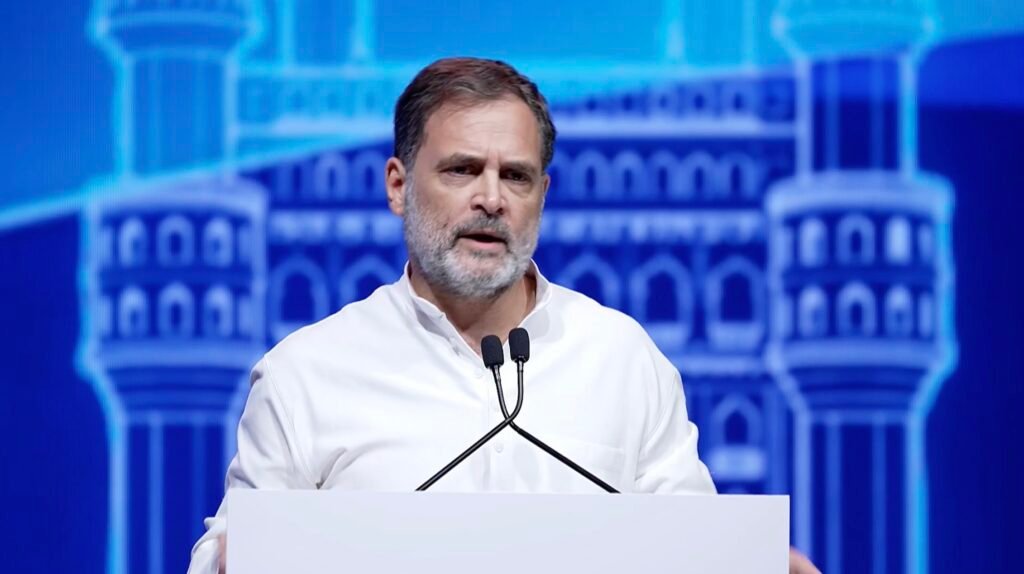
Here are the major developments. Rahul Gandhi’s Bharat Summit speech: November 14. At the Congress-organized Bharat Summit 2026 in Hyderabad, attended by international delegates from around 70 countries, Rahul Gandhi made several significant political arguments.
His principal points were: He alleged that India’s democratic institutions had been weakened since 2014. He questioned the credibility of India’s electoral processes. He attacked what he described as the growing nexus between political power and big business. He argued that the Opposition’s struggle was rooted in truth, non-violence and democratic resistance.
He also expressed confidence that the Opposition would defeat Narendra Modi.
Advertisement
In a particularly striking statement, he declared that Modi’s defeat was a “done deal.”
BJP launches counterattack over foreign delegates. The BJP responded sharply to Rahul’s international outreach. Its leaders accused Congress of providing an international platform to people allegedly associated with George Soros-funded organizations and individuals critical of India.
BJP spokespersons accused Rahul of: Seeking international support against the Modi government. Undermining India’s democratic institutions before foreign audiences. Giving legitimacy to alleged anti-India narratives.
These are BJP allegations, not established evidence of foreign interference in the Congress summit. The controversy has reopened the political argument over whether Indian opposition leaders should take concerns about democratic institutions to international forums.
A major initiative for gig workers in Telangana. This is one of the more substantive developments. Rahul Gandhi participated in the launch of the Telangana Gig Workers’ Social Security and Welfare Scheme alongside Chief Minister A. Revanth Reddy.
The announced provisions include: ₹5 lakh accident insurance.. ₹10 lakh health insurance. Social security protection. Dedicated Wi-Fi-enabled rest zones for delivery workers and other gig workers.
Rahul accused the BJP-RSS of favoring billionaires and large corporations at the expense of gig workers. He argued that workers employed by companies such as Uber and Ola should become partners in economic growth rather than remain vulnerable contract workers. He also joined a motorcycle rally with gig workers in Hyderabad.
Rahul challenges Modi to a public debate. On November 13, Rahul renewed his challenge to Narendra Modi for a one-on-one televised debate. He claimed that the Prime Minister would be unable to withstand a direct debate with him.
He also alleged that his telephone was being tapped and said his mobile phone contained evidence relating to foreign influence and alleged anti-national activities. He challenged Modi to debate him on these allegations.
The government has not established the truth of Rahul’s surveillance allegations through the reports available here. The challenge is part of a wider confrontation over the Special Intensive Revision (SIR) of electoral rolls, alleged voter deletions and the Election Commission’s conduct.
Home Minister Amit Shah has argued that these matters should be debated in Parliament.
Rahul Gandhi’s forthcoming American visit; Rahul is scheduled to visit the United States next week. According to reports, he will participate in academic fireside conversations: November 17: Columbia University, New York. November 18: Chicago.
Indian Overseas Congress chairman Sam Pitroda has described the engagements as academic conversations rather than diaspora political rallies.
The discussions are expected to cover student movements, international affairs and geopolitics. Given the controversy surrounding his Hyderabad summit remarks, his American engagements will attract considerable attention.
What does all this mean for Indian politics? Three political developments deserve attention.
First, Rahul is internationalizing his democracy argument. Rather than confining his criticism of the Election Commission, electoral rolls and political institutions to Parliament and domestic rallies, he is presenting these concerns to international audiences.
Second, he is trying to expand the Congress’s economic narrative. The Telangana gig-worker legislation provides a concrete policy example around which Congress can build an argument about employment insecurity, social protection and corporate concentration.
Third, the BJP is attempting to turn Rahul’s international outreach into a political liability. Its foreign-influence allegations are intended to challenge the legitimacy of his international criticism of the Modi government.
The central question is whether Rahul can translate these initiatives into a sustained national political movement, rather than simply a series of high-profile confrontations with the Prime Minister.
Disclaimer: The opinions and views expressed in this article/column are those of the author(s) and do not necessarily reflect the views or positions of South Asian Herald.