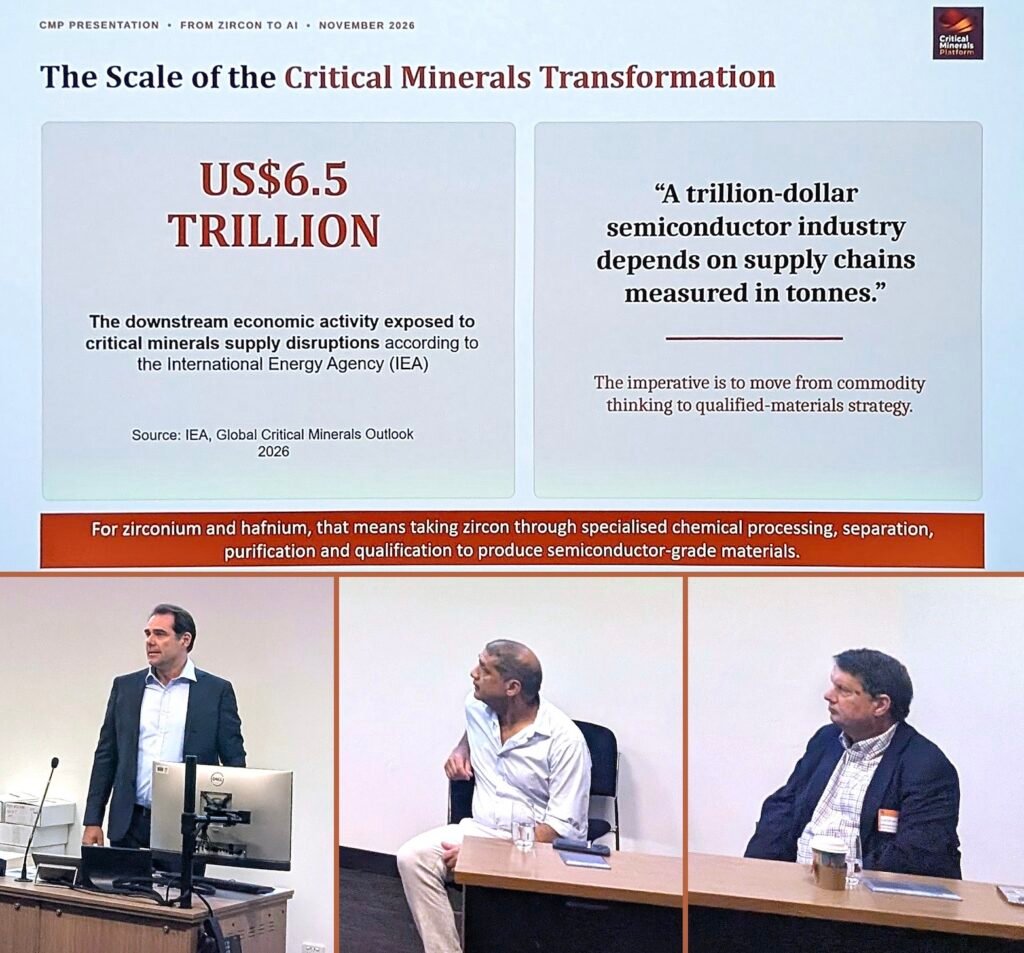
The white glaze on a coffee cup and the chips inside an AI data center have more in common than most people realize, according to critical minerals specialist Alister MacDonald. Speaking at a Perth forum on November 9, 2026, he traced how zircon from Western Australian mineral sands gives coffee cups their whiteness and also yields hafnium, a metal he called essential to modern computer chips. He described that supply chain as “hidden in plain sight.”
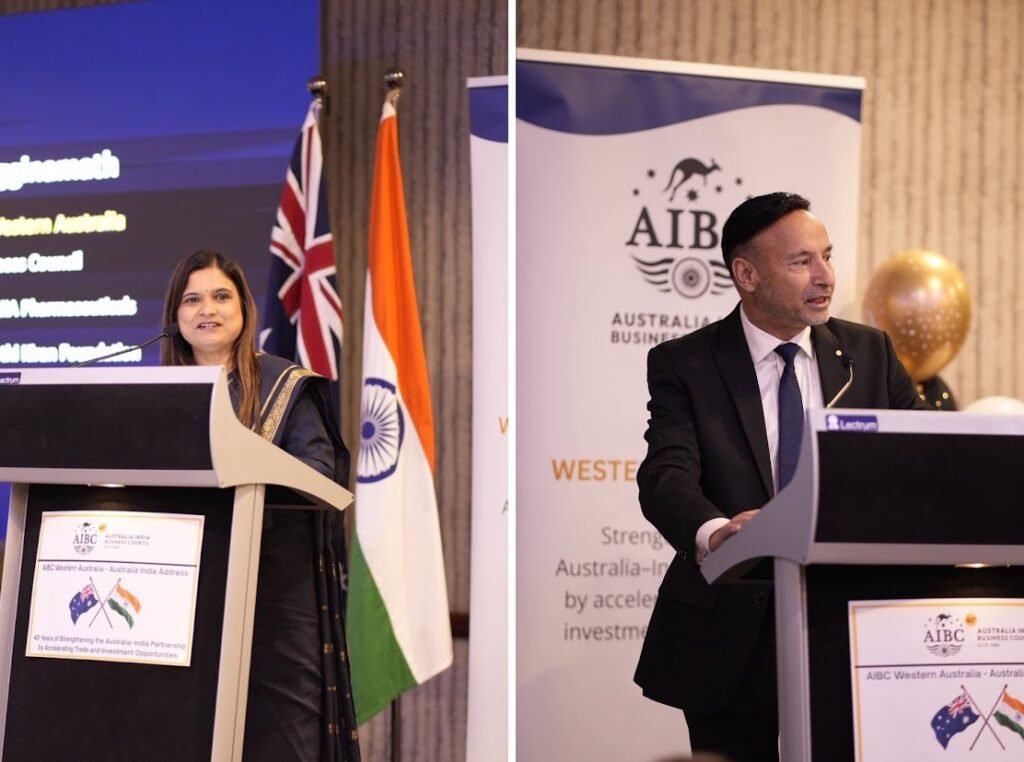
The forum, “WA’s Hidden Place in the AI Race: The materials behind AI and advanced technology,” was presented by the Critical Minerals Platform and hosted by the UWA Business School, in partnership with the Critical Minerals Institute’s Platinum Membership. It brought together leaders from mining, finance, government and research. The forum was convened by Prof. Raymond da Silva Rosa, co-director of the Asia Center at UWA.
A Year Into the US and Australia Deal
The forum came just over a year after President Donald Trump and Prime Minister Anthony Albanese signed the United States and Australia critical minerals framework at the White House on October 20, 2025. According to the framework published by the Australian government, each country committed at least US$1 billion to critical minerals projects within six months, and the two governments agreed to jointly identify projects to strengthen priority supply chains.
Advertisement
The Prime Minister’s office put the pipeline of priority projects at US$8.5 billion. It named one Western Australian project, the Alcoa and Sojitz gallium recovery project at Wagerup, which it said could supply up to 10% of the world’s gallium.
Inside the Data Center
Mark Andrich, founder of the Critical Minerals Platform, brought that story close to home. He told the audience that gallium is expected to be produced “about 100 kilometers from here,” at Wagerup, “in the next maybe six to 12 months.”
He then turned to the AI boom. Andrich said 18 of the 22 minerals that make up the most weight in an AI data center are already produced in Western Australia. By his estimate, a single data center being built by Meta holds about US$3 billion worth of critical minerals at today’s prices, and that is before counting what it takes to power it.
Andrich compared Western Australia’s moment to Britain in 1830, when it produced about 80% of the world’s coal and gave the world the steam engine. He pointed to lithium as proof of what can happen. In 2003, he said, lithium did not even have its own line in the state’s resource figures. Twenty years later, Western Australia produced about 40% of the world’s supply, and the value of its exports had grown about 200 times.
The Metal You’ve Never Heard Of
MacDonald, of Technical Ceramic Marketing Services and the Critical Minerals Institute, was the forum’s keynote speaker and was introduced as a ceramics engineer with more than 40 years of international experience and a former General Manager at Australian Strategic Materials. His subject was hafnium.
MacDonald said hafnium lets computer chips “be smaller, operate faster and consume less energy.” Without it, he said, “everything basically stops.”
For a metal so important, the market is tiny. MacDonald said the entire world’s supply of hafnium once fit in a single shipping container. Today the world produces only about 100 to 120 metric tons a year, he said, and the price of hafnium metal has risen from about US$2,000 a kilogram in 2017 to about US$14,000. He challenged the audience to ask an AI search engine what would happen to memory chips without hafnium, and to see what answer came back.
From Jet Engines to Jewelry
Hafnium’s reach goes well beyond chips. According to MacDonald, it is found in the jet engines of passenger planes and in the rockets launching satellite fleets, which he said are expected to grow from about 10,000 satellites to 100,000.
Zircon even turns up in jewelry boxes. MacDonald said turning Western Australian zircon into cubic zirconia increases its value about 1,000 times.
Western Australia sits right at the start of this chain. MacDonald said Australia supplies about 400,000 of the world’s roughly 1.1 million tons of zircon a year, more than any other country. The next opportunity, he said, lies in processing that zircon into the high purity materials chip makers need.
Building It Together
MacDonald said the semiconductor industry increasingly recognizes it needs to take part earlier in the supply chain, through investment or partnerships, to secure its materials. He said the fastest way to build new processing capability is to partner with companies that already have the know-how.
Raj Surendran, Chief Executive Officer of Tianqi Lithium Energy Australia, said the answer is not only to build new supply chains but to learn from those that already exist. “How do we learn from China? How do we work with China?” he asked. He added that if Australia wants a second supply chain, “there’s a premium to pay for the products that are made in Australia.”
Who Was in the Room
The audience included representatives of BHP, Fortescue, Arafura Rare Earths, the Chamber of Minerals and Energy of Western Australia, the International Lithium Association, EY Parthenon, Alvarez and Marsal, Defense West, the Western Australian government and several universities. Guests included Kajari Biswas, Consul General of India in Perth, and Palanivel Thiaga Rajan, an adjunct professor at the UWA Business School and former Finance Minister of Tamil Nadu.
Setting the Pace
Da Silva Rosa said developing the critical minerals sector well would take “a lot of creativity and also a lot of goodwill” to ensure good outcomes for everyone, including traditional custodians. He said he hoped a future forum could take up that conversation.
He described Western Australia as “the Texas of Australia.” He said the state “should be setting the pace” and should be the place “people talk about in the rest of the world when they talk about critical minerals.” He said the people in the room from government, industry and academia were “exactly the right sort of people to help make that happen.”