Gold demand in India remained resilient through the October festive season despite a sharp correction in prices, with jewelry purchases and investment in gold exchange-traded funds (ETFs) providing support even as futures trading weakened and official imports remained below historical seasonal levels.
A decline in international gold prices, driven by expectations of further US Federal Reserve rate hikes, a stronger dollar and investor selling, helped revive physical buying during Dhanteras and Diwali. Retailers across regions reported improved customer footfall, with demand spread across jewelry, bars and coins.
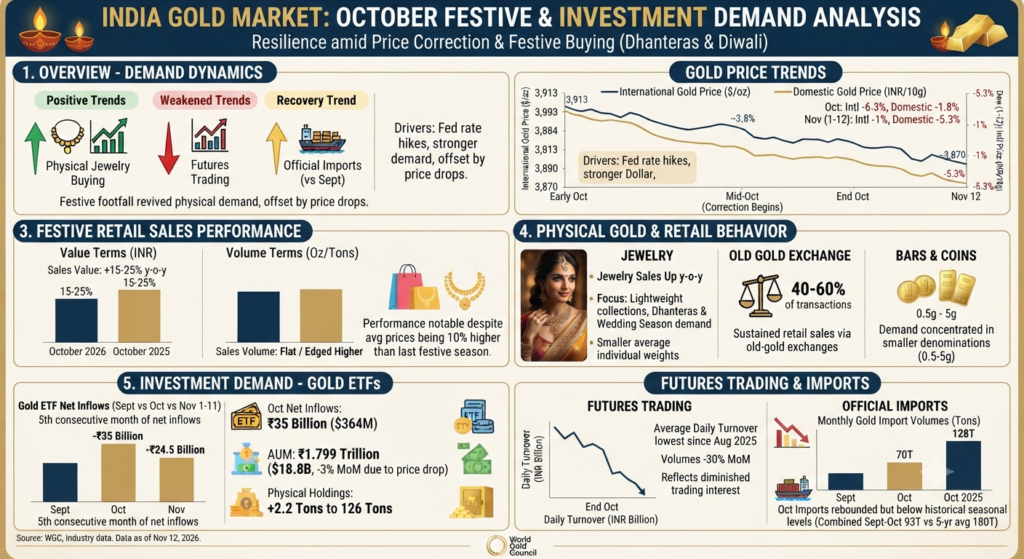
According to the World Gold Council (WGC), retailers estimated that gold sales in value terms increased 15-25% year-on-year during the festive period, while volumes remained largely flat or edged higher. The performance was notable because average gold prices during this year’s festive season were nearly 10% higher than during the corresponding period last year, while prices were up 17% year-on-year.
Gold prices, however, remained under pressure. After staying relatively stable during the first half of October, international prices fell 6.3% during the month to close at $3,913 an ounce, marking their second consecutive monthly decline. Domestic prices declined 1.8%.
Advertisement
The downward movement continued into November. By November 12, international gold prices had fallen a further 1% to $3,870 an ounce, while domestic prices dropped 5.3%. The sharper decline in the Indian market partly reflected a 1.7% appreciation of the rupee against the dollar since the end of October.
Despite the recent correction, gold prices remained significantly elevated compared with historical levels, keeping affordability a consideration for retail buyers. Year-to-date prices were down 11% in dollar terms and 4% in rupee terms.
The WGC attributed the international price weakness to expectations of further monetary tightening by the Federal Reserve, a stronger US dollar and a shift among investors towards bonds. Selling in gold futures added to the pressure.
The correction nevertheless appears to have encouraged physical purchases, particularly as jewelers entered the wedding season with expectations of continued demand.
Jewelry sales reportedly performed better than a year earlier, supported by promotional offers, new designs and lightweight collections. While more customers visited jewelry stores, the average weight of individual purchases remained relatively low, indicating that consumers were adjusting their buying patterns to elevated prices.
Old-gold exchanges also continued to play an important role in sustaining retail sales, accounting for 40-60% of transactions at several retailers. However, some jewelers reported a marginal decline in exchange activity as prices softened.
Purchases of bars and coins were also healthy, although demand was concentrated largely in smaller denominations of 0.5-5 grams, suggesting that buyers continued to favor modest, symbolic purchases rather than larger investment outlays.
Financial gold attracts investors
The resilience of investment demand was particularly evident in gold ETFs, which recorded their fifth consecutive month of net inflows in October.
Net inflows stood at ₹35 billion ($364 million), 22% lower than in September but above the average monthly inflow of ₹24 billion recorded during the preceding six months.
Although assets under management declined 3% month-on-month to ₹1.799 trillion ($18.8 billion) at the end of October, reflecting the correction in gold prices, physical holdings increased by 2.2 tons to 126 tons.
Cumulative additions to Indian gold ETF holdings reached 31.3 tons during January-October, representing a 22% increase from the corresponding period last year.
The momentum continued into November, with estimated net inflows of ₹24.5 billion ($262 million) during November 1-11, translating into an additional 1.75 tons of gold holdings.
The WGC said the continued inflows despite falling prices suggested that investors were treating the correction as an opportunity to increase their exposure to gold. Dhanteras may also have encouraged investors to extend traditional physical gold purchases into financial products.
The trend persisted even after domestic mutual funds temporarily suspended fresh subscriptions to gold fund-of-funds schemes in mid-October.
Investor participation also widened, with 64,163 new folios added during October, taking the total number of gold ETF accounts to 12.74 million.
Futures trading loses momentum
In contrast to the strength in physical purchases and ETF investments, activity in India’s gold futures market weakened considerably during October.
Average daily turnover fell to ₹176.5 billion ($1.85 billion), its lowest level since August 2025, while average daily trading volumes declined 30% month-on-month to 12.7 tons, the lowest since January 2025.
The slowdown reflected diminished trading and hedging interest amid falling prices, broadly mirroring a weakening in gold trading activity across international markets.
India accounted for just 0.5% of global gold trading volumes and 1.3% of global exchange-traded volumes during October.
Imports recover, but remain below seasonal levels
Gold imports rebounded in October after falling sharply in September, supported by festive restocking and lower prices. Imports in value terms more than tripled month-on-month to $5.51 billion, although they remained 63% below the level recorded a year earlier.
Gross import volumes were estimated at approximately 70 tons, compared with 23 tons in September and 128 tons in October 2025.
The recovery, however, was insufficient to restore the usual seasonal import momentum. Combined gold imports during September and October were estimated at around 93 tons, substantially below the 2021-25 average of approximately 180 tons for the same two-month period.
The divergence between reported retail demand and official imports suggests that a portion of domestic consumption was being met through alternative supply channels, including recycled gold and unofficial imports.
The WGC said persistent domestic price discounts and industry feedback pointed to an increase in unofficial supplies following the increase in import duty in May.
Domestic gold discounts narrowed sharply from an average of $66 an ounce in September to just $5 an ounce by November 12, reflecting improved seasonal demand. Prices nevertheless remained at a modest discount to import parity, indicating adequate domestic availability.
For the January-October period, India’s official gold imports stood at $47.36 billion, down 6% year-on-year, while gross import volumes were estimated at approximately 470 tons, a decline of around 14%.
Wedding season to support demand
Looking ahead, the combination of relatively softer prices and the ongoing wedding season is expected to underpin jewelry demand, although a sustained price recovery could constrain discretionary purchases.
Investment demand is likely to remain steady, supported by continued interest in gold ETFs and the tendency among investors to use price corrections to accumulate holdings.
The October experience highlights a changing pattern in India’s gold market: consumers continue to value physical gold as a festive and wedding purchase, but elevated prices are encouraging lighter jewelry, smaller bullion purchases and greater participation through financial investment products.