
Traversing by road from the bucolic landscapes of Arizona into the quietly charming state of New Mexico in the American Southwest is an enthralling experience. The Spanish influence remains palpable, lending the region a distinctive cultural character. Santa Fe, the state capital, sits at an elevation of nearly 7,000 feet and is the highest capital city in the United States. Yet beyond the scenic vistas and vast open spaces, what strikes a traveler most is the sense of calm. Even on long stretches of highway with sparse traffic, one feels neither intimidated by the solitude nor exhausted by the journey.
For Indian grandparents traveling with their daughter, son-in-law and grandchildren, the road trip offered both discovery and delight. The younger members of the family ensured that every day was filled with energy and laughter. Our first stop was the Apache Point Observatory, a research facility operated by the Astrophysical Research Consortium. Home to several astronomical telescopes, it offers sweeping views and a glimpse into the world of modern astronomy. However, during our afternoon visit, there were few staff members available to explain the facility’s scientific significance.
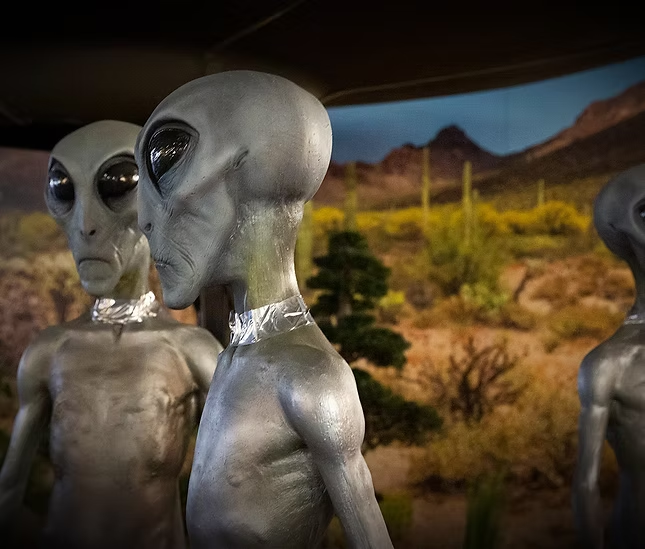
The journey then took us to Roswell and the International UFO Museum and Research Center, where visitors continue to explore one of America’s most enduring mysteries. In 1947, rancher W.W. “Mac” Brazel discovered unusual debris near Roswell. Initial reports from military officials appeared to suggest the recovery of a “flying saucer,” only for the claim to be quickly withdrawn and replaced with an explanation that the debris came from a weather balloon.
Decades later, the U.S. Air Force acknowledged that the material was part of Project Mogul, a secret programme designed to monitor Soviet nuclear activity. Subsequent reports dismissed stories of alien bodies, attributing them to misidentified military experiments and other incidents. Yet the Roswell mystery has never entirely faded. Believers continue to suspect a government cover-up, while sceptics remain unconvinced. The result is a thriving tourism industry built around the enduring fascination with extraterrestrial life. A visit to the museum, with its collection of exhibits and artefacts, remains almost obligatory for curious travelers.
Advertisement
Our final major stop was White Sands National Park in south-central New Mexico. Spread across the Tularosa Basin, its vast gypsum dunes create an extraordinary landscape of shimmering white. The sight evokes memories of the White Rann of Kutch in Gujarat, though the two are formed by very different natural processes. Children and adults alike delight in sliding down the dunes, while the setting sun transforms the landscape into a spectacle of remarkable beauty. The serenity of twilight at White Sands is unforgettable.
New Mexico offers far more attractions than can be covered in a single visit. Yet even a brief exploration reveals a state rich in history, mystery and natural splendor.
Disclaimer: The opinions and views expressed in this article/column are those of the author(s) and do not necessarily reflect the views or positions of South Asian Herald.