The fight for control of the U.S. Congress this November is expected to be decided in a relatively small number of competitive districts. In many of those battlegrounds, one of America’s fastest-growing immigrant communities—the South Asian diaspora—is emerging as a constituency that both Democrats and Republicans believe could make a difference.
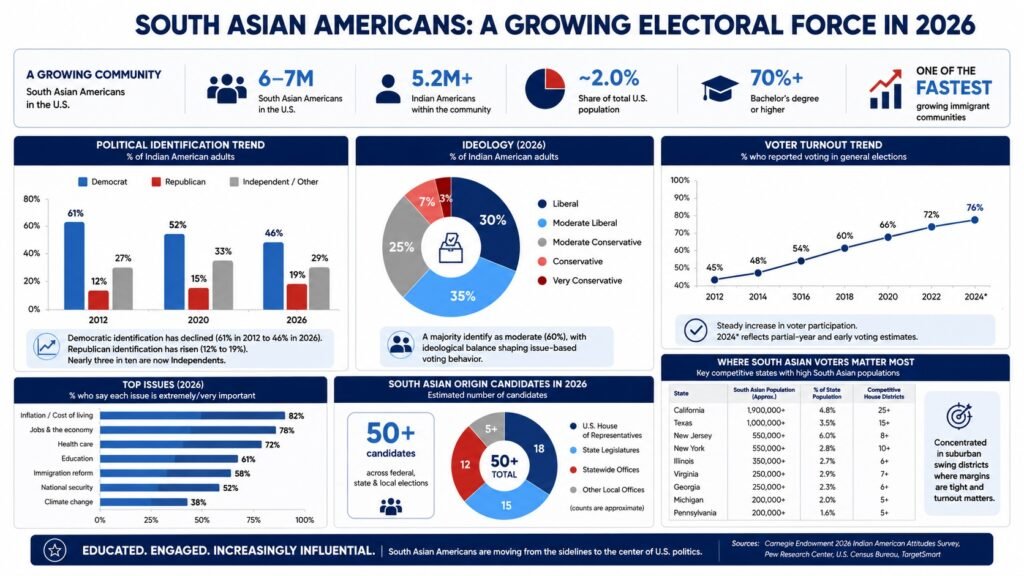
Numbering an estimated 6-7 million people, including more than 5 million Indian Americans, the broader South Asian community accounts for only a small share of the U.S. population. Yet its growing concentration in affluent suburban districts, high voter participation, economic influence and expanding political representation have transformed it into an increasingly important electoral bloc.
Unlike previous election cycles, the 2026 midterms are witnessing not only greater voter engagement but also an unprecedented number of South Asian Americans seeking public office. From congressional races to statewide contests and local elections, the community is fielding candidates across the political spectrum, reflecting a political maturation that extends well beyond symbolic representation.
A changing political landscape
Advertisement
For much of the past two decades, Indian Americans have ranked among the Democratic Party’s most dependable supporters. While that remains broadly true, recent research suggests the community is becoming more politically diverse.
The Carnegie Endowment’s 2026 Indian American Attitudes Survey found Democratic identification slipping modestly while Republican affiliation has increased. More striking, however, is the growth in voters identifying as independents, indicating that many Indian Americans are becoming less attached to either political party rather than shifting decisively toward Republicans.
Researchers Milan Vaishnav, Sumitra Badrinathan and Devesh Kapur argue that the community is increasingly characterized by ideological moderation and political independence. Although many Indian Americans remain critical of President Donald Trump’s second-term policies, particularly on immigration and economic issues, dissatisfaction with both major parties has become more pronounced among younger professionals and second-generation voters.
That changing political outlook has prompted both Democrats and Republicans to intensify engagement with South Asian communities through multilingual campaigns, ethnic media, professional organizations and cultural institutions.
Geography magnifies political influence
South Asian political influence is driven less by numbers than by geography.
The largest Indian American populations remain concentrated in California, Texas, New York, New Jersey and Illinois, while rapid growth in Georgia, Pennsylvania and Virginia has created new centres of political influence. Many of these communities are located in suburban congressional districts that have become decisive battlegrounds in recent elections.
New Jersey, home to one of the country’s largest South Asian populations, has become a testing ground for sophisticated voter outreach in languages including Gujarati, Hindi, Punjabi and Urdu. In Pennsylvania, Indian-American communities in the Philadelphia suburbs live in districts expected to play a critical role in determining House control. Georgia continues to see extensive voter mobilization across metropolitan Atlanta, while Republicans have expanded outreach in Texas, where rapidly growing Indian-American communities in Dallas-Fort Worth, Houston and Austin are attracting increasing political attention.
A broader pipeline of candidates
Perhaps the clearest sign of the community’s growing political influence is the breadth of candidates now seeking public office.
The foundation for that expansion was laid by leaders such as Vice President Kamala Harris and members of Congress including Raja Krishnamoorthi, Ro Khanna, Ami Bera, Pramila Jayapal, Shri Thanedar and Suhas Subramanyam, whose electoral success helped establish South Asian Americans as a visible presence in national politics.
This election cycle is producing another generation of aspirants hoping to build on that legacy.
Among the most closely watched congressional hopefuls is Amish Shah, the Arizona physician and former state legislator seeking to advance to the November election. In Pennsylvania, physician and state representative Arvind Venkat is campaigning in one of the country’s most politically competitive states. Bushra Amiwala, one of the youngest Muslim elected officials in the United States, is seeking to become one of the first Pakistani American women elected to Congress. In New Jersey, Jay Vaingankar is attempting to represent one of the nation’s largest Indian-American communities in Washington, while attorney Lisa Kaul is pursuing a congressional bid in New York.
The South Asian political footprint extends beyond congressional contests. Hetal Doshi is seeking to become Colorado’s Attorney General, while Darshana Patel and Fatima Iqbal-Zubair are among candidates contesting state legislative races in California. Across the country, dozens of South Asian Americans are campaigning for judicial positions, county offices, city councils, school boards and other local posts, underscoring the growing institutional depth of the community’s political participation.
The field itself is becoming increasingly diverse. While Indian Americans remain the largest and most established segment of the diaspora, Pakistani, Bangladeshi, Nepali and Sri Lankan Americans are assuming a more visible political role. Pakistani American congressional hopeful Aisha Farooqi, whose campaign has drawn support from Congressman Ro Khanna, is among candidates reflecting a broader South Asian political identity that increasingly transcends national origin.
Whether all of these candidates ultimately secure places on the November ballot remains to be seen. But together they represent one of the largest and most diverse cohorts of South Asian Americans ever to seek elected office in a single election cycle.
Mobilization over persuasion
Campaign strategists increasingly believe the community’s greatest electoral impact lies not in changing minds but in increasing participation.
Rather than relying primarily on television advertising, both parties have expanded outreach through temples, mosques, gurdwaras, cultural associations, business organizations, professional networks and ethnic media. Multilingual voter engagement has become a central feature of campaign strategy, particularly among first-generation immigrants.
The issues motivating South Asian voters have also broadened. Immigration remains important, but healthcare, education, taxation, entrepreneurship, housing affordability, economic opportunity and civil rights now feature prominently in community discussions. For younger South Asian Americans, domestic economic issues often carry greater weight than foreign policy questions involving South Asia.
From representation to electoral influence
Seventy years after Dalip Singh Saund became the first Indian American elected to Congress, South Asian Americans have moved from the margins of American politics to its competitive center.
The growing number of candidates seeking office reflects a community that has become more politically confident, better organized and more willing to participate in every level of government. At the same time, the electorate itself has become increasingly influential in suburban districts where congressional races are often decided by only a few thousand votes.
That combination of demographic growth, expanding representation and rising voter engagement is reshaping campaign strategies across the country. Both Democrats and Republicans now view South Asian Americans not simply as a growing minority community but as an electorate capable of influencing outcomes in some of the nation’s most closely contested races.