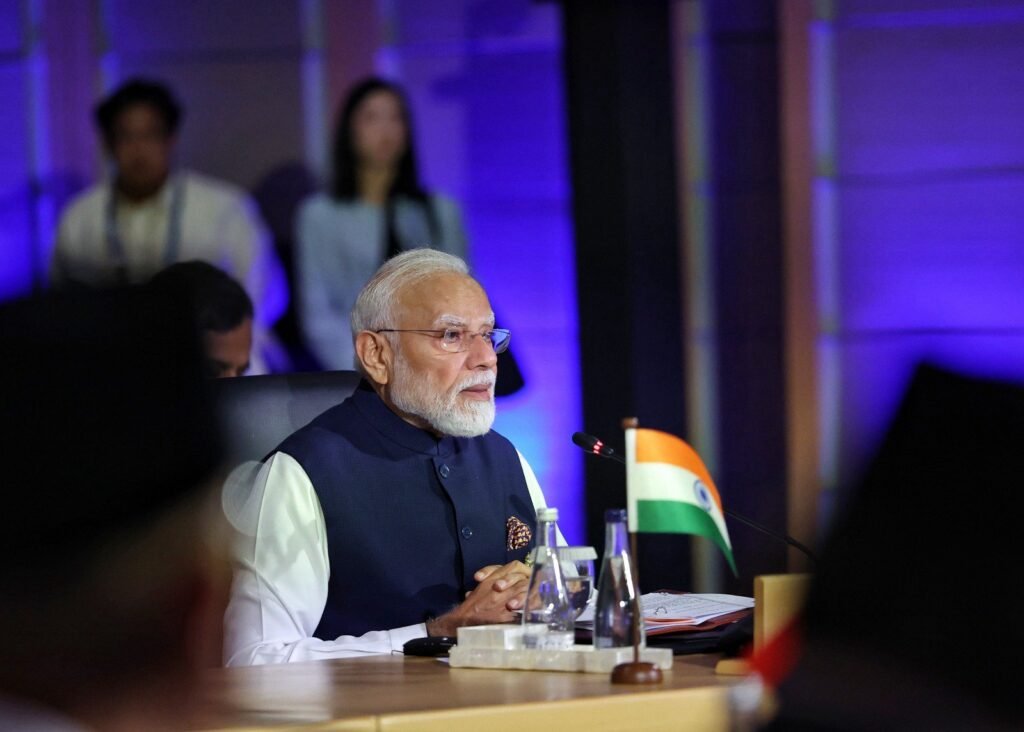
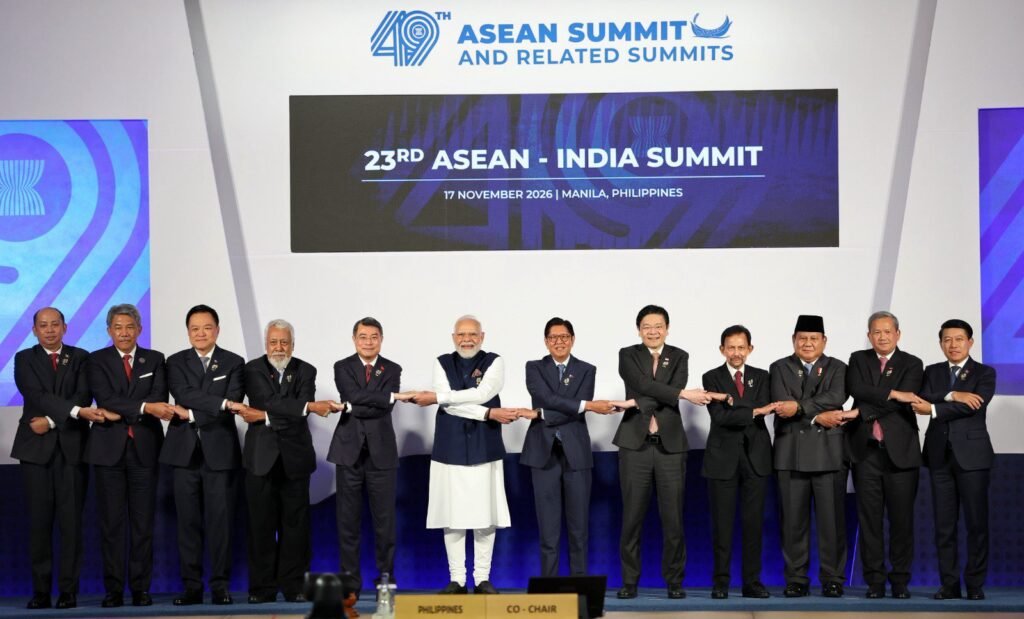
Indian Prime Minister Narendra Modi highlighted expanding cooperation between India and ASEAN in digital technology, defense and space at the 23rd ASEAN-India Summit in Manila on November 17, saying the partnership now extends beyond shared cultural and historical ties.
PM Modi said the meeting marked his 13th interaction with ASEAN leaders in the summit format.
“Over the past few years, our Act East Policy has given new momentum and greater depth to India-ASEAN relations,” he said.
Since 2014, India and ASEAN have undertaken more than 100 initiatives to strengthen people-to-people ties, launched nearly 250 Quick Impact Projects and provided more than 10,000 skill-building scholarships, according to the Prime Minister.
Advertisement
He cited direct flights connecting India with nine ASEAN countries and increasing tourism as further indications of closer ties. Against a backdrop of successive global crises, PM Modi said the summit’s theme, “Navigating Our Future, Together,” underscored the need for peace, stability and predictability.
“Together, India and ASEAN represent nearly one-fourth of the world’s population,” he said. “That is why it is essential to ensure that our future is shaped not by competition, but by cooperation. We have both the capabilities and the shared resolve to achieve this. Together, we can make this region a symbol of peace and stability.”
PM Modi said his third visit to an ASEAN country this year demonstrated the importance India places on the regional grouping.
“We firmly believe that India’s growth and ASEAN’s prosperity are deeply interconnected,” he said.
He added that the ASEAN Community Vision 2045 and Viksit Bharat 2047 could help translate shared aspirations into concrete outcomes in the coming years.
“Over the past twelve years, we have given fresh momentum to our partnership,” he said. “Now, together, we must give a new direction to the future of our region. India’s commitment to ASEAN unity and centrality in this partnership has been, and will remain, unwavering. I am confident that today’s meeting will take our Comprehensive Strategic Partnership to new heights and contribute to building a secure, inclusive, and prosperous Indo-Pacific.”
In a joint statement on disaster management cooperation, India and ASEAN outlined measures to strengthen coordination, improve early warning systems and expand disaster preparedness, response and recovery capabilities.
The statement called for regular consultations among the ASEAN Committee on Disaster Management, the AHA Centre and India’s National Disaster Management Authority to improve coordination between their disaster management mechanisms. It also proposed exploring consultations through existing ASEAN mechanisms to review cooperation and identify priorities for joint action.
On early warning systems, the statement outlined cooperation on earthquakes, tsunamis, floods, cyclones and landslides through the voluntary sharing of satellite data, seismic information and weather forecasts, subject to national laws and regulations. It also supported using space-based data and applications under ongoing ASEAN-India space cooperation to assess disaster risks and improve monitoring and forecasting.
Preparedness measures included training exercises, simulation drills and exchanges of disaster response personnel. The statement also sought to facilitate the rapid deployment of humanitarian assistance and disaster relief through existing mechanisms when requested or approved by an affected member state.
Cooperation between armed forces and civil defense agencies would take place within the ASEAN Defense Ministers’ Meeting-Plus framework and their respective mandates. The statement recognized civilian authorities’ primary responsibility for disaster response and specified that military assets should be used as a last resort.
For recovery and reconstruction, India and ASEAN proposed sharing experience in post-disaster recovery and environmentally sustainable practices. They also supported building capacity among vulnerable populations and encouraging the meaningful participation of women, young people, older adults and people with disabilities in disaster preparedness and recovery.
The statement promoted resilience through risk-informed governance, investment, stronger infrastructure, science and technology, and approaches centered on people, consistent with national laws and regulations.
It also encouraged the safe, responsible and ethical use of artificial intelligence, machine learning and big data to assess disaster risks, strengthen early warnings and coordinate responses. Research institutions would be encouraged to collaborate on disaster-resilient technologies and infrastructure standards.
Additional measures included joint training through relevant ASEAN and AHA Centre programs, India’s National Institute of Disaster Management and other Indian agencies, along with scholarships and technical exchanges for disaster management professionals.
Relevant ASEAN bodies and their Indian counterparts were tasked with identifying activities under the ASEAN-India Plan of Action for 2026–2030 and reporting progress through existing mechanisms.
PM Modi also addressed the 21st East Asia Summit in Manila on November 17, calling for dialogue, mutual respect and cooperation to advance peace. He reiterated India’s support for a free, open, inclusive and rules-based Indo-Pacific and urged the summit to help strengthen global stability and predictability.
“Since the COVID pandemic, the world has been facing one crisis after another. Conflicts are putting increasing pressure on food, fuel, and fertilizer supplies,” he said.
He also pointed to attacks on ships and seafarers along international waterways, the threat of terrorism and the growth of cross-border crimes, including cyber fraud and online scams.
PM Modi said the world needed “peace, stability, and predictability,” describing the East Asia Summit as an important forum for addressing common challenges and strengthening cooperation. He said dialogue, mutual respect and cooperation remained central to India’s foreign policy.
“ASEAN unity and centrality are at the heart of our Act East Policy,” he said, reiterating India’s commitment to a free, open, inclusive and rules-based Indo-Pacific. He added that India would continue to support peace efforts in Ukraine and West Asia.
“Our seas are the lifelines of our shared prosperity. Ensuring their security and freedom of navigation is the responsibility of us all,” he said. “In this direction, we are launching a Seafarers’ Safety Initiative, under which we will enhance cooperation in joint training and emergency response.”
PM Modi also emphasized the need to strengthen trust and security in the digital sphere.
“At the AI Impact Summit held in India this year, we emphasized the development of human-centric, inclusive, and safe AI,” he said.
He added that India had highlighted the role of technologies such as digital watermarking in addressing deepfakes and misinformation.
Welcoming the summit’s joint statement on combating online scams, PM Modi proposed hosting an East Asia Summit Cyber Crime Conference at India’s National Forensic Sciences University to help address the threat.
“The foundation of our relationship lies in a shared heritage that goes back thousands of years,” he said. “The National Maritime Heritage Complex, being developed at Lothal in India, will soon showcase this shared heritage to the world. To further strengthen our historical and cultural ties, we will also host the East Asia Summit Maritime Heritage Festival at Lothal.”
PM Modi said India would host the East Asia Summit University Heads Conclave at Nalanda next year to strengthen educational and research cooperation between India and ASEAN.
“This year, we are commemorating the 50th anniversary of the historic Treaty of Amity and Cooperation in Southeast Asia,” he said.
He added that the treaty’s emphasis on peace, respect for sovereignty and dialogue had become increasingly relevant.
“Our shared future will be shaped not by conflict, but by mutual respect and cooperation,” PM Modi said. “With this vision, India will continue to stand shoulder to shoulder with ASEAN, remaining committed to regional peace, stability, and shared prosperity.”