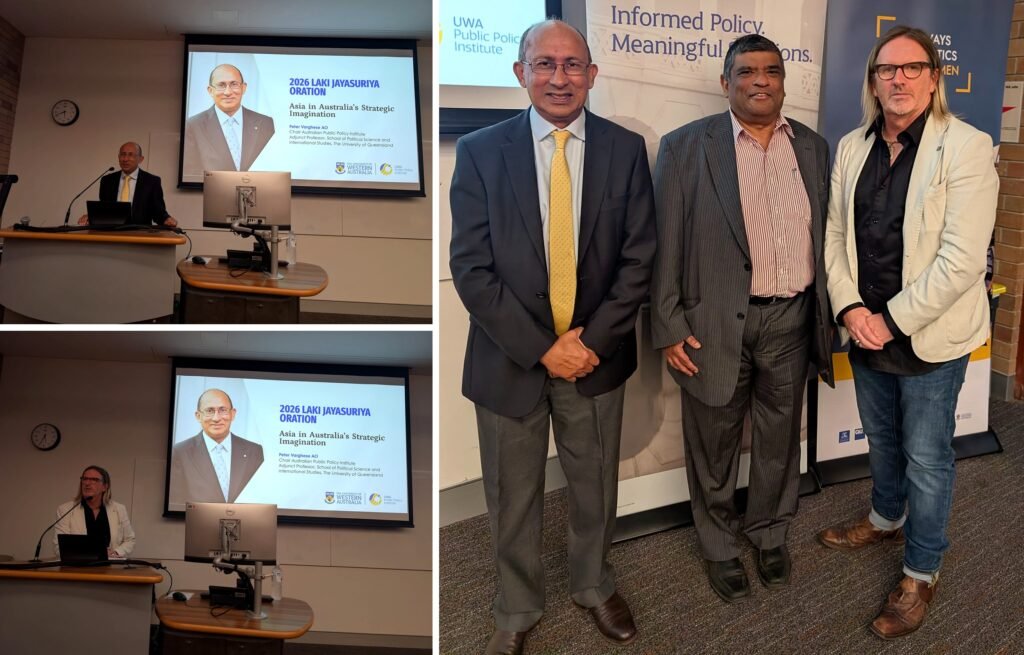
When Peter Varghese AO arrived in Australia from Kenya with his Indian-born parents in 1964, the White Australia policy was still in place. In 2012, he became the first non-white Secretary of the Department of Foreign Affairs and Trade, a milestone he said went completely unremarked.
Varghese shared that journey as he delivered the 2026 Laki Jayasuriya Oration for the UWA Public Policy Institute (PPI) in Perth on October 14, 2026, tracing how Asia has moved in Australia’s strategic imagination from a source of anxiety to a source of opportunity, and how identity, race, trade and shifting global power continue to shape the relationship.
The annual oration honors the late Emeritus Prof. Laksiri (Laki) Jayasuriya, whom Varghese described as an academic who also made a large contribution to Australian public policy, especially in immigration and multiculturalism. Jayasuriya was the first Asian professor at The University of Western Australia, where he founded the Department of Social Work and Social Policy, and was appointed by the Whitlam government to the Immigration Advisory Council in 1973. The UWA Public Policy Institute describes him as one of the key architects of Australia’s multicultural policy and a staunch supporter of engagement with Asia and the Indian Ocean region who challenged historic assumptions about Australia’s European identity.
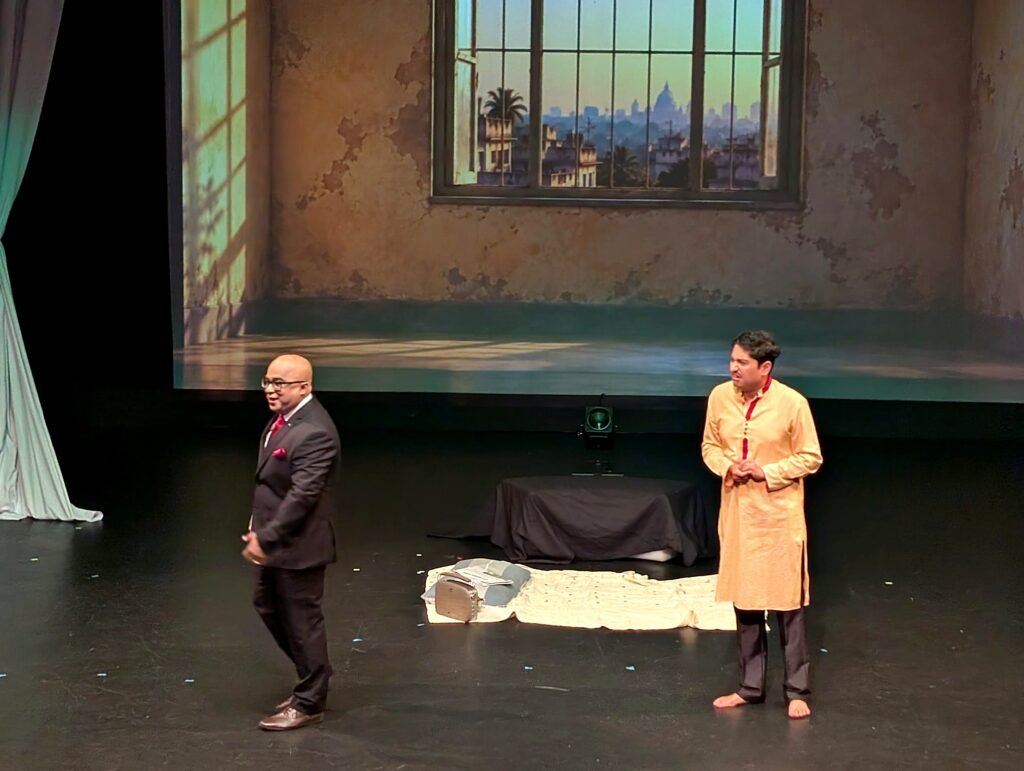
Opening the evening, Associate Professor Paul Maginn, Director of the UWA Public Policy Institute, said that as a geographer he saw Asia being imagined in different ways, as the Indo-Pacific, the Indian Ocean region or Australasia, and that what mattered most were the relationships between the nations within those spaces.
Advertisement
Maginn introduced Varghese as chair of the Australian Public Policy Institute and an adjunct professor at The University of Queensland, where he served as chancellor from 2016 to 2026. Varghese spent 38 years in the Australian Public Service, including as Secretary of the Department of Foreign Affairs and Trade, High Commissioner to India and Malaysia, Director General of the Office of National Assessments and Senior Advisor (International) to the Prime Minister. He is also the author of the India Economic Strategy to 2035.
Varghese acknowledged members of the Jayasuriya family in the audience, along with former federal minister Stephen Smith, the founding chair of the UWA Public Policy Institute’s advisory board, and former diplomat Sue Boyd. Varghese opened by arguing that the worlds of policymakers and academics in Australia should be brought closer together, saying universities can help by drawing on research, explaining what has worked in other countries and analyzing why policies fail.
Race, Identity and Shared Values
Varghese said race pride anchored Australian identity from the late 19th century until well after the Second World War, recalling Henry Parkes’ 1890 federation remark that the “crimson thread of kinship” ran through all Australians. He said that in less than a generation, Australia went from White Australia to one of the most multiracial nations in the world.
He described himself as a long-term optimist that multiracial Australia is now part of the nation’s social fabric. Diversity alone, he argued, cannot hold a society together. In his view, the glue must be a commitment to citizenship, equality of opportunity and a sense of shared destiny, built on the values of a secular liberal democracy such as the rule of law, a free press, freedom of speech, gender equality and a fair go. He said those values do not depend on any single cultural lineage.
Varghese said the memory of the White Australia policy still lingers in Asia, pointing to his time as High Commissioner to India, when attacks on Indian students in Australia made headlines in India for more than a year. He urged Australia to make better use of its diaspora communities as a bridge to the region, tied more closely to foreign and trade policy, while cautioning that diaspora groups should avoid pursuing homeland agendas that could see their loyalties questioned.
Trade Grows as Asia Literacy Falls
Varghese said the biggest shift in the relationship has been economic, with seven of Australia’s top 10 trading partners now in Asia. Investment, however, remains the gap. He said that apart from Japan and Singapore, Australian business tends to see investment in Asia as risky and prefers the United States and Europe.
He linked low investment to declining Asia literacy, citing a 75 percent fall in domestic university enrollments in Southeast Asian languages between 2005 and 2024, and said weak business demand for Asia expertise remains an unaddressed national challenge.
A Multilayered Strategy
On security, Varghese said Australia has long relied on a great and powerful friend, first the United Kingdom and then the United States. He argued Australia should not treat continued US global primacy as a vital national interest, and should instead combine the US alliance with greater defense self-reliance and deeper regional partnerships, beginning with Japan and extending to Indonesia, India and Southeast Asia.
He concluded that Australia does not need to become an Asian nation or reinvent its identity to engage the region, recalling former department secretary Dick Woolcott’s description of Australia’s aspiration to be the “odd man in” in Asia.
The Quad and AUKUS
Responding to a question from the South Asian Herald about the Quad and Australia’s role as a partner, Varghese said the grouping’s future depends on whether the United States pursues a collective or a unilateral approach to balancing China. He said he was concerned the Quad was drifting toward becoming a public goods grouping, and that it would only make a mark with “a sharp strategic focus” on balancing China.
Varghese said Australia’s interest lies in collective balancing and that he would like to see the Quad concentrate on hard strategic issues, while acknowledging that view was not necessarily shared by others.
Asked about AUKUS, Varghese described himself as a skeptic, citing what he saw as a return to forward defense and the opportunity cost of the nuclear-powered submarine program, while acknowledging that nuclear-powered submarines are more capable than conventional ones.
Migration, Refugees and Diaspora
During the Q&A, Maginn asked how the legacy of the White Australia policy was carried across generations. Varghese said younger Australians take diverse backgrounds as a given, but that migration has become “a proxy for whatever complaint is front of mind at any given point in time,” whether housing, infrastructure or the pace of change. He warned that arbitrary cuts to migration could have profound effects on the labor market, and said he hoped politicians would rediscover the ability to explain the reasons behind policy.
Asked whether the government might cut Australia’s humanitarian intake, Varghese said the best that could be hoped for was to maintain current numbers. Asked about Indonesia, he said it remains a high priority for government, though business engagement has lost momentum.
On diaspora communities, he said judgments about the national interest must rest with government rather than diaspora groups, and that Australia should take a realistic view of the direction of India’s politics while recognizing it could look very different within five years.
On the migration debate, he said the public service should clearly model the consequences of policy options so ministers can make decisions on the best available evidence.
Prof. Kanishka Jayasuriya of Murdoch University, son of Laki Jayasuriya, delivered the closing remarks. He said his father would have been very pleased with the content of the oration, as he always saw Australia’s strategic policy in Asia and its domestic political identity as intimately linked. Jayasuriya said the debate over race and identity had not ended but was being refracted through other narratives, and welcomed Varghese raising these issues at a time of deep change in the global order, calling it “a debate that we need to have.”