The economic impact of the Middle East conflict is becoming increasingly visible in the United States. On Thursday, the US Labor Department reported that producer prices rose 6.3 percent over the past year, the sharpest annual increase since December 2022. Wholesale diesel and gasoline prices jumped more than 20 percent in September alone.
The figures show how instability thousands of miles away can affect American businesses and households. The conflict involving Iran has disrupted energy supplies and shipping through the Strait of Hormuz. Insecurity around the Bab el-Mandeb Strait has threatened another major trade route. Higher fuel, insurance and shipping costs are putting pressure on global supply chains.
For Washington, this raises a larger question. Beyond protecting existing shipping lanes, can the United States and its partners develop alternative routes that reduce the risks of future disruptions? An ambitious project announced three years ago in New Delhi offers one possible answer.
A vision interrupted by conflict
Advertisement
The India–Middle East–Europe Economic Corridor (IMEC), announced at the G20 Summit in September 2023, brought together India, the United States, Saudi Arabia, the UAE, France, Germany, Italy and the European Union.
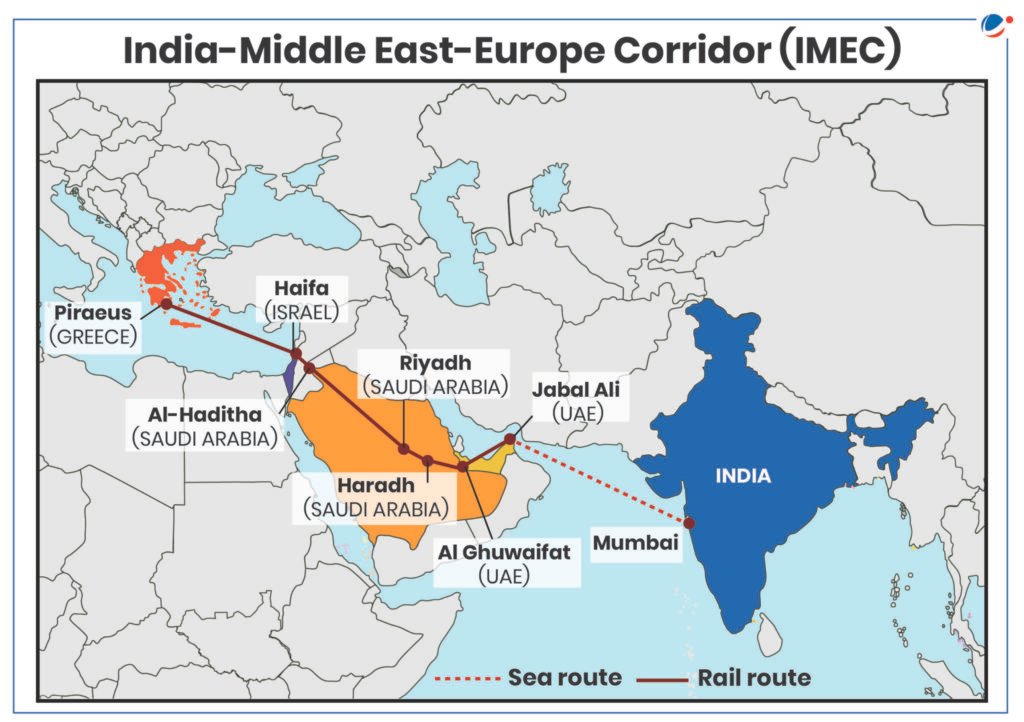
The vision was to connect East and West through the Middle East. Ships would carry goods from India to Gulf ports. Railways would then move them across the Arabian Peninsula to the Mediterranean, from where they would reach Europe. The project also included plans for energy and digital networks.
IMEC offered an alternative to the traditional sea route through Bab el-Mandeb, the Red Sea and the Suez Canal. For India, it promised better access to European markets. For Gulf countries, it supported plans to become global trade hubs. For Washington, it offered closer economic ties with major partners and an alternative to China’s Belt and Road Initiative.
But the October 7, 2023, attacks on Israel and the Gaza war disrupted the diplomatic environment. Saudi-Israeli normalisation, important for the proposed route, became more difficult. IMEC lost momentum.
The cost of vulnerable trade routes
The events of 2026 have strengthened the case for IMEC. Hormuz is a vital passage for global oil and liquefied natural gas supplies. Bab el-Mandeb connects the Indian Ocean to the Red Sea and Suez Canal, a major route for trade between Asia and Europe. Disruptions at both passages have raised shipping risks, insurance premiums and transportation costs. Some vessels face longer journeys around Africa.
The impact extends well beyond shipping. Higher fuel and freight costs affect manufacturing, farming, food distribution and consumer prices. According to the Bureau of Labor Statistics, US producer prices rose 1.3 percent in September alone, the largest monthly increase since March 2022. Energy accounted for more than 80 percent of the rise in goods producer prices. Several factors drive inflation, but the conflict’s impact on energy costs is significant. It shows why secure trade routes matter to the American economy.
Renewed interest in IMEC
Recent developments suggest the project is returning to the diplomatic agenda.
During an October 6 visit to New Delhi, Gérard Mestrallet, French President Emmanuel Macron’s special envoy for IMEC, said the crises involving Gaza, Iran and Hormuz had increased the need for a more resilient corridor. He also called for multiple routes while acknowledging that none could be entirely free of risk.
His visit coincided with the first IMEC Club workshops, organised by India’s Adani Ports and France’s Marseille Fos port. Participants discussed pilot projects on trade, logistics, digital systems and clean energy, with a roadmap for 2027–2028. Countries including Oman, Egypt, Greece, Cyprus and Lebanon have also shown interest in joining an expanded corridor. These are early steps, but they indicate renewed efforts to move the project forward.
Why Washington matters
The United States helped launch IMEC in 2023. President Donald Trump and Prime Minister Narendra Modi reaffirmed support for economic corridors during their February 2025 meeting in Washington. IMEC could strengthen ties among American partners, support more reliable supply chains and create opportunities for investment in transport, energy and digital infrastructure.
Washington need not finance the entire project. Its greater contribution could be bringing governments and investors together. The approach could draw lessons from the US-led Pax Silica initiative, which brings together trusted partners and private investors to secure critical technology supply chains. IMEC serves a broader purpose, but it could benefit from similar diplomatic and financial coordination.
The United States could help mobilise private investment, support common trade rules and address political obstacles involving Saudi Arabia, Jordan and Israel. However, India, Gulf countries and Europe must also take ownership. Their investments and cooperation will determine whether IMEC succeeds.
More than one corridor
The present crisis has exposed a weakness in IMEC’s original design. While it could bypass Bab el-Mandeb and Suez, it would not automatically avoid Hormuz. Ships entering ports inside the Persian Gulf would remain vulnerable.
Oman’s Arabian Sea ports, particularly Duqm, could offer an alternative outside both chokepoints. An Atlantic Council study has proposed developing IMEC as a network of routes rather than a single corridor. Such a network could give traders more options during crises. But missing railways, political tensions, financing and border procedures remain major challenges. A freight corridor would also need separate energy infrastructure to reduce dependence on Hormuz for oil and gas.
From vision to reality
IMEC’s significance now goes beyond connecting India with Western Europe through the Middle East. It offers a chance to make global trade less vulnerable to conflict. The latest US inflation figures show how disruptions to energy and transport can affect businesses and households far from the crisis. IMEC will not lower prices immediately, but it could help reduce the impact of future shocks.
Three years after its announcement, the project remains largely a vision. The same instability that makes it more necessary also makes it harder to build. For Washington and its partners, the challenge is to turn diplomatic support into practical investment and working trade routes.