
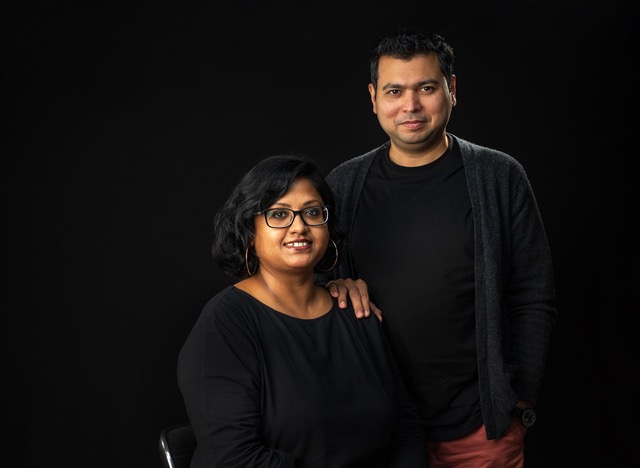
In 2016, Nirupesh Joshi walked away from a senior director’s title, and an enviable compensation package in Hong Kong. His wife Mercy Amalraj gave up her career in mobile gaming. What they built instead is now capable of orbiting the edges of our atmosphere.
There are particular moments Joshi returns to when people ask why. Not the years of planning, or the spreadsheets, or the long conversations about what Indian luxury could mean. The moment is smaller. He was sitting in a fighter plane cockpit at a luxury watch boutique in Hong Kong, surrounded by the instrument-panel of a British aviation watchmaker built on story and precision. The thought came simply: why can’t this be done from India?
That question would eventually cost them their careers in technology. At the time, they were living in Hong Kong, immersed in one of the world’s most serious watch cultures—surrounded by collectors, retailers, and a way of looking at watches not as accessories, but as objects of craft. They had arrived as tech professionals. They left with a different ambition.
Bangalore Watch Company™ launched in 2018. The founding team was two people. There was no inherited workshop, no lineage in horology to draw from. What there was: a story they believed in, a point of view, and the persistence to see it through.
Advertisement
The early reality was unglamorous. In the first year, five hundred watches needed to reach customers. There was no operations team to rely on. Each watch was checked, packed, labelled, and shipped by the founders themselves—five hundred times. It is the kind of detail that rarely enters the brand narrative but explains something essential about how the company was built.
With the brand, the India they refer to is not the one often packaged for export. It is not elephants or palaces or nostalgia. It is an India defined by engineering, aviation, and space exploration—by people building complex systems, often without spectacle.
“We wanted to build something that reflected the India we see around us — and make sure every part of it felt true to that,” says Mercy Amalraj, Co-Founder of the brand.
Their Apogee® Karman Line watch is the most direct expression of that belief. Named for the boundary where Earth’s atmosphere gives way to space, it was designed and built in Bangalore, then subjected to a stratospheric flight to test its performance at extreme altitude. It held!
India’s first space-qualified watch—not developed in Geneva or Tokyo but in a workshop in South Bangalore by a motley crew working to global standards.
The materials follow the same logic. Meteorite dials from material older than the solar system. Steel recovered from INS Vikrant, the Indian Navy’s historic aircraft carrier. Aluminum from decommissioned Indian Air Force aircraft. Each element is chosen with intent, tied to a specific story before it becomes part of a watch.
“I love the idea it feels very personal, the fact that I could connect with the watch was very important to me,” says Bambarkar, a structural and industrial designer based in Richmond, Virginia who purchased a MACH 1 Aviator’s watch.
The Cover Drive® collection approaches this differently; the only watch in the world with an overs-turning bezel—tracking the passage of play in a way that feels both functional and culturally precise.
For many in the South Asian diaspora, particularly those who left India to build careers in the United States, the brand occupies an unusual space. It is not simply a product, but a signal. That something associated with India can stand, without qualification, in a category long defined by European history and accumulated craft.
“They’re trying to create an international brand out of India, the product is of unbelievable quality, and the customer service is stellar” says Krish, who is a senior tech leader based in New York and owns several watches from the brand.
Their recent Peninsula collection was nominated at the Grand Prix d’Horlogerie de Genève – the first, for any Indian watch brand. Their work has been covered by Hodinkee. In 2025, the brand presented at Dubai Watch Week. Recognition arrived gradually, then all at once.
That, in the end, is the story. Not the nominations, not the press coverage, not the new flagship boutique in Lavelle Road. The story is a question asked in a luxury watch showroom in Hong Kong, and the extraordinary stubbornness of two people who decided it deserved an answer.
(The customer names have been redacted for privacy)