 Join WhatsApp Channel

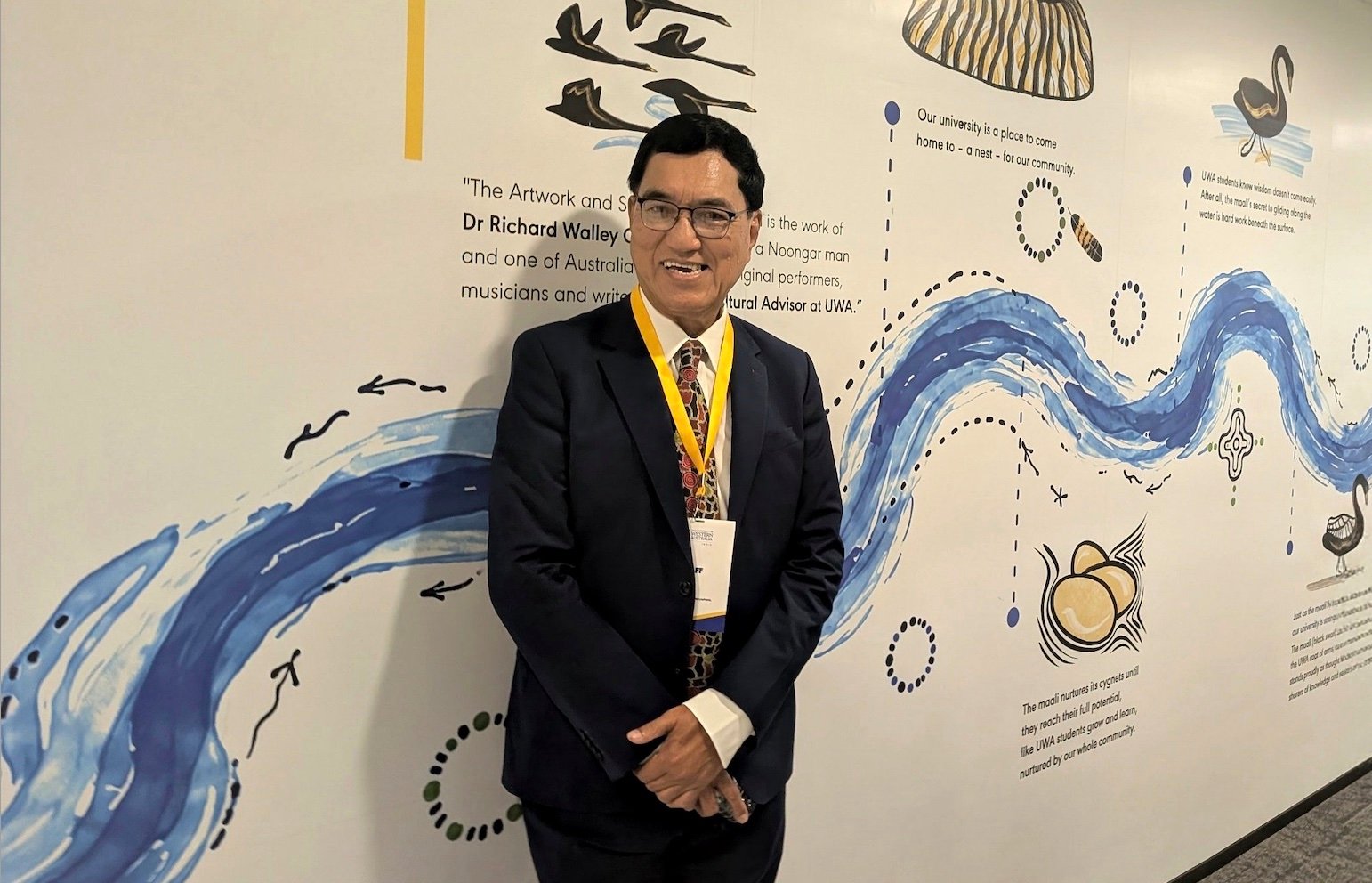
Speaking exclusively with South Asian Herald at the UWA Soirée in Mumbai on September 17, 2026, University of Western Australia Vice Chancellor Prof. Amit Chakma outlined a long-term vision for UWA India that goes beyond an offshore teaching presence, encompassing research, industry collaboration and a two-way relationship between India and Western Australia.
With UWA establishing a physical presence in Mumbai, Chakma described the development as “more than the opening of a campus” and “the beginning of a new chapter for UWA in India.”
“Our ambition is simply not to bring an Australian university to India,” Chakma said. “Our ambition is to build a local university, an Indian university with Australian characteristics.”
That means, he said, “delivering a world-class education that is responsive to Indian needs,” while remaining in dialogue with governments, industry, students, parents and community leaders.
The new presence builds on a relationship with India stretching back more than a century. In 1921, UWA became the first Australian university to admit students without any consideration for race or ethnicity. Chakma said that, based on the university’s records, UWA was also the first Australian university to offer a scholarship to an Indian student.
Beyond the campus itself, Chakma sees the relationship working in both directions.
“Our relationship with India has never been a one-way connection,” Chakma said. “We’re not coming to India just to be here and to bring our knowledge. We are coming to India to learn from India and take some of that knowledge back to Australia.”
Chakma also spoke about what UWA itself has learned through establishing a presence in India. Referring to the university’s motto, “Seek Wisdom,” he said the experience of setting up campuses in Mumbai and Chennai had already enriched UWA’s understanding.
He pointed to artificial intelligence, clean energy, advanced engineering, critical minerals, technology and life sciences as areas where India’s development aligns with UWA’s research strengths.
UWA also intends to contribute to research and technology transfer in India and is already working with the University of Mumbai on research projects in sport and oceans.
For Western Australia, Chakma expects the India presence to have implications extending beyond higher education. “I’m pretty sure that our presence here will enhance our economic, social, but more importantly, people-to-people ties between the great state of Maharashtra and Western Australia,” he said.
Looking five or ten years ahead, Chakma’s vision extends well beyond the current decade.
“Our campuses in Mumbai and Chennai represent a long-term institutional commitment,” he said. “We want to build something that grows within India, with India, not just over the next few years, but over the coming decades.”
That longer horizon is reflected in UWA’s plans for India. In other discussions captured during the Mumbai visit, the university’s expansion was framed around a 25-year vision, with an ambition to establish UWA as a preeminent university in India. For Chakma, that growth is tied not only to teaching, but to research, technology transfer and contributing to India’s higher education ecosystem over the long term.
Mumbai and Chennai mark UWA’s first teaching and learning presence outside Australia, with the Chennai campus scheduled to open on December 11, 2026.
Related posts:
 University of Western Australia to Establish Campuses in Mumbai and Chennai
 University of Western Australia’s Mumbai Campus Clears Final Approval Ahead of September Opening
 UWA Hosts Roundtable on Transforming Higher Education, Building Global Pathways from India
 West Australian Indian Film Council Invites Indian Screen Partners, Building On Its University Ties
