A child born in America may no longer automatically become an American citizen if a parent is a foreign government employee under a sweeping new U.S. immigration rule that could hit South Asian diplomatic families and open a new front in the battle over birthright citizenship.
The interim final rule issued by the Department of Homeland Security expands the categories of foreign officials whose U.S.-born children can be excluded from the traditional birthright-citizenship framework.
For families from India, Pakistan, Bangladesh, Sri Lanka, Nepal and other South Asian countries serving in diplomatic missions or official government postings, the change could turn childbirth in the United States from a straightforward citizenship question into a complex immigration decision.
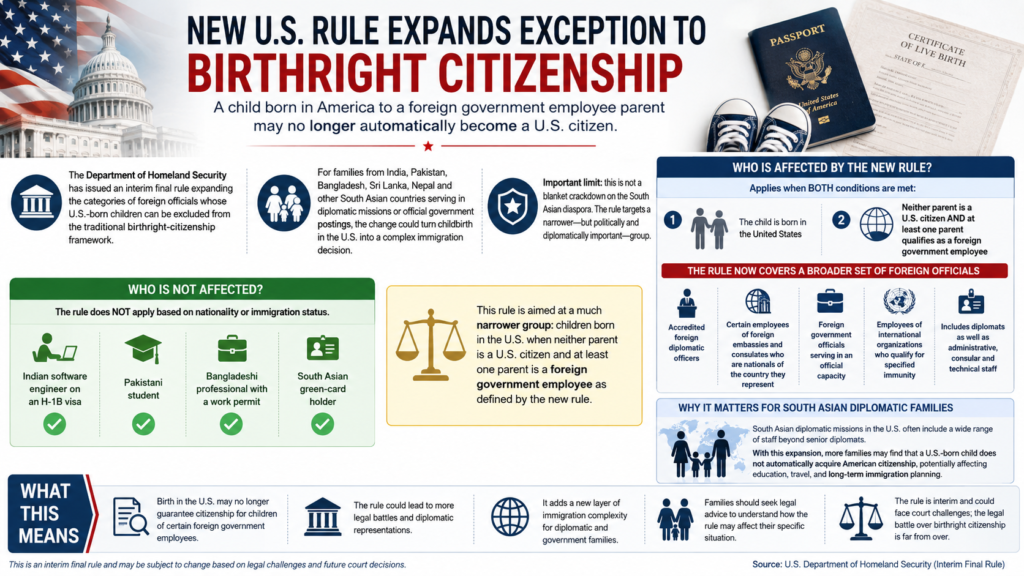
But there is an important limit: this is not a blanket crackdown on the South Asian diaspora.
Advertisement
An Indian software engineer on an H-1B visa, a Pakistani student, a Bangladeshi professional with a work permit or a South Asian green-card holder is not covered simply because of nationality or immigration status.
The rule is aimed at a much narrower — but politically and diplomatically important — group: children born in the United States when neither parent is a U.S. citizen and at least one parent qualifies as a foreign government employee.
And that definition has now become much broader.
DIPLOMATS — AND MORE
The traditional exception to birthright citizenship has largely focused on children of foreign diplomatic officers.
The new rule reaches further.
It covers accredited foreign diplomatic officers, certain employees of foreign embassies and consulates who are nationals of the country they represent, foreign government officials serving in an official capacity and employees of international organizations who qualify for specified immunity.
That expansion could matter significantly for South Asian diplomatic missions, where families may include diplomats as well as administrative, consular and other official personnel.
A South Asian national working directly for an embassy or consulate could potentially fall within the rule, depending on the person’s position and legal status.
The message from Washington is blunt: being born on U.S. soil may no longer be enough when a child’s parents occupy certain foreign-government roles.
The rule applies prospectively to children born on or after its effective date. Children born before that date are not subjected to the new requirements.
FROM CITIZEN TO GREEN-CARD HOLDER
For an affected child, the alternative could be lawful permanent residence rather than U.S. citizenship at birth.
Eligible children can seek permanent residence through Form I-485. If approved, their permanent-resident status is recorded as beginning on their date of birth.
That creates a fundamentally different legal starting point.
Instead of growing up as a U.S. citizen from birth, the child would enter an immigration system as a lawful permanent resident.
There are also registration obligations. Form G-325R is used for alien registration, with children under 14 required to have a parent or legal guardian file on their behalf. Once they turn 14, they must re-register and provide fingerprints within 30 days.
The paperwork also carries potential costs.
DHS estimates the total cost associated with an I-485 application at roughly $1,994 for paper/PDF filing and about $1,906 electronically, including filing fees, time costs and biometrics-related expenses. The agency estimates biometrics-related costs at about $218.
A NEW HEADACHE FOR SOUTH ASIAN FAMILIES
For diplomatic families, the consequences could go beyond paperwork.
A child’s immigration status can affect travel documentation, movement across borders and the family’s decisions about remaining in the United States.
Families posted to Washington, New York, Houston, Chicago, San Francisco and other U.S. diplomatic and consular centers could face a new calculation when planning their futures.
The rule could also make the precise employment status of a parent at the time of birth far more important than it was under the traditional understanding of birthright citizenship.
DHS itself acknowledges that it cannot say how many children will be affected. USCIS has not historically tracked this population as a separate category.
The State Department’s Office of Foreign Missions reports more than 124,000 foreign mission members and dependents in the United States, but DHS says that figure cannot be used to determine the number of children potentially covered by the rule.
RECIPROCITY WARNING
There is also a diplomatic dimension that could resonate across South Asia.
DHS says the rule directly involves foreign affairs and points to the possibility of reciprocal consequences for American diplomats and government personnel stationed abroad.
That could put governments such as India, Pakistan, Bangladesh, Sri Lanka and Nepal in a sensitive position if Washington’s policy affects children born to their officials.
The question becomes bigger than individual families: how will countries treat children of U.S. officials if Washington changes the rules for children of their officials?
That reciprocity argument was also cited by DHS in bypassing the normal notice-and-comment process.
THE COURTS ARE ALREADY INVOLVED
The rule is entering an already volatile legal fight over birthright citizenship.
DHS acknowledged a preliminary injunction issued Sept. 2 in Casa Inc. v. Trump and said it will not implement the rule against members of the court-certified class covered by the injunction, or otherwise act contrary to the order, unless it obtains further judicial relief.
That leaves the final reach of the policy vulnerable to litigation.
Public comments are being accepted for 30 days after Federal Register publication.
For the wider South Asian diaspora, the immediate impact is limited. Most South Asian Americans have nothing to fear from this particular rule.
But its significance is harder to dismiss.
The policy redraws the line between being born in America and being American for a specific class of children — and places the status of diplomatic families at the center of a much larger fight over the future of U.S. citizenship.
For South Asian governments and their communities abroad, that makes this more than an immigration regulation.
It is a warning of how quickly the legal value attached to a U.S. birthplace can change when immigration, foreign policy and citizenship collide.