Join WhatsApp Channel

The Nepal Army on Saturday rescued alive 208 persons including 43 foreigners who were trapped inside the tunnel of the Trishuli-III Hydropower project since the catastrophic flash floods that ripped through Rasuwa district on August 26.
Among those rescued alive, 38 are Chinese and five Indians, according to the army.
The Nepal Army team involved in rescue operation has been trying to locate the outer point of the tunnel with the use of various machines including drilling equipment.
Meanwhile, an Indian rescue team has arrived to assist with the rescue operation at the Trishuli-3 ‘A’ Hydropower Project in Rasuwa. The team is to conduct an initial aerial assessment of the Chilime and Langtang areas by helicopter.
The rescue operation at Trishuli began early Saturday, with teams clearing mud and debris from the tunnel entrance. Continuous rainfall, mud and debris have made it difficult for rescuers to reach the tunnel entrance and carry out the search, media reports said.
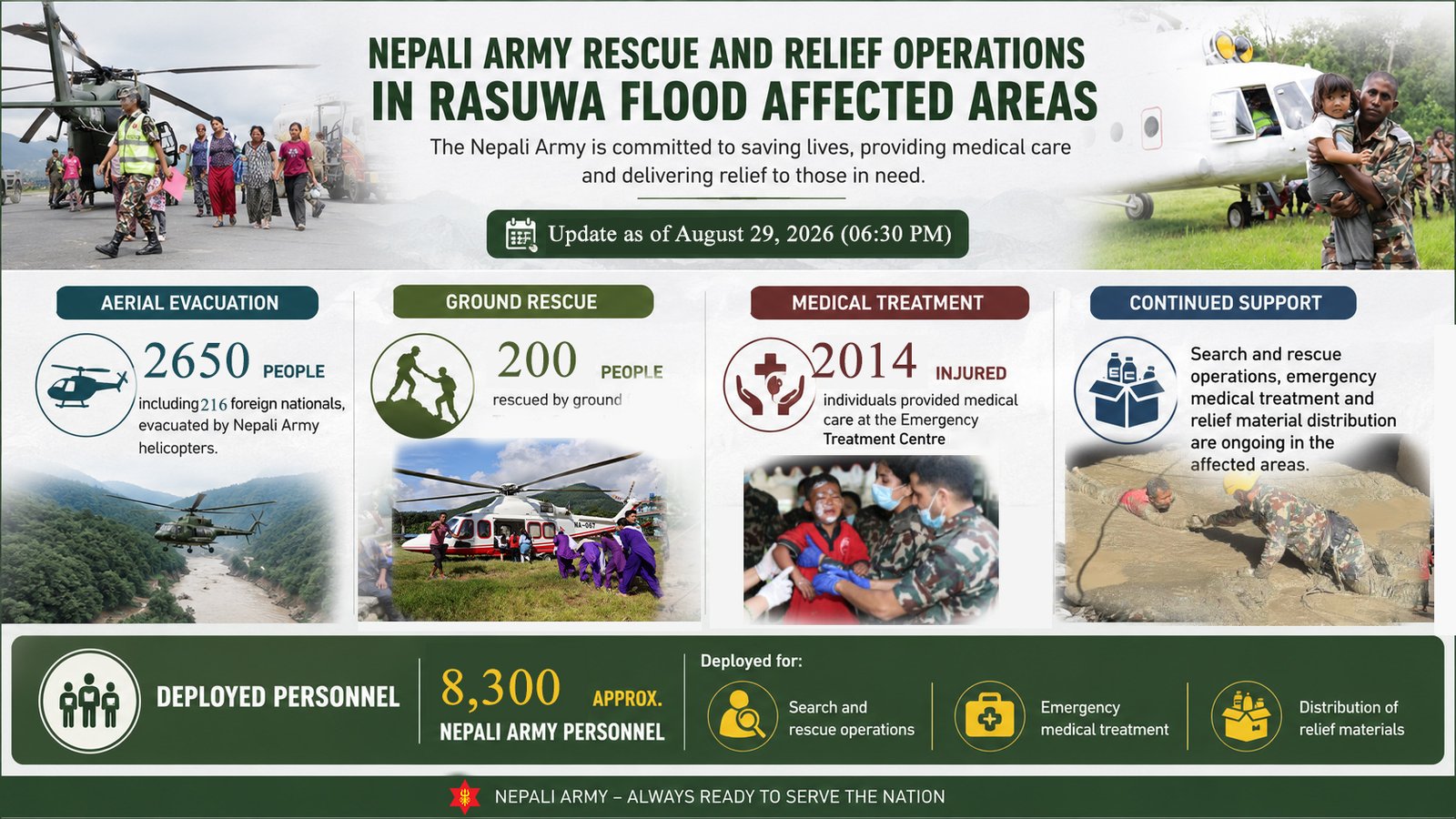
The Nepal army further shared that over 7,000 military personnel were mobilized and were working in a close coordination in the flood-ravaged districts— Rasuwa, Nuwakot and Dhading for search, rescue, emergency treatment and management of bodies. (RSS) Brig Gen Raja Ram Basnet said rescuers had already pulled one man from the tunnel, with video showing teams dragging and pushing the survivor, who was covered in dark brown mud, to safety.
Nepali Foreign Minister Shisir Khanal said locating those still missing was “currently our national priority.” He said Nepal had sought specialized assistance from neighboring countries for tunnel rescue operations, survivor-detection technology, rapid forensic and DNA analysis, and morgue refrigeration facilities.
An 11-member tunnel rescue reconnaissance team from India has already been deployed, while a similar team from China is expected to arrive soon, Khanal said.
At relief centers and hospitals, families continue to wait anxiously for information about missing relatives.
In Kathmandu, relatives and friends gathered outside the main government hospital from early morning, moving between help desks and notice boards while checking lists of injured people.
Families have covered hospital walls with photographs and contact details of missing relatives, hoping that someone will recognize them.
Officials have also posted photographs of unidentified bodies to help families identify them.
The Red Cross estimated on Friday that around 90,000 people had been affected by the flooding.
Nepal has received more than 57 metric tons of relief supplies from India, with additional assistance arriving from China, Japan, Australia and other countries.
Rescue teams have also been closely monitoring a new lake that formed high in the Himalayan mountains after the initial floods on Wednesday. Experts had warned that the lake, created following the glacier collapse that triggered the disaster, was beginning to overflow.
Basnet said rescue teams had temporarily relocated after warnings of possible further flooding.
However, monitoring data from China’s Ministry of Water Resources showed that the lake had subsequently shrunk, with its water level falling by around 32 feet from its peak on Thursday morning, according to Chinese broadcaster CCTV.
Scientists examining satellite imagery said the initial disaster began when bedrock beneath a glacier in the high Himalayan region collapsed, dragging part of the glacier with it.
The rockfall was so severe that it registered as a magnitude 5.2 seismic event.
The falling rock and melting ice rapidly swelled rivers in the valleys below, producing torrents of water, mud and debris that swept through settlements in Nepal and Tibet, leaving a trail of destruction in its wake as it destroyed whole roads, bridges and severely damaged major hydropower facilities.
Climate scientists say the Hindu Kush Himalayan region is warming rapidly, driving major changes in glaciers, snow cover, permafrost and mountain slopes.
Around 78% of the glacier area at elevations between about 14,760 and 19,685 feet is considered highly exposed to warming.
The floods were triggered on Wednesday after a glacier collapse unleashed a massive surge of rock, ice, mud and debris into Himalayan river systems, sweeping through settlements near the Nepal-China border and causing widespread destruction.
The death toll from the devastating floods has risen to 675, with more than 2,400 people still missing as thousands of security personnel and rescue workers continue searching areas ravaged by floods near the border with China.
According to the Indian Ministry of External Affairs, at least 320 Indians remain missing and around 400 others are stranded on the Chinese side following the devastating flash floods along the Nepal-Tibet border.
The disaster struck at about 8:40 am on Wednesday, when a huge surge swept down the Bhotekoshi and Trishuli river corridors, destroying roads, bridges, settlements and other infrastructure across central Nepal.
Chinese state media has reported seven additional deaths in Tibet, bringing the combined death toll from the disaster in Nepal and Tibet to 682. The number of people reported missing in Nepal stands at 2,426, including 517 foreign nationals and 933 workers employed at hydropower projects along the river system hit by the floods.
Poor weather and difficult terrain continue to hamper aerial rescue efforts. More than 3,700 people have so far been rescued in Nepal, according to authorities. Chinese state media has separately reported that 558 people remain missing on the Chinese side of the border. Hundreds of those missing are foreign nationals who had travelled to the region to work, trek or for pilgrimage.