Join WhatsApp Channel

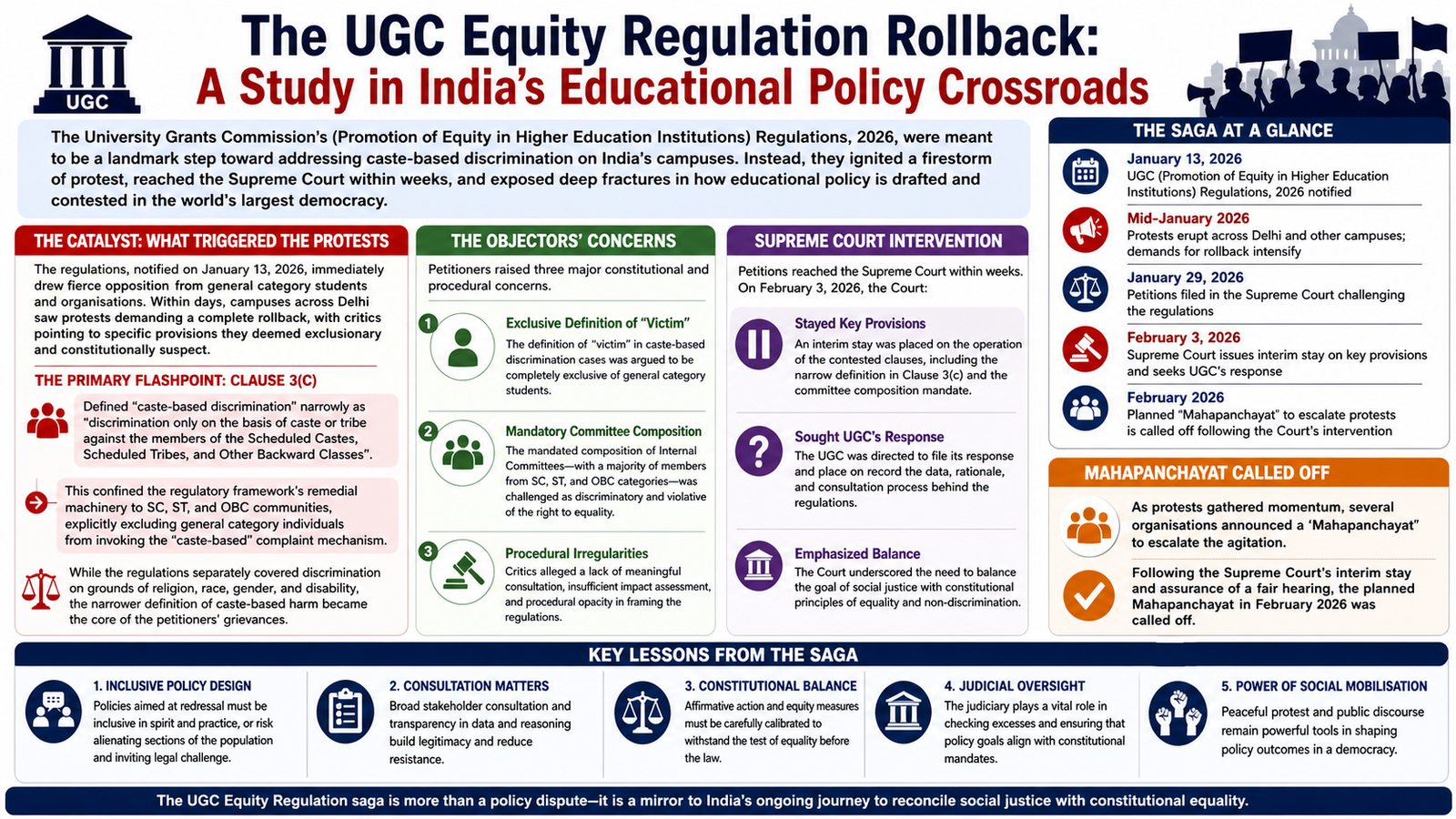
The University Grants Commission’s (Promotion of Equity in Higher Education Institutions) Regulations, 2026, were meant to be a landmark step toward addressing caste-based discrimination on India’s campuses. Instead, they ignited a firestorm of protest, reached the Supreme Court within weeks, and exposed deep fractures in how educational policy is drafted and contested in the world’s largest democracy. An analysis of the saga—from the triggering clauses to the Supreme Court’s intervention and the eventual halting of a planned mahapanchayat—reveals critical lessons about policymaking, judicial oversight, and social mobilization in contemporary India.
The Catalyst: What Triggered the Protests
The regulations, notified on January 13, 2026, immediately drew fierce opposition from general category students and organizations. Within days, campuses across Delhi saw protests demanding a complete rollback, with critics pointing to specific provisions they deemed exclusionary and constitutionally suspect.
The primary flashpoint was Clause 3(c), which defined “caste-based discrimination” narrowly as “discrimination only on the basis of caste or tribe against the members of the Scheduled Castes, Scheduled Tribes, and Other Backward Classes.” This effectively confined the regulatory framework’s remedial machinery to SC, ST, and OBC communities, explicitly excluding general category individuals from invoking the “caste-based” complaint mechanism. While the regulations separately covered discrimination on grounds of religion, race, gender, and disability, the narrower definition of caste-based harm became the core of the petitioners’ grievances.
Objectors raised three major constitutional and procedural concerns. First, the definition of “victim” in caste-based discrimination cases was argued to be completely exclusive of general category students. Second, the mandated composition of institutional Equity Committees—requiring representatives from OBCs, SCs, STs, Persons with Disabilities, and Women—made no provision for general category representation. Third, the regulations lacked an explicit mechanism to penalize false complaints, raising fears among critics about potential misuse.
Beyond these legal objections, the regulations mandated every higher education institution to establish Equal Opportunity Centres, Equity Squads, and monitoring teams to handle complaints. Critics characterized these provisions as “draconian,” with some student protesters likening the proposed Equity Squads to living under “constant surveillance” on campus. The irony, however, was that these regulations emerged directly from a Supreme Court case—Abeda Salim Tadvi v. Union of India—filed by the parents of two students who had allegedly died by suicide after facing caste-based discrimination. The court had explicitly directed the UGC to notify new anti-discrimination regulations, making the 2026 framework a judicial mandate rather than a purely legislative or executive initiative.
The Turning Point: Supreme Court Intervention and Local Negotiations
Within sixteen days of notification, on January 29, 2026, a two-judge Bench comprising Chief Justice Surya Kant and Justice Joymalya Bagchi intervened decisively. Hearing writ petitions led by Mritunjay Tiwari v. Union of India, the court ordered that the 2026 regulations be kept “in abeyance.” The Bench’s observations were remarkably sharp, characterizing the provisions as “prima facie vague” and observing that they left considerable room for potential misuse. Expressing concern that the regulations could have “very sweeping consequences” and might “divide society,” the court invoked its extraordinary powers under Article 142 to revert to the 2012 UGC equity framework until further orders.
The court also framed four key legal questions for future adjudication: the rational basis for Clause 3(c)’s restrictive definition; its interaction with constitutional sub-classification doctrines; the reference to “segregation” in Clause 7(d); and the omission of ragging from the enumerated forms of discrimination. The matter was made returnable on March 19, keeping the government and the UGC under judicial scrutiny.
However, the Supreme Court stay did not quell the protests—it intensified them. By August 2026, the demand for a “UGC rollback” had evolved into a broader campaign against the caste-based reservation system itself. The Reservation Hatao Andolan mobilized supporters heavily through digital platforms, amassing an Instagram following of 5.6 million. On August 22, hundreds gathered at Jantar Mantar demanding that quotas be determined by income rather than caste.
The planned “Savarn Aakrosh Mahapanchayat” for August 23 at Delhi’s Shah Auditorium became the focal point of this intensified movement. Organized by the Savarn Samaj Sangharsh Samiti and Kshatriya Karni Sena, it was billed as a decisive show of strength. Yet, Delhi Police denied permission for the gathering, stating that social media claims of official approval were “false and misleading.” Section 163 of the Bharatiya Nagarik Suraksha Sanhita (BNSS) was invoked, and prohibitory orders were put in place across the vicinity.
What proved decisive, however, were the back-channel negotiations that followed. Delegations from the organizing bodies held discussions with senior police and administrative officials, describing the talks as a “positive development.” Local political figures, including the Noida MP, were reportedly involved in facilitating the dialogue. Simultaneously, the Union government informed the Supreme Court that the 2026 UGC equity regulations were “under reconsideration”—effectively signaling a willingness to pursue a substantive rollback or revision. The combination of judicial pressure, sustained protest, administrative prohibitions, and behind-the-scenes negotiations successfully halted the planned mahapanchayat and created space for a negotiated resolution, even as no formal withdrawal has been officially announced.
The Big Picture: How Educational Policies Are Drafted and Contested in India
The UGC equity regulation episode offers several enduring insights into the mechanics of Indian educational policymaking and the forces that shape its outcomes.
First, policy is increasingly reactive rather than proactively consultative. The 2026 regulations were court-mandated; they emerged from judicial intervention in the Tadvi case rather than from broad-based legislative deliberation or extensive stakeholder consultation. In drafting them, the UGC appears to have focused narrowly on addressing the specific concerns raised before the court, without adequately anticipating the broader political and social backlash. This reactive posture left the framework vulnerable to charges of being rushed and insufficiently vetted.
Second, the absence of inclusive consultation remains a recurring institutional weakness. Critics from both sides of the debate acknowledged flaws in the drafting process. Even supporters of stronger equity measures conceded that the representation of SC, ST, OBC, and women in the Equity Committee was “low, vague and inadequately defined.” The general category students’ sense of being blindsided—captured in protests that erupted within days of notification—underscores how policies touching deeply divisive social issues cannot succeed without building broad-based consensus before notification.
Third, the Supreme Court has become an unavoidable, and sometimes conflicting, actor in educational governance. From the Tadvi case that mandated the regulations to the Mritunjay Tiwari petition that stayed them, the court has been central to both the creation and the suspension of this policy. This judicialization of education policy—where courts are asked to prescribe administrative frameworks and then later asked to strike them down—raises fundamental questions about the separation of powers and the appropriate limits of judicial intervention in university governance.
Fourth, social media has fundamentally transformed protest mobilization. The Reservation Hatao Andolan’s 5.6 million Instagram followers demonstrate how digital platforms enable rapid, large-scale mobilization that bypasses traditional organizational hierarchies. This makes policy contestation more volatile, faster-moving, and harder for governments to manage through conventional administrative and political channels. The spread of misinformation regarding official permissions for the mahapanchayat further illustrates the challenges of maintaining factual clarity in such digitally mediated protests.
Fifth, and most significantly, the episode reveals the unresolved constitutional tension between formal equality and substantive equality. Petitioners argued that Clause 3(c) violated the equality guarantee under Article 14, contending that remedial measures must be “generic” to be constitutionally valid. Yet legal scholars and constitutionalists have long maintained that equality under Articles 14 and 15 has never mandated identical treatment in all circumstances. Remedial frameworks—from the Vishakha Guidelines to the Prevention of Sexual Harassment at Workplace Act and domestic violence legislation—adopt differentiated protections precisely because social harms are historically situated and unevenly distributed. The UGC dispute pits two constitutionally valid concerns against each other: the imperative to protect marginalized communities from systemic caste-based discrimination versus the demand for equal procedural treatment for all citizens regardless of caste identity.
Sixth, the episode underscores the critical role of administrative capacity—and its limits. The UGC, as an expert body, found itself caught between a Supreme Court directive to address discrimination and a political backlash from organized social groups. Its inability to navigate this tension speaks to the broader challenges faced by regulatory bodies in India’s federal structure, where central mandates must contend with local political realities and deeply entrenched social hierarchies.
Finally, the episode demonstrates that educational policy in India is shaped by a complex, multi-layered interplay of judicial directives, political calculations, social movements, and administrative pragmatism. The outcome remains fluid—the regulations are in abeyance, not formally withdrawn; the Centre is reconsidering them; and the Supreme Court will hear the matter again. What is certain is that the next iteration of equity regulations—if and when it emerges—will be drafted with far greater attention to political feasibility, stakeholder engagement, and constitutional nuance.
The UGC equity regulation rollback saga is a cautionary tale about the perils of top-down, court-driven policymaking in a deeply divided society. It reminds observers that policies aimed at correcting historical injustices cannot succeed without building broad social consensus, and it raises uncomfortable questions about whether India’s institutions—the UGC, the judiciary, and the political class—are equipped to navigate the treacherous terrain of caste, equality, and higher education in the twenty-first century. The story is far from over, but its lessons are already clear.
Disclaimer: The opinions and views expressed in this article/column are those of the author(s) and do not necessarily reflect the views or positions of South Asian Herald.