Join WhatsApp Channel

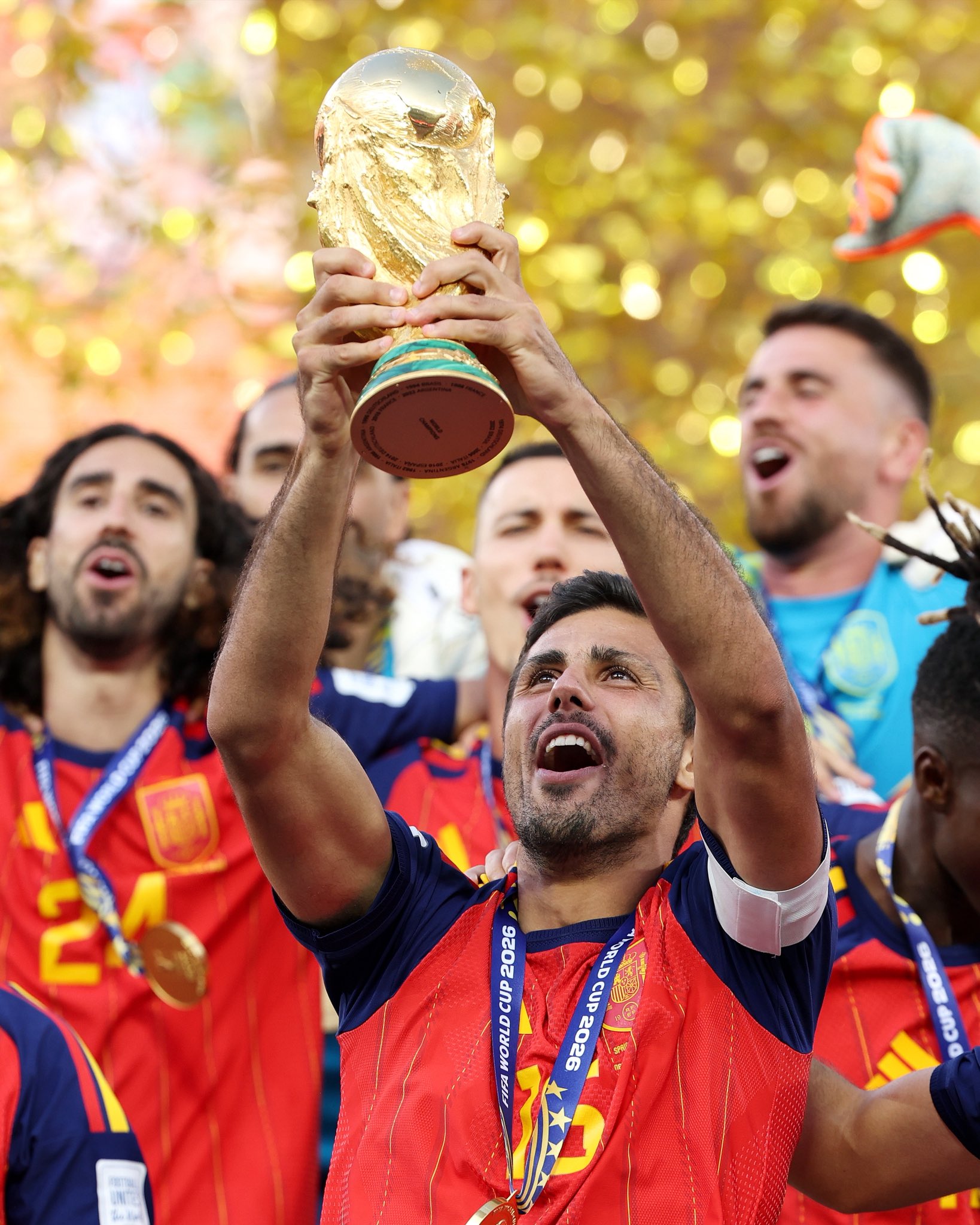
Members of Spain’s FIFA World Cup 2026 championship team appeared to forgo the customary post-match group photograph with the chief guest during the trophy presentation at MetLife Stadium in New Jersey following their victory.
After presenting the trophy, US President Donald Trump walked toward the Spanish players on the podium to congratulate them. While he briefly paused near the team, no players appeared to invite him to join for a group photograph. Trump looked back momentarily before FIFA President Gianni Infantino escorted him away.
Neither the players nor tournament officials commented on whether the omission was simply a result of the team’s celebrations or a deliberate departure from tradition. The moment, however, sparked public discussion.
Some observers linked the episode to recent tensions between the United States and Spain following Trump’s remarks at the NATO summit, where he criticized Spain and warned of potential tariffs.
The incident reflected the broader political backdrop surrounding the 2026 FIFA World Cup, the first men’s tournament to be jointly hosted by three countries. It also marked the first time FIFA World Cup matches were played on Canadian soil.
“It has really been an extraordinary journey for all Canadians. The World Cup itself, in terms of sport, was remarkable. It was a huge step forward for Canadian soccer, or football, or whatever we call it. But what is clear is that Canada is a soccer nation,” said Canada’s Secretary of State for Sport, Adam van Koeverden, an Olympic gold medalist.
Canadian Prime Minister Mark Carney and his wife, Diana Fox Carney, watched the final from a private suite alongside US President Donald Trump and First Lady Melania Trump, Mexican President Claudia Sheinbaum, and FIFA President Gianni Infantino.
The gathering came despite ongoing political and trade disagreements among the three co-host nations. Earlier this month, Trump declined to renew the trilateral trade agreement involving the United States, Canada, and Mexico in its current form, instead advocating separate bilateral agreements with Canada and Mexico.
Despite those differences, the three nations worked together to stage the expanded tournament, which featured 48 teams, 104 matches over 39 days, making it the largest FIFA World Cup in history.
Politics remained a recurring theme throughout the tournament. Before the competition concluded, Trump again threatened higher tariffs on Canada, criticizing its handling of wildfires in neighboring Ontario.
The tournament also intersected with broader geopolitical issues, including immigration and international relations. Iran, one of the 48 participating nations, requested that its matches scheduled in the United States be relocated to Mexico because of travel concerns. The request was denied.
Iranian players were granted limited-duration visas that allowed them to enter the United States only for scheduled matches before returning to their team base in Tijuana, Mexico. They were not permitted to travel to Los Angeles for their group-stage matches against New Zealand and Belgium and were allowed into the United States only two days before their final group match against Egypt in Seattle.
Throughout the tournament, players wore armbands bearing the message “Football Unites” during all 104 matches.
Following the final, Carney praised Canada’s performance and the nationwide support shown by fans.
Canada made history by earning its first-ever FIFA World Cup point with a 1-1 draw against Bosnia and Herzegovina, recording its first tournament victory with a 6-0 win over Qatar, advancing to the Round of 32 with a victory over South Africa, and ultimately reaching the Round of 16, matching the achievements of fellow co-hosts Mexico and the United States.
“Our team and our fans showed the world that Canada belongs on any pitch, against any team. Canada’s soccer journey is just beginning. The best is yet to come,” Carney said.
In a statement issued after the tournament concluded, Carney said co-hosting the FIFA World Cup alongside Mexico and the United States marked a historic milestone, as it was the first time Canada had staged matches in the men’s FIFA World Cup.
Reflecting on Canada’s campaign, he said the national team’s achievements would be remembered for generations. He highlighted Canada’s first-ever World Cup victory, its first knockout-stage win, and its run to the Round of 16, describing the team as a symbol of resilience and determination.
Carney also praised several standout moments from the tournament, including Jonathan David’s hat trick, Nathan Saliba’s memorable goal after replacing the injured Ismaël Koné, and Stephen Eustáquio’s dramatic 92nd-minute winner against South Africa.
“Our team demonstrated extraordinary character and showed the world that Canada belongs on any pitch, against any opponent,” Carney said.
He also commended Canadian fans for their overwhelming support throughout the tournament, noting that hundreds of thousands gathered in Vancouver, Toronto, and communities across the country to celebrate the matches. He added that Canadians followed the tournament from stadiums, fan festivals, hotels, sports bars, and their homes.
According to Carney, the World Cup generated tens of thousands of jobs, delivered lasting economic benefits, and welcomed visitors from around the world to Canada.
Looking ahead, Carney said the tournament should serve as a catalyst for the continued growth of soccer in Canada. He announced that the federal government would invest $1 billion in sports infrastructure and participation initiatives, including upgrading stadiums, fields, and local parks while expanding opportunities for aspiring athletes.
He also reaffirmed the government’s support for the Canada Soccer National Training Centre, saying it would provide a permanent home for the sport and help nurture future generations of Canadian soccer talent.
“As fans, we can support our local clubs and our national teams not just every four years, but throughout the year,” Carney said. “Canada’s soccer journey is just beginning. The best is yet to come.”
Related posts:
 Sunil Gulati: The Indian American Architect Behind Soccer’s Rise in the United States
 Canada Names 26-Player FIFA World Cup 2026 Squad as Soccer Fever Sweeps North America
 Justin Bieber Joins FIFA World Cup Final Halftime Show
 From Russia 2018 to North America 2026: How Geopolitics Is Reshaping the FIFA World Cup