Join WhatsApp Channel

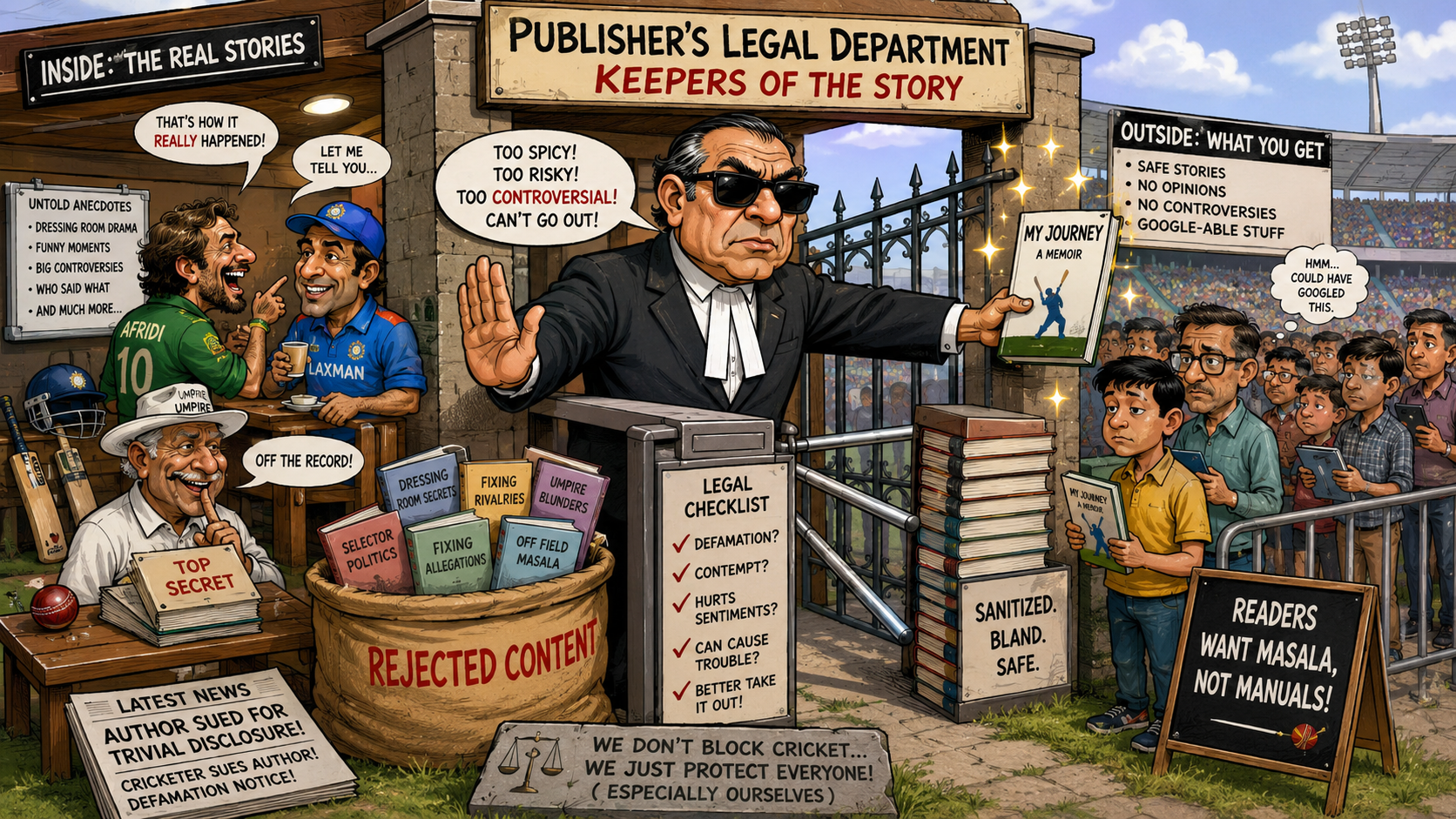
Caricature…focus on lawyers acting as door keeper to the flow of information…Indians love their cricket but do they love books on cricket? I have read over 50 such books and it is hard to say that they do because there is only one way of deciding: the sales of such books. And the sad truth is that books on or about cricket and cricketers aren’t quite best sellers. There are the usual exceptions of course, like Sunil Gavaskar’s first book ‘Sunny Days.’
But that was perhaps because it was amongst the first such book to be published, half a century ago. David Gower’s ‘Autobiography’ in the early 1990s and the subsequent book called ‘Endangered Species’ in 2013 did very well, as did Michael Holding’s autobiography, ‘No Holding Back.’ Surprisingly, Sachin Tendulkar’s autobiography was less of a hit, probably because it was so anodyne.
But leave sales aside because the reading habit is declining. Cricketers and umpires now prefer the electronic medium like YouTube to say whatever they want you to know. Not just that. The risk of becoming needlessly controversial is also a deterrent to would-be authors. Who wants a court case about some trivial disclosure? I have read a book on court cases that cricket threw up.
So even though many cricketers have published their memoirs only a few stands out. Like the ones by, say, VVS Laxman and Shahid Afridi.
In most other books there’s no masala because everyone has to be very careful. The publisher’s lawyers ensure that the books are dull with hardly any opinions. This is fatal because, in the final analysis, the reader wants to know more about controversies and funny happenings on the field, not just something he can Google.
What makes some books tick, however, are anecdotes both on field ones and off field. Some like Laxman and Afridi do better than most others — and there are dozens — on this count but that’s rare. Laxman talks down to the reader in a very patrician way but tells some good stories. Afridi is more of a brawler and hilarious when he is not being scathingly offensive. And imagine, he thinks Pakistani cricketers lack sophistication!
But what about umpires? They rarely tell their stories even though they have such a ringside view. I have always been in the lookout for books by then but have found just two or three. I wonder if their contracts with the country’s cricketing board inhibit them. These Boards can be very dictatorial.
One book that did get published was by the retired Indian umpire, the famous Piloo Reporter. It was a great read. Reporter, by the way, was the one of the two first neutral umpires and the only Indian umpire in the 1992 World Cup.
Then there was the late Dickie Bird. His book is an absolute must if you are a real connoisseur of the game even though much of it is about English county cricket. Nevertheless he. has a trunkful of stories to tell. One his best is when he umpired in the 1983 World Cup final. He writes that around the 15th over of the West Indian innings Kapil Dev, the Indian captain, told him that India would win. Bird didn’t think so then but in the end that’s what happened. Bird also talks about how to control the players and his account of how he prevented intimidation by West Indian bowlers is fascinating. Someone, he says, has to start implementing the rules. Player reputations can’t usurp the umpires.
Modern cricket has been going the football way for some years now with the new role and importance being given to coaches. Two of the best are by John Wright, the quiet New Zealander who was the Indian coach from 2001 to 2095 and Paddy Upton the South African the mental trainer. It was Wright who cemented the role of the coach and it was Upton who shifted the Indian obsession with individual performance to team performance. He was the mind trainer when India won the 2011 World Cup. The head coach was another South African, Gary Kirsten.
Finally, no account of cricket books can be complete without mentioning Mike Brearly the understated professor of philosophy. If you love the game, you should read all his books, the last of which was simply called ‘On Cricket.’ It’s more of a fireside chat, really, and leaves you purring like a satisfied cat.
Disclaimer: The opinions and views expressed in this article/column are those of the author(s) and do not necessarily reflect the views or positions of South Asian Herald.