 Join WhatsApp Channel

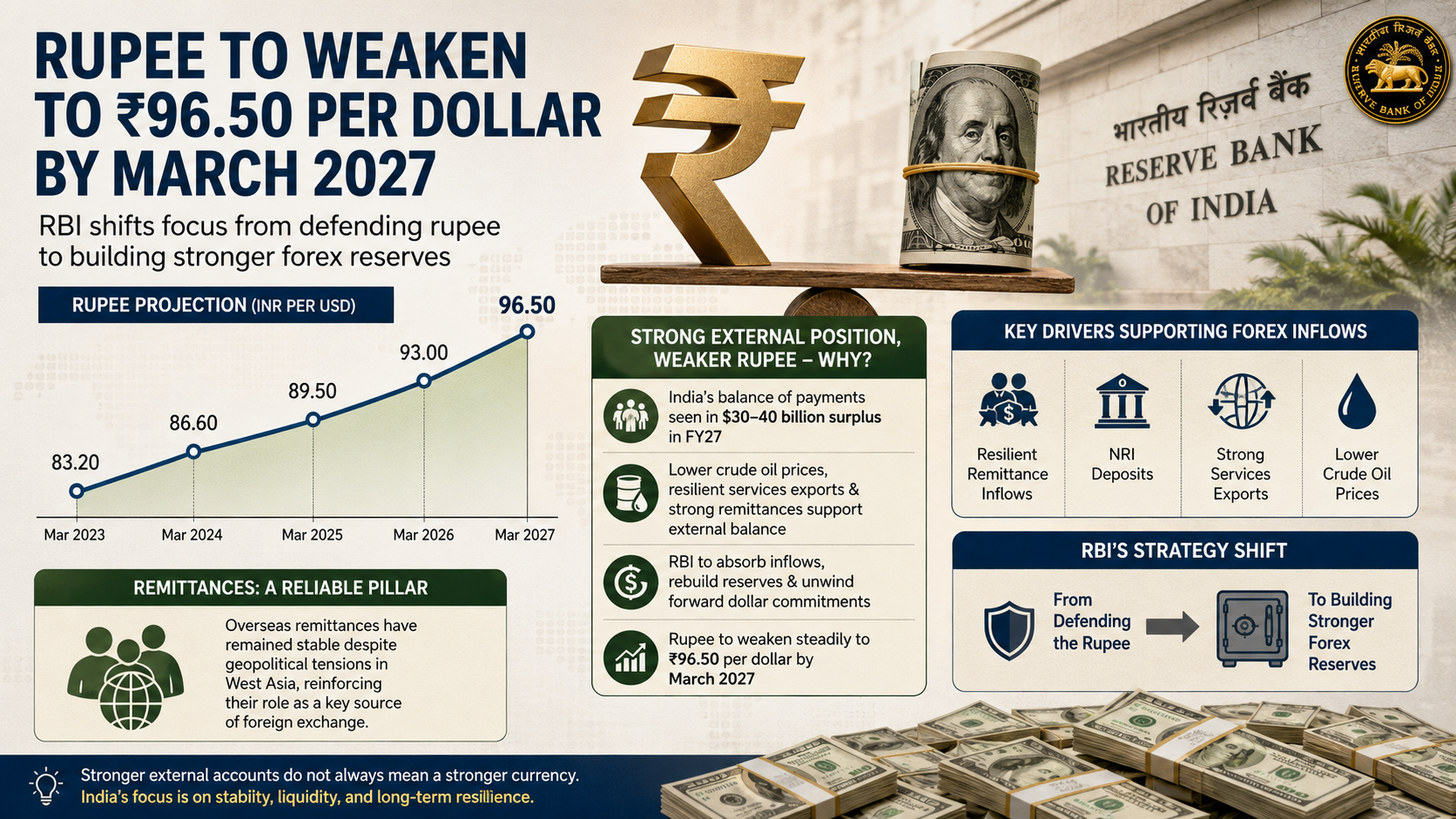
The Indian rupee is likely to weaken steadily to around 96.50 against the U.S. dollar by March 2027 despite an improving external balance, underscoring a shift in the Reserve Bank of India’s (RBI) currency strategy from defending the exchange rate to building a stronger buffer of foreign exchange reserves.
Economists say the expected depreciation is not a sign of external weakness but reflects the RBI’s willingness to absorb incoming dollars rather than allow the rupee to appreciate sharply. The central bank is expected to use robust inflows from remittances, NRI deposits and other foreign currency sources to rebuild reserves and unwind its forward dollar commitments while maintaining export competitiveness.
IDFC FIRST Bank expects India’s balance of payments to swing into a US$30-40 billion surplus in FY27, helped by lower crude oil prices, resilient services exports and strong remittance inflows. Yet the rupee is still projected to weaken gradually to 96.50 per dollar, illustrating that stronger external accounts do not necessarily translate into a stronger currency.
The divergence reflects India’s structural challenge. While invisible earnings continue to offset much of the merchandise trade deficit, the economy remains a net importer of goods, keeping underlying demand for dollars elevated. Rather than resisting market pressures through aggressive intervention, the RBI appears focused on ensuring adequate foreign exchange liquidity while allowing the exchange rate to adjust in an orderly manner.
That strategy is increasingly being supported by resilient remittance inflows.
The Finance Ministry’s Monthly Economic Review says overseas remittances have remained stable despite geopolitical tensions in West Asia, reinforcing their role as one of India’s most dependable sources of foreign exchange and an important pillar of the balance of payments.
IDFC FIRST Bank notes there has been “no negative impact…on transfers due to the West Asia crisis,” with net inward transfers rising to US$16 billion in April, significantly above the previous quarterly monthly average of US$13.7 billion.
More importantly, the source of these dollars is changing.
The Gulf Cooperation Council’s share of India’s remittances has declined to 34% from 47% in FY17, while advanced economies now account for a growing share, led by the United States (28%), United Kingdom (11%) and Singapore (6.6%). The shift reflects the growing contribution of Indian professionals in technology, healthcare, finance and other high-value sectors, reducing dependence on oil-linked employment in the Gulf.
Alongside remittances, the RBI has launched an aggressive push to attract overseas dollar savings from non-resident Indians.
Its latest package includes incentives for Foreign Currency Non-Resident (Bank) [FCNR(B)] deposits, easier external commercial borrowings and other foreign currency funding avenues. By absorbing the entire hedging cost on FCNR(B) deposits, the RBI has significantly improved returns for overseas Indians while reducing banks’ funding costs. IDFC FIRST Bank estimates the scheme could mobilize US$60-70 billion before it expires in September.
For the RBI, these measures are becoming as important as interest-rate policy in managing the rupee.
Rather than attempting to strengthen the currency, the central bank appears intent on creating a durable pipeline of dollar inflows that can finance India’s current account deficit, rebuild reserves and cushion the economy against future global shocks.
The policy marks a subtle shift in India’s external sector strategy. The focus is moving away from short-term exchange-rate management toward strengthening the country’s foreign currency balance sheet through stable, long-term inflows.
A weaker rupee is increasingly becoming a policy outcome rather than a policy failure. As long as depreciation remains orderly and is backed by rising foreign exchange reserves, policymakers appear willing to tolerate a softer currency to preserve export competitiveness and external stability. The real test for India will not be whether the rupee breaches 96 or even weaker levels, but whether the country can continue generating sufficient structural dollar inflows through skilled migration, resilient remittances and sustained NRI investment to finance its growing economy in an increasingly volatile global environment.
Related posts:
 Rupee Near 90 Fails to Lift Exports; GTRI Flags Structural Barriers as the Real Drag
 Volatile Capital Flows Put RBI in Policy Crosshairs as Rupee Weakens
 Weaponizing Remittances: How the US is Threatening South Asia’s Stability
 As Global Growth Slows, RBI Bets on Domestic Strength With Aggressive Cuts
