Join WhatsApp Channel

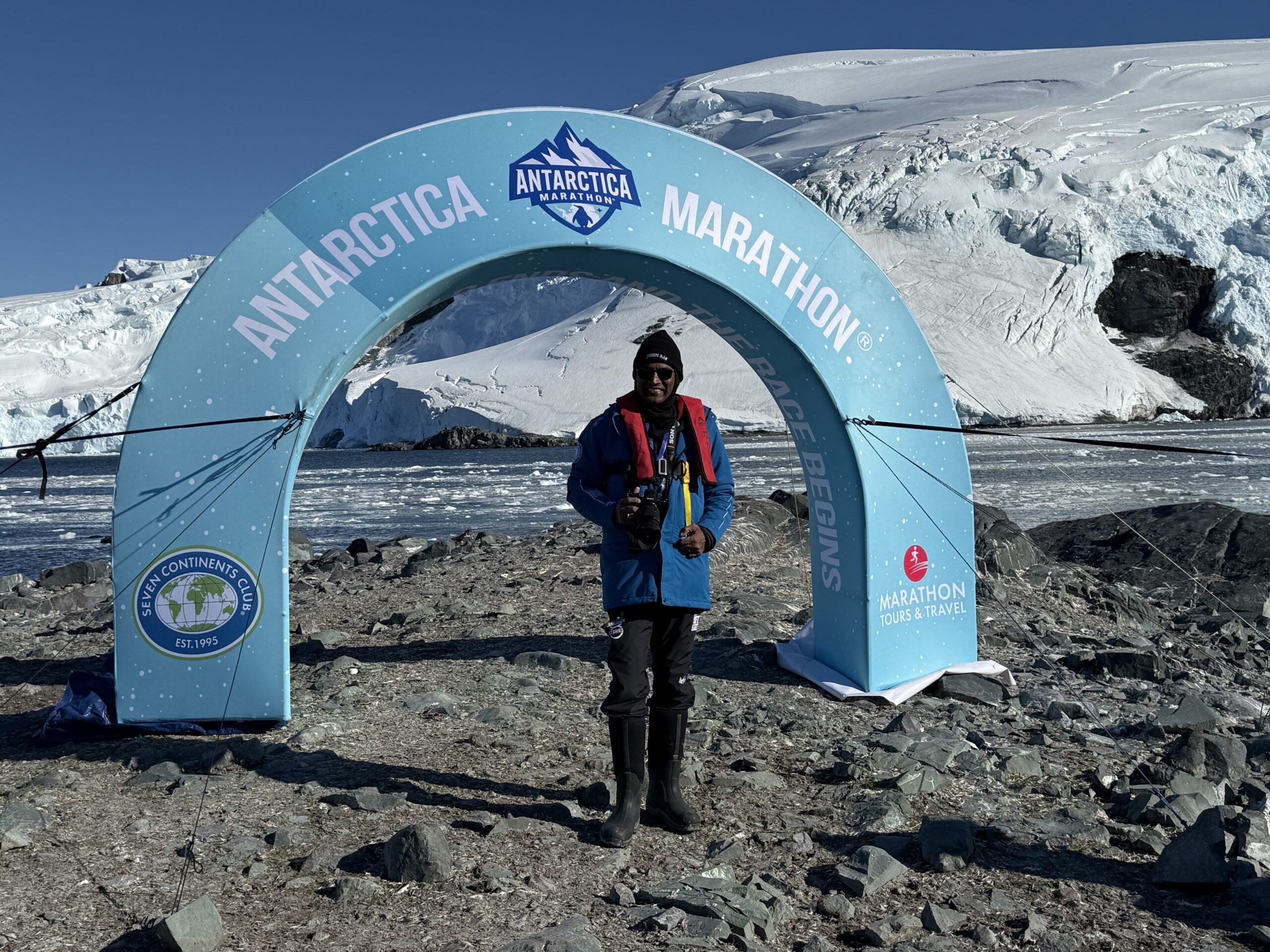
The finish line was little more than a strip of colored fabric against an endless landscape of white.
There were no cheering grandstands. No booming loudspeakers. No familiar city skyline waiting beyond the final bend. Only glaciers that seemed to stretch forever, snow whipped sideways by Antarctic winds and the occasional penguin waddling across the course as if this marathon was just another interruption to its day.
After 42.2 kilometers through one of the harshest places on Earth, Sunil Robert Vuppula stopped, looked around and allowed the silence to sink in. For a few moments, the Indian-American runner stood alone at the bottom of the world.
“Now I can die happy,” he remembers thinking.
Then, as if finishing a marathon in Antarctica was not enough, he stripped down and plunged into the freezing Southern Ocean, joining an age-old polar tradition that felt less like celebration than rebirth. For most runners, crossing a finish line marks the end of a race.
For Vuppula, it closed a chapter that had taken 16 years to write—a journey across seven continents, through injuries, heartbreak, cancelled races, personal reinvention and countless mornings when giving up would have been the easier choice.
Weeks later, back in Edison, New Jersey, where he has lived for more than two decades, the moment found an unexpected epilogue.
Mayor Samip Joshi presented him with an official proclamation recognizing him as one of fewer than 1,000 people in the world to complete a marathon on every continent. It was a civic honor for an extraordinary sporting achievement.
But medals and proclamations rarely tell the whole story. Because this one did not begin in Antarctica. It began on a crowded road in Hyderabad.
Long before marathon bibs and finish-line photographs, there was twisted metal, shattered bone and the uncertain future of a young man whose right knee had been catastrophically damaged in a motorcycle accident.
Doctors rebuilt what they could, removing significant portions of the joint in the process. Running was never part of the recovery plan. Life, meanwhile, moved on.
Career opportunities took Vuppula first to Britain and later to the United States. Like so many ambitious professionals, he buried himself in deadlines, meetings and airports. Exercise became an afterthought. Weight accumulated. Health deteriorated quietly, almost imperceptibly.
“There is a saying among runners,” he says. “You may have 99 problems, but when your health fails, it becomes problem number one.”
By 2010, he knew something had to change. A friend persuaded him to enter the Philadelphia Half Marathon. He wasn’t chasing records or medals. He simply wanted to reclaim a body that no longer felt like his own.
He crossed that finish line exhausted. He also crossed an invisible line that would change the rest of his life. “I never imagined running would become such a defining part of who I am,” he says.
Marathons have a way of exposing character. They strip away pretense, ambition and ego until all that remains is the conversation between body and mind.
For Vuppula, that conversation unfolded over 24 marathons, eight Abbott World Marathon Majors, one ultramarathon and seven continents. There were glorious mornings. There were miserable ones too.
Boston drenched him in relentless rain, leaving him shivering dangerously close to hypothermia after more than five hours on the course. Tokyo remained stubbornly out of reach after the Covid-19 pandemic postponed the race by three years. Chicago slipped away because of a torn hamstring. Cape Town broke his heart.
After travelling thousands of kilometers to South Africa in 2025, he stood among nearly 30,000 runners waiting for the starting gun when organizers cancelled the marathon barely an hour before it was due to begin because of severe weather.
Many athletes would have crossed Cape Town off the list. Instead, Vuppula returned this year. The course punished him with steep climbs, humidity and muscle cramps. He finished anyway. “Respect the course,” he says now with the quiet wisdom of experience. “It always demands humility.”
Nothing, however, prepared him for Antarctica. The journey itself took nearly ten days aboard an expedition ship carrying around 200 runners and their families through the Southern Ocean.
Unlike the spectacle of New York, London or Berlin, Antarctica offers no crowds. Nature becomes both audience and opponent. The runners negotiated snow, loose rocks, freezing winds and uneven terrain while seals lounged along the shoreline and penguins occasionally wandered onto the route, bringing the race to a gentle halt.
For many, it was the most physically demanding marathon they had ever attempted. For Vuppula, it became the most emotional. Perhaps because Antarctica represents more than a destination. It is, in every sense, the end of the road.
Standing there, surrounded by silence older than civilization itself, he realized he had travelled much farther than the 295 kilometers that separate the world’s seven continental marathons. He had journeyed from self-doubt to self-belief. From recovery to resilience. From merely surviving to truly living. Running, however, is only one thread in Vuppula’s story.
By weekday, he built a distinguished career in corporate communications, marketing and public relations, becoming the first communications professional from India to receive the prestigious Stevie Award. He would later be named Best Chief Marketing Officer of the Year, author two books on resilience, deliver a TED Talk and launch a podcast devoted to stories of extraordinary human comebacks.
Yet he speaks just as passionately about the hours spent inside correctional facilities teaching communication skills to inmates preparing to re-enter society. Or volunteering at a soup kitchen. Or mentoring members of the Indian diaspora through the Global Organization of People of Indian Origin (GOPIO).
Perhaps that is because he understands something marathons teach exceptionally well. Success means little unless it lifts someone else along the way. Today, he coaches with a local running club in Edison, encouraging a new generation of South Asian runners to discover the sport that transformed his own life.
His wife has completed a half marathon. His elder son has already finished two. His younger son, now a teenager, is waiting for his turn. The finish line, it seems, has become a family tradition.
Looking back, Vuppula dismisses his achievements with characteristic modesty. “Twenty-four marathons, seven continents and one ultramarathon isn’t a spectacular résumé,” he says.
Perhaps not. Unless you know where the race really began. Not in Philadelphia. Not in Boston. Not even in Antarctica. It began on a Hyderabad street where a devastating accident could easily have become the defining chapter of one man’s life.
Instead, it became the first page of a much longer story. A story that ended, fittingly, at the edge of the Earth—not with applause echoing through stadiums, but with the quiet satisfaction of a man who had outrun not his competitors, but the limitations he once believed would define him. Sometimes, the greatest victories are celebrated in silence.