
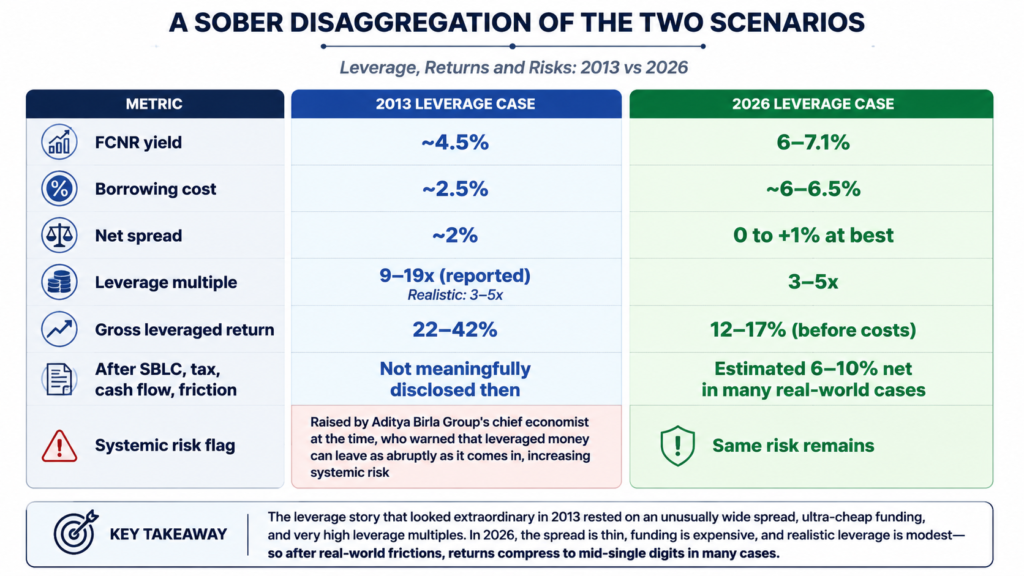
The Reserve Bank of India’s latest Foreign Currency Non-Resident (FCNR-B) deposit window has sparked intense interest among non-resident Indians (NRIs), with banks, wealth managers and financial influencers promoting strategies that claim returns of up to 20-22% through leverage. However, market analysts warn that the headline numbers may significantly understate the financial, regulatory and operational risks involved.
The RBI’s special swap facility, available for fresh FCNR(B) deposits mobilized between June and September 2026, allows banks to hedge foreign currency deposits with the central bank at a fixed exchange rate. The move effectively removes currency hedging costs that previously reduced returns on FCNR deposits and has enabled several large lenders to offer dollar deposit rates approaching 6-7%.
For NRIs holding idle dollar balances, the proposition appears attractive. FCNR deposits are denominated in foreign currency, carry no exchange-rate risk for the depositor and remain tax-exempt in India for eligible account holders.
The controversy centers on a second layer being aggressively marketed by some advisors: borrowing against FCNR deposits and repeatedly redeploying the funds to magnify returns.
Advertisement
Proponents argue that leverage can transform a 6-7% deposit yield into annual returns exceeding 20%, drawing comparisons with the highly successful FCNR mobilization program introduced during India’s 2013 balance-of-payments pressures.
Analysts, however, say the comparison is increasingly misleading.
“The mathematics works on a spreadsheet, but today’s interest-rate environment is fundamentally different from 2013,” said a Mumbai-based banking analyst. During the earlier FCNR scheme, offshore borrowing costs were often close to 2%, while deposit rates were substantially higher, creating a wide positive carry. Today, borrowing costs linked to the Secured Overnight Financing Rate (SOFR), together with bank spreads and guarantee charges, can approach or even exceed FCNR deposit yields.
Research houses estimate leveraged returns of 12-17% under favorable conditions, but analysts note that these projections often exclude several layers of costs.
Among the concerns cited are standby letter of credit (SBLC) charges, floating-rate borrowing costs, liquidity mismatches and tax treatment in investors’ home jurisdictions. While FCNR interest remains tax-free in India, investors in countries such as the United States, United Kingdom and Canada may still face taxation on global income, potentially reducing net returns.
Market experts also highlight asset-liability mismatches embedded in the strategy. FCNR deposits typically lock in a fixed return for three to five years, while financing costs remain linked to floating benchmark rates. A rise in global interest rates could quickly erode profitability.
Regulatory uncertainty is another issue. Some wealth managers caution that the most aggressive leverage structures involving multiple borrowing and redeposit cycles may attract scrutiny if they resemble circular financing arrangements.
Questions have also been raised over concentration risk. India’s deposit insurance framework covers only ₹5 lakh per depositor per bank, leaving large FCNR balances effectively uninsured beyond that threshold.
Analysts broadly agree that the RBI’s FCNR window offers a compelling opportunity for NRIs seeking dollar-denominated fixed-income exposure. However, they argue that the leveraged versions being promoted in wealth-management circles should be viewed as complex carry trades rather than low-risk wealth-building strategies.
“The FCNR deposit itself is attractive,” one analyst said. “The leverage overlay is where investors need to carefully evaluate whether the additional return truly compensates for the added financial, regulatory, tax and liquidity risks.”