Join WhatsApp Channel

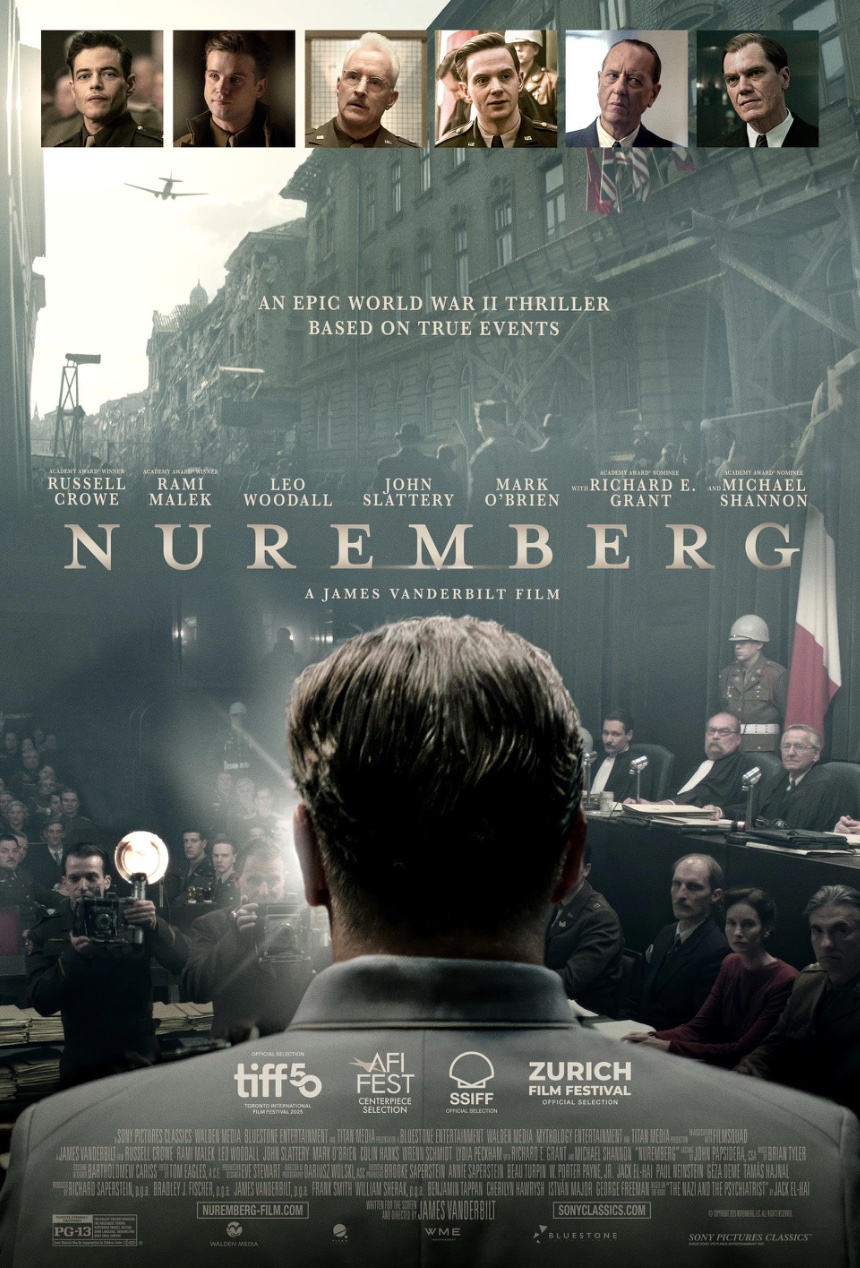
Eighty years after Hermann Goering smuggled cyanide past his guards and cheated the hangman, Hollywood has returned to Nuremberg — not to replay the verdict, but to probe the mind behind the crime.
The 2025 film Nuremberg, directed with deliberate restraint and anchored by Russell Crowe’s towering performance as Goering, arrives at a moment of acute geopolitical irony: when the very nations that sat in judgment at Nuremberg are themselves accused — by many in the Global South and beyond — of conducting wars without accountability.
That tension is the film’s greatest unacknowledged asset, and its greatest unexplored opportunity.
The 1961 Film vs. The 2025 Reimagining
Stanley Kramer’s Judgment at Nuremberg (1961) was a courtroom epic — sweeping, morally thunderous, and deliberately constructed as a reckoning with collective guilt. With Spencer Tracy as Judge Haywood, Burt Lancaster as the remorseful jurist Ernst Janning, and Maximilian Schell in his Oscar-winning role as defense counsel, Kramer’s film asked a civilizational question: how does an educated, cultured nation become complicit in genocide? It indicted not just the defendants in the dock but an entire system — the judges, lawyers, civil servants, and silent millions who looked away.
The 2025 Nuremberg chooses a narrower, more intimate lens. It enters the cell block rather than the courtroom, framing the trial through the psychological duel between American psychiatrist Douglas Kelley (Rami Malek) and Goering himself — the Reich’s last great showman, performing even in defeat. Where Kramer gave us civic tragedy, the new film offers psychological thriller. Where the 1961 version broadcast its moral lessons with the force of a sermon, the 2025 film whispers them — sometimes too softly. This is both its distinction and its limitation.
Structurally, the earlier film was built on argument: the clash of ideologies, the weight of documentary evidence, the slow moral awakening of the bench. The new film is built on personality. Crowe’s Goering is a figure of seductive menace — vain, brilliant, self-exculpating, but never quite innocent. His claim that the concentration camps and the genocide of the Jews were Himmler’s domain, not his, forms the spine of his courtroom strategy. Whether or not the film — or history — ultimately buys that defense is where the drama lives.
Performances: Crowe Dominates, Malek Divides, Shannon Grounds
Russell Crowe delivers what may be the finest performance of his later career. He plays Goering not as a cartoon monster but as a man of genuine intelligence corroded by narcissism and ideology — a man who served Hitler not despite his ego but because of it. His Goering believes he was building an empire; that the extermination machinery running beneath that empire was someone else’s paperwork. The chilling effectiveness of Crowe’s portrayal is that, for moments, you almost follow his logic — before the British prosecutor’s footage of the camps destroys it utterly.
Rami Malek’s Kelley has divided critics, and the division is understandable. Malek brings his characteristic intensity but occasionally tips into a register that feels mismatched with the gravity of the proceedings — a twitchy interiority that suits Silicon Valley thrillers less well than it suits Nuremberg. Yet the real Kelley’s story is extraordinary: a man so mesmerized by Goering that he died, years later, by cyanide — the same method Goering used to rob the gallows. The film handles this biographical echo with more restraint than sensationalism, which is to its credit.
Mike Shannon as Robert H. Jackson — the brilliant American prosecutor undone by Goering’s courtroom bravura, only to be rescued by his British counterpart — is a study in institutional pride meeting a formidable adversary. History records that Jackson’s cross-examination of Goering was a costly stumble; the film renders it as near-humiliation, which is accurate enough in spirit if compressed in detail.
Historical Accuracy: Where the Film Succeeds and Simplifies
The core facts hold. Twenty-four Nazi leaders were indicted. The tribunal was multinational — American, British, Soviet, French — though the film reduces this to largely an Anglo-American affair, marginalizing the Soviet and French roles. Goering was the Reich’s second-in-command, head of the Luftwaffe, and founder of the Gestapo — not merely a bystander to the Holocaust. His trial performance was indeed one of defiant brilliance. He did commit suicide by cyanide the night before his scheduled execution. These facts are honored.
Where the film takes dramatic license is in the psychological intimacy of the Kelley-Goering relationship. The real Kelley was one of several psychiatrists involved; the one-on-one chess match the film constructs is narratively compelling but historically overstated. Similarly, the film’s figure of 70 million Jews exterminated is factually wrong — the accepted historical figure is approximately six million Jewish victims of the Holocaust; total war deaths across all nations reached approximately 70-85 million. This is a significant error that critics and historians have rightly flagged.
The Geopolitical Mirror: Where the Film Is Boldest and Most Evasive
This is where Nuremberg (2025) becomes genuinely provocative — and where its restraint courts frustration. In one of the film’s most uncomfortable moments, Goering in the dock raises the American bombing of Hiroshima and Nagasaki — the incineration of civilian populations by the very nation sitting in judgment — and calls it Western hypocrisy. The tribunal dismisses it. The audience is not permitted to.
Because the film is a period piece set entirely in 1945-46, it cannot name the crises that its moral architecture shadows: the Russian invasion of Ukraine — a sovereign state separated from the Soviet body, invaded on ethnonationalist logic not unlike Hitler’s rationale for annexing the Sudetenland or marching into Poland; the war in Gaza, where Israeli operations under Prime Minister Netanyahu have killed over 70,000 Palestinian civilians, with the United States supplying arms while blocking ceasefire resolutions at the United Nations; Iran’s arming of Hezbollah and the Houthis as proxy instruments of regional destabilization; and the broader pattern of great-power impunity that international law, born at Nuremberg, was designed to prevent.
The film gestures at these parallels without committing to them — which is both diplomatically cautious and artistically cowardly. Judgment at Nuremberg (1961) had no such ambivalence: Kramer made his film during the height of the Cold War, with the Holocaust barely sixteen years in the past, and he demanded that his audience sit with the discomfort of complicity. The 2025 film raises the same questions and then retreats into psychology rather than politics. It is the more intimate film; it may also be the less courageous one.
The Verdict on the Verdict
Nuremberg (2025) sits at roughly 70-72% on Rotten Tomatoes — appreciatively reviewed, moderately praised, seldom challenged. That score feels about right, and about wrong. Right, because the film is well-crafted, genuinely performed, and serious in intent. Wrong, because a film about the most consequential war crimes trial in history, released into a world where the UN’s own investigators are once again documenting possible crimes against humanity, deserved to be more than well-crafted and serious in intent.
The 1961 film endures because Kramer was willing to indict his own epoch. The 2025 film may be remembered as a technically accomplished film that stood at the edge of a precipice — the same precipice its subject matter demands you look over — and politely stepped back. Russell Crowe’s Goering would have recognized that instinct. And he would have called it, with a thin, contemptuous smile, exactly what it is: the instinct of a man who knows the truth and finds it inconvenient.
Disclaimer: The opinions and views expressed in this article/column are those of the author(s) and do not necessarily reflect the views or positions of South Asian Herald.
Related posts:
 The Fall of Sheikh Hasina: Death Sentence Shakes South Asia
 Film Review: Bhagwat Chapter 1; Raakshas is Atmospheric Thriller
 Jimmy Lai: From Refugee Entrepreneur to Beijing’s Most Defiant Critic — And the Trial That Sealed Hong Kong’s Fate
 RSS Leader Hosabale Highlights Indian Diaspora’s Global Role; Experts Discuss India’s Emerging Influence