 Join WhatsApp Channel

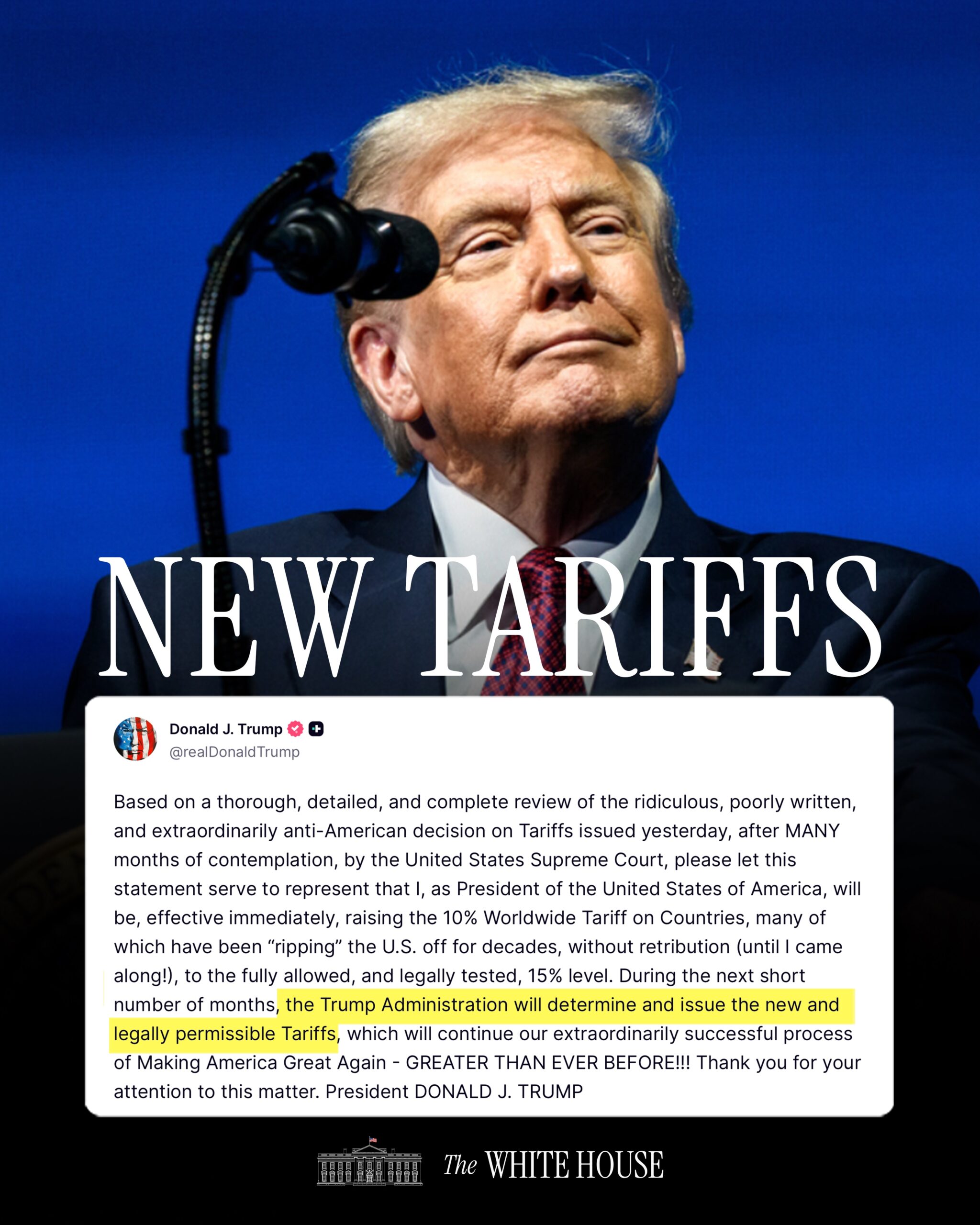
It was indeed a stunning verdict. Three conservatives in the United States Supreme Court joined three of their liberal colleagues in springing one of the biggest upsets for the Trump administration especially to President Donald J Trump.
By a 6 to 3 margin the apex court struck down what it deemed as a wrongful application of a 1977 law, the International Emergency Economic Protection Act (IEEPA), that President Trump based his sweeping tariffs on many nations globally for the last one year. What started off as punitive measures against China, Canada, and Mexico in February 2025, soon came to the April 2 Liberation Day when a slew of nations were added to the list deemed to be taking the United States for a ride in matters of trade.
Students of constitutional law in the United States and elsewhere will take time to digest detailed reasoning of the Justices. At this point of time the most important takeaway from the learned bench is straightforward: the power to levy taxes—in this case tariffs—rests not with the Executive Branch but with that of Congress.
More than the ruling on the separation of powers, the verdict appeared to only reinforce the notion that democracy is all about the rule of law and constitutions, not of individuals. And in the context of America the verdict came at a time when there was the general resignation that the conservative-majority Supreme Court will tow the White House as it had been generally preferential in the recent past.
A defiant President already livid at the two lower courts that had already ruled against the tariffs—let loose a barrage that many considered even below his standards. Forgetting for the moment all the words hurled at the ruling and at Justices personally—it would have been news if there were no invectives– the fact remained that President had been dealt not just a blow on his major economic policy but also a political one in the context of the mid-terms that are to come in November. The Democrats who are always waiting for a chance to pounce on the White House did so gleefully, even if not sure how to translate all this into additional votes some eight months down the line. For now, the bottom line is one of a President snubbed.
More than the words of reaction, President Trump came back swinging. First was the ten percent global tariffs that will take effect from Tuesday but under a different law; and hours later the revised global tariffs to fifteen percent, all of these to be in place for 150 days. President Trump moved away from the IEEPA of 1977 to Section 122 of the Trade Act of 1974.
Further it is being pointed out that all tariffs imposed by the Trump administration invoking other laws can stay in place as the apex court only looked at tariffs in the context of the 1977 law—for instance the specific levies on steel, aluminum, lumber and automobiles came under Section 232 of the Trade Expansion Act of 1962 that cited national security concerns. The White House says that it has also at its disposal Section 301 of the 1974 Trade Act that can investigate if countries are resorting to discriminatory or unfair practices which then can be used to slap tariffs.
And in all the noise and din of the Supreme Court verdict also came a realization that nothing had been mentioned about refunding the money that had been collected—variously pegged at between US$ 130 and US$ 250 billion. With at least one Democratic Governor demanding immediate reimbursement to his state, the word from the administration was clear: it could take days, months or even years. And Treasury Secretary Scott Bessent had even a word of “cheer” when he said that combined tariffs from Sections 122, 232 and 301 “will result in virtually unchanged tariff revenue in 2026.”
It was not as if the administration and the White House were totally shocked at the ruling. In fact, the President and his cabinet colleagues were quite openly talking of the alternative routes even while warning the apex court the implications of an adverse ruling and in the mess that could follow.
The Justices were not oblivious to the implications of striking down tariffs with at least one Judge during hearings in November pointedly talked of the chaos that could come about disbursing refunds. With the apex court not having said the final word on returns the matter is now subject to further litigation, it would seem.
For a long time, the contention of President Trump has been that America had been ripped off by its trading partners, and he was going to set it right by levying reciprocal tariffs so that people can have money in their pockets. The initial projections were around US$ 2.5 trillion revenue over a ten-year fiscal period that would go the distance in meeting budget requirements, addressing overall deficit issues including making interest payments to the national debt.
It is not as if the Supreme Court has put a hole in the pockets of the Treasury; only that it has made cash collection less certain and cumbersome by imposing a circuitous route.
Disclaimer: The opinions and views expressed in this article/column are those of the author(s) and do not necessarily reflect the views or positions of South Asian Herald.
Related posts:
 President Trump Says India Trade Deal Intact After Supreme Court’s Decision Striking Down Global Tariffs
 Lawmakers Khanna and Beyer Renew Effort to Reform Supreme Court with 18-Year Term Limits Bill
 Supreme Court Showdown to Decide Fate of President Trump’s Global Tariffs
 Global Traders See Flicker of Hope as Trump’s Tariffs Head to Supreme Court
